

Macaroni Penguin vs Southern Rockhopper Penguin
Eudyptes chrysolophus versus Eudyptes chrysocome
Play a quiz with Macaroni Penguin and Southern Rockhopper Penguin
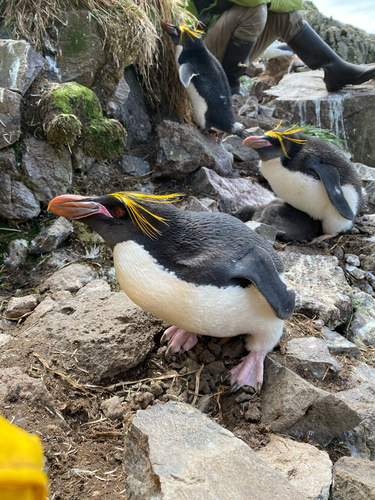 Macaroni Penguin
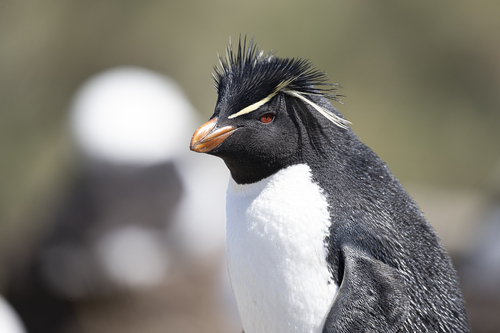 Southern Rockhopper Penguin
In short
The most reliable field mark between Macaroni and Southern Rockhopper Penguins is the crest shape and placement: Macaroni Penguins have a thick, bushy yellow crest that starts from the center of the forehead and extends straight back, while Southern Rockhoppers show thinner, sparser yellow crests that originate above the eye and sweep outwards, often looking more 'eyebrowed.' Macaronis are also noticeably larger and bulkier, with a heavier, more bulbous orange-brown bill. Immature Macaronis lack a full crest and have a duller bill, which can cause confusion with Rockhoppers, but the overall size and bill shape remain useful. Both are crested penguins with similar black-and-white patterns, so careful attention to head detail and structure is essential, especially in mixed colonies or at sea.
Identification tips
- Crest shape and placement (all ages): Macaroni Penguins have a thick, bushy yellow crest that starts from the center of the forehead and extends straight back; Southern Rockhoppers have thinner, sparser yellow crests that originate above the eye and sweep outward, often appearing as 'eyebrows.'
- Bill size and shape (all ages): Macaronis show a large, bulbous, orange-brown bill with a pinkish bare patch from bill to eye; Rockhoppers have a slimmer, shorter bill with less pronounced bare skin.
- Overall size (all ages): Macaronis are much larger and heavier (about 5 kg vs. 2.5 kg for Rockhoppers) and have a bulkier build, even in immatures. This is often the best fallback mark if crest is not visible.
- Crest in immatures: Young Macaronis may lack a full crest or have only scattered yellow feathers, but will still be larger and have a heavier bill than Rockhopper immatures, whose yellow plumes are always more lateral.
- Head pattern: Both species have black heads, but Macaroni's black is sharply demarcated from the white underparts, and the crest is more central; Rockhopper's yellow is always above the eye and more spiky.
- Bill color in immatures: Immature Macaronis have a duller brown bill, which can cause confusion, but the bill remains thicker than in Rockhoppers.
- Leg and foot color: Both have pink legs and feet, but Macaroni's are slightly more robust; not a primary mark but may help in close views.
- Bare skin patch: Macaronis have a pinkish bare patch from the base of the bill to the eye, which is less obvious in Rockhoppers.
- Behavior (in colony): Rockhoppers are more likely to be seen hopping energetically over rocks and boulders; Macaronis may do so but are less specialized for it.
- Foraging groups: Rockhoppers often leave and return to colonies in groups; Macaronis' colony behavior is more focused on social displays.
- Plumage sheen: Macaroni's black upperparts have a bluish sheen when fresh, turning brownish when worn; Rockhoppers' upperparts are less glossy.
- Tail length: Macaronis have a tail around 9–10 cm, but this is not a strong field mark unless seen side by side.
- Sexual dimorphism: Both sexes are similar, but male Macaronis have slightly larger bills; not usually useful without direct comparison.
- Habitat context: If seen further south (Antarctic Peninsula), Macaroni is more likely; if on southern South American islands, Rockhopper is more likely, but overlap does occur.
- No reliable flight/wing pattern: Neither species has a distinctive upperwing or flight mark to separate them at a distance; always rely on head and bill structure in perched or close views.
Size
Macaroni Penguins are significantly larger and heavier than Southern Rockhopper Penguins. Adult Macaronis average about 4985 g, nearly double the Rockhopper's 2470 g. Macaronis also reach about 70 cm in length, with a noticeably thicker, more robust build and a larger, more bulbous bill. Rockhoppers are more compact and lighter, with a slimmer profile and smaller bill. This size difference is often evident when both species are seen side by side, but can be harder to judge at a distance or with lone birds.
Plumage
- Juvenile/Immature birds: Young Macaroni Penguins lack the full, bushy yellow crest, showing only scattered yellow feathers or none at all. Their bills are smaller and duller brown, and the chin and throat are dark grey. Immature Rockhoppers also have less pronounced crests, but their yellow eyebrow-like plumes are still more lateral than the Macaroni's central crest. Both species' immatures can look similar, but Macaroni's larger size and heavier bill persist even in young birds.
- Adults: Macaroni Penguins have a dense yellow crest starting from the center of the forehead, sweeping straight back, and a sharply demarcated black head and upperparts with a bluish sheen when fresh. The bill is large and orange-brown, with a patch of pinkish bare skin from bill to eye. Rockhoppers have a thinner yellow crest that starts above the eye and extends outward, giving a 'spiky eyebrow' look, and their head is also black but with a less sharply defined crest. Both have pink legs and feet, but Macaroni's are slightly more robust.
- Wing/flight pattern: No distinctive upperwing or flight marks are described for either species that would separate them in flight, so perched or close views are necessary for reliable ID.
Behaviour
Both species are highly social and breed in dense colonies, but Southern Rockhoppers are especially noted for their hopping movement over rocks and boulders, which is less typical of Macaronis. Macaroni Penguins engage in a wide range of social displays, including bill-jousting and elaborate courtship postures, but these are not unique compared to Rockhoppers. Foraging behavior is complex in both, with Rockhoppers noted for both pelagic and benthic dives and group foraging trips. Macaronis' behaviors are more often described in the context of colony interactions.
Habitat
Macaroni Penguins breed from the Subantarctic to the Antarctic Peninsula, while Southern Rockhopper Penguins are found around the southern coasts of South America and nearby subantarctic islands. Both inhabit rocky, coastal environments and can sometimes overlap in range, but Macaronis are generally found further south and east. In mixed colonies, careful attention to head and bill structure is essential, as both can occur in similar habitats.
Macaroni Penguin · Southern Rockhopper Penguin · My Tricky Birds