
Motmot

Magnificent Frigatebird vs Brown Booby

Fregata magnificens versus Sula leucogaster

Play a quiz with Magnificent Frigatebird and Brown Booby
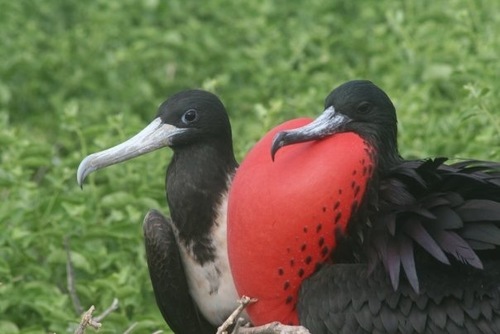
Magnificent Frigatebird (Fregata magnificens) Magnificent Frigatebird
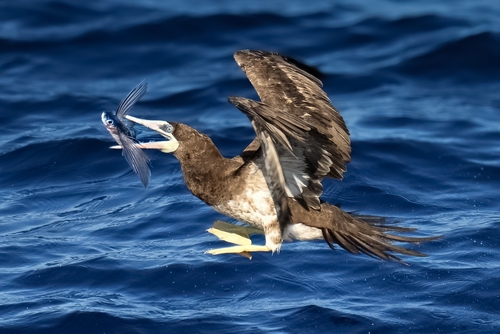
Brown Booby (Sula leucogaster) Brown Booby

Media

Loading…

In short

The most reliable field mark to separate Magnificent Frigatebird from Brown Booby is overall structure and flight silhouette: frigatebirds are huge, slender, with extremely long, angular wings and a deeply forked tail, while boobies are stockier with shorter, broader wings and a straight, pointed tail. Juvenile Magnificent Frigatebirds show a distinctive white head and underparts with a diamond-shaped white belly patch, while juvenile Brown Boobies already resemble adults, with brown upperparts and white bellies but no sharply defined belly patch. Adult males of both are mostly dark above, but the frigatebird's long, scythe-like wings and red throat pouch (in breeding males) are unique. Females of both species show white underparts, but the frigatebird female has a diagnostic blue eye-ring and a more extensive white breast. In flight, the frigatebird's silhouette is unmistakable compared to the booby's more typical seabird shape.

Identification tips

  1. Flight silhouette is the fastest check: Magnificent Frigatebird shows extremely long, narrow, angular wings and a deeply forked tail, giving a 'scythe' or 'M'-shaped outline; Brown Booby has shorter, broader wings and a straight, pointed tail.
  2. Juvenile/immature plumage: Juvenile Magnificent Frigatebirds have a white head and underparts with a sharply defined, diamond-shaped white belly patch; juvenile Brown Boobies are brown above and white below, but lack a sharply defined belly patch and show brown flecking on the underparts.
  3. Adult male plumage: Male Magnificent Frigatebird is all black with a purple sheen and, in breeding season, a red gular pouch; male Brown Booby is dark brown above and white below, with a blue orbital ring but never a red pouch.
  4. Adult female plumage: Female Magnificent Frigatebird is black with a white breast and lower neck sides, a brown band on the wings, and a blue eye-ring; female Brown Booby is brown above, white below, with a yellow orbital ring and lacks the blue eye-ring and white breast patch.
  5. Tail shape: Frigatebird's tail is long and deeply forked, often held closed in flight to appear pointed; Brown Booby's tail is straight and pointed but never forked.
  6. Bill and head shape: Frigatebird has a long, slender, hooked bill and a small head relative to body; booby has a thicker, dagger-like bill and a more robust head.
  7. Behavior in flight: Frigatebird soars and glides with minimal flapping, often at great height; booby flies with rapid, deep wingbeats and is usually seen flying low over water.
  8. Perched posture: Frigatebirds rarely perch except at breeding colonies, and are almost never seen on the water; boobies often perch on rocks, buoys, or ships and may be seen swimming.
  9. Underwing pattern: Not diagnostic with current notes, but frigatebird's underwing is uniformly dark in adults, while booby shows contrasting dark upperparts and white underparts.
  10. Bare part color: Female frigatebird has a blue eye-ring; male booby has a blue orbital ring, female booby has a yellow orbital ring. Use with caution as these can be hard to see at a distance.
  11. Size impression: Frigatebird appears much larger and more elongated in flight, with a wingspan up to 2.4 m; booby is stockier and shorter-winged.
  12. Habitat context: Frigatebirds are more likely to be seen soaring high over open ocean or coast, rarely near land except at colonies; boobies are often seen near shore, perched, or diving.
  13. Kleptoparasitic behavior: Only frigatebirds are seen chasing other birds to steal food in flight.
  14. Vocalization: Not useful for field separation; both are silent in flight.
  15. Pitfalls: Female and immature frigatebirds can be confused with brown-and-white boobies at a distance, but look for the forked tail, long wings, and white head/diamond belly patch in frigatebirds. Boobies never show a forked tail or the 'scythe' wing shape.

Size

Magnificent Frigatebird is much larger and more lightly built than Brown Booby. Frigatebirds reach 89–114 cm in length with a wingspan of 2.17–2.44 m, while Brown Boobies are 75–80 cm long with a wingspan up to 1.5 m. The booby is heavier-bodied (body mass around 1266 g), but the frigatebird's wings are much longer and narrower, and its tail is much more deeply forked. In the field, the frigatebird appears both larger and more elongated, especially in flight.

Plumage

Juvenile Magnificent Frigatebirds (and immatures) are strikingly pale-headed and white below, with a distinctive diamond-shaped white belly patch—this sharply contrasts with juvenile Brown Boobies, which are already brown above and white below, but with brown flecking and no sharply defined belly patch. Adult male Magnificent Frigatebirds are all black with a purple sheen and a bright red gular pouch in breeding season, while adult male Brown Boobies are dark brown above and white below, with a blue orbital ring. Adult female frigatebirds are black with a white breast and lower neck sides, a brown wing band, and a diagnostic blue eye-ring; female Brown Boobies are similar in pattern (brown above, white below) but have a yellow orbital ring and lack the white breast patch and blue eye-ring. The frigatebird never shows the sharply demarcated brown-and-white 'vest' look of the booby. In all ages, the frigatebird lacks the booby's sharply pointed tail and instead has a long, deeply forked tail.

Behaviour

Magnificent Frigatebirds are almost always seen soaring high or gliding effortlessly, rarely flapping, and almost never seen sitting on the water. They often harass other seabirds for food (kleptoparasitism) and can spend days aloft. Brown Boobies, in contrast, fly with rapid wingbeats and are often seen flying low over the water, diving for fish, or perched on rocks and buoys. Boobies are much more likely to be seen swimming or resting on the water's surface.

Habitat

Both species occur over tropical and subtropical waters, often overlapping in range. Magnificent Frigatebirds are usually seen far offshore or soaring over coastal waters, rarely landing except at breeding colonies. Brown Boobies are more often seen closer to shore, foraging over inshore waters, and are more likely to be seen perched on ships, buoys, or rocks.

Voice

Neither species is vocal in flight. Magnificent Frigatebirds are silent when flying but make rattling sounds at the nest. Brown Boobies are also usually silent but may grunt or quack at the nest. Vocalizations are not useful for field separation at a distance.

Submit a better description

Use the same sections as the comparison. Your text is published immediately.

The most reliable field mark to separate Magnificent Frigatebird from Brown Booby is overall structure and flight silhouette: frigatebirds are huge, slender, with extremely long, angular wings and a deeply forked tail, while boobies are stockier with shorter, broader wings and a straight, pointed tail. Juvenile Magnificent Frigatebirds show a distinctive white head and underparts with a diamond-shaped white belly patch, while juvenile Brown Boobies already resemble adults, with brown upperparts and white bellies but no sharply defined belly patch. Adult males of both are mostly dark above, but the frigatebird's long, scythe-like wings and red throat pouch (in breeding males) are unique. Females of both species show white underparts, but the frigatebird female has a diagnostic blue eye-ring and a more extensive white breast. In flight, the frigatebird's silhouette is unmistakable compared to the booby's more typical seabird shape.

  1. Flight silhouette is the fastest check: Magnificent Frigatebird shows extremely long, narrow, angular wings and a deeply forked tail, giving a 'scythe' or 'M'-shaped outline; Brown Booby has shorter, broader wings and a straight, pointed tail.
  2. Juvenile/immature plumage: Juvenile Magnificent Frigatebirds have a white head and underparts with a sharply defined, diamond-shaped white belly patch; juvenile Brown Boobies are brown above and white below, but lack a sharply defined belly patch and show brown flecking on the underparts.
  3. Adult male plumage: Male Magnificent Frigatebird is all black with a purple sheen and, in breeding season, a red gular pouch; male Brown Booby is dark brown above and white below, with a blue orbital ring but never a red pouch.
  4. Adult female plumage: Female Magnificent Frigatebird is black with a white breast and lower neck sides, a brown band on the wings, and a blue eye-ring; female Brown Booby is brown above, white below, with a yellow orbital ring and lacks the blue eye-ring and white breast patch.
  5. Tail shape: Frigatebird's tail is long and deeply forked, often held closed in flight to appear pointed; Brown Booby's tail is straight and pointed but never forked.
  6. Bill and head shape: Frigatebird has a long, slender, hooked bill and a small head relative to body; booby has a thicker, dagger-like bill and a more robust head.
  7. Behavior in flight: Frigatebird soars and glides with minimal flapping, often at great height; booby flies with rapid, deep wingbeats and is usually seen flying low over water.
  8. Perched posture: Frigatebirds rarely perch except at breeding colonies, and are almost never seen on the water; boobies often perch on rocks, buoys, or ships and may be seen swimming.
  9. Underwing pattern: Not diagnostic with current notes, but frigatebird's underwing is uniformly dark in adults, while booby shows contrasting dark upperparts and white underparts.
  10. Bare part color: Female frigatebird has a blue eye-ring; male booby has a blue orbital ring, female booby has a yellow orbital ring. Use with caution as these can be hard to see at a distance.
  11. Size impression: Frigatebird appears much larger and more elongated in flight, with a wingspan up to 2.4 m; booby is stockier and shorter-winged.
  12. Habitat context: Frigatebirds are more likely to be seen soaring high over open ocean or coast, rarely near land except at colonies; boobies are often seen near shore, perched, or diving.
  13. Kleptoparasitic behavior: Only frigatebirds are seen chasing other birds to steal food in flight.
  14. Vocalization: Not useful for field separation; both are silent in flight.
  15. Pitfalls: Female and immature frigatebirds can be confused with brown-and-white boobies at a distance, but look for the forked tail, long wings, and white head/diamond belly patch in frigatebirds. Boobies never show a forked tail or the 'scythe' wing shape.

Magnificent Frigatebird is much larger and more lightly built than Brown Booby. Frigatebirds reach 89–114 cm in length with a wingspan of 2.17–2.44 m, while Brown Boobies are 75–80 cm long with a wingspan up to 1.5 m. The booby is heavier-bodied (body mass around 1266 g), but the frigatebird's wings are much longer and narrower, and its tail is much more deeply forked. In the field, the frigatebird appears both larger and more elongated, especially in flight.

Juvenile Magnificent Frigatebirds (and immatures) are strikingly pale-headed and white below, with a distinctive diamond-shaped white belly patch—this sharply contrasts with juvenile Brown Boobies, which are already brown above and white below, but with brown flecking and no sharply defined belly patch. Adult male Magnificent Frigatebirds are all black with a purple sheen and a bright red gular pouch in breeding season, while adult male Brown Boobies are dark brown above and white below, with a blue orbital ring. Adult female frigatebirds are black with a white breast and lower neck sides, a brown wing band, and a diagnostic blue eye-ring; female Brown Boobies are similar in pattern (brown above, white below) but have a yellow orbital ring and lack the white breast patch and blue eye-ring. The frigatebird never shows the sharply demarcated brown-and-white 'vest' look of the booby. In all ages, the frigatebird lacks the booby's sharply pointed tail and instead has a long, deeply forked tail.

Magnificent Frigatebirds are almost always seen soaring high or gliding effortlessly, rarely flapping, and almost never seen sitting on the water. They often harass other seabirds for food (kleptoparasitism) and can spend days aloft. Brown Boobies, in contrast, fly with rapid wingbeats and are often seen flying low over the water, diving for fish, or perched on rocks and buoys. Boobies are much more likely to be seen swimming or resting on the water's surface.

Both species occur over tropical and subtropical waters, often overlapping in range. Magnificent Frigatebirds are usually seen far offshore or soaring over coastal waters, rarely landing except at breeding colonies. Brown Boobies are more often seen closer to shore, foraging over inshore waters, and are more likely to be seen perched on ships, buoys, or rocks.

Neither species is vocal in flight. Magnificent Frigatebirds are silent when flying but make rattling sounds at the nest. Brown Boobies are also usually silent but may grunt or quack at the nest. Vocalizations are not useful for field separation at a distance.

Discard your changes?

You have unsaved edits. If you leave now, those changes will be lost.

Magnificent Frigatebird · Brown Booby · My Tricky Birds