
Motmot

Mangrove Cuckoo vs Lesser Antillean Bullfinch

Coccyzus minor versus Loxigilla noctis

Play a quiz with Mangrove Cuckoo and Lesser Antillean Bullfinch
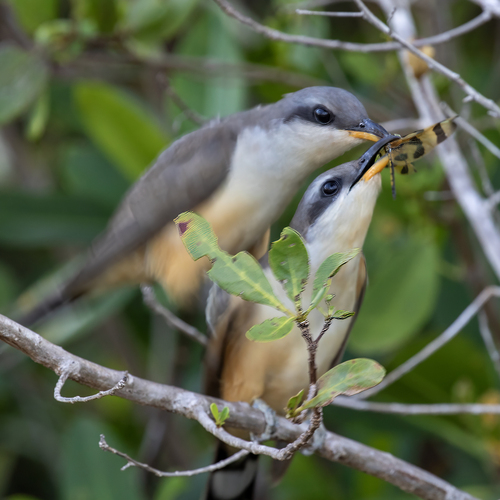
Mangrove Cuckoo (Coccyzus minor) Mangrove Cuckoo
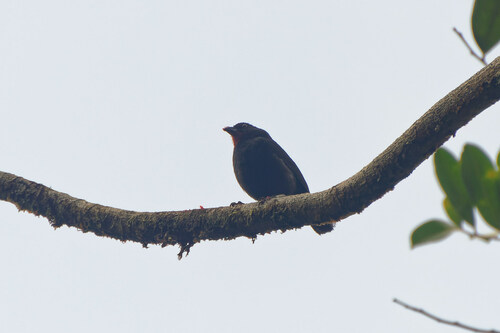
Lesser Antillean Bullfinch (Loxigilla noctis) Lesser Antillean Bullfinch

Media

Loading…

In short

The most reliable field mark to separate Mangrove Cuckoo from Lesser Antillean Bullfinch is overall structure: the cuckoo is much larger, slender, and long-tailed, with a distinctive black facial mask and buffy underparts, while the bullfinch is a compact, short-tailed songbird with a thick bill and, in males, mostly black plumage with a red supercilium and throat. Females and young bullfinches are warm brown and lack the cuckoo’s mask and bill shape. Even at a distance, the cuckoo’s long tail and slim profile stand out against the bullfinch’s chunky, finch-like appearance. If you see a bird with a curved bill and yellow eyering, it’s the cuckoo; if it’s a stubby, thick-billed bird, it’s the bullfinch.

Identification tips

  1. Size and shape: Mangrove Cuckoo is much larger and longer-tailed than the bullfinch; use this as your first check, especially if you have a size reference.
  2. Bill shape: Cuckoo has a long, slightly decurved bill with yellow on the lower mandible; bullfinch has a short, very thick conical bill (black in males, bicolored in females).
  3. Tail: Cuckoo’s tail is long, brown above, and black-and-white below; bullfinch’s tail is short and does not show contrasting pattern.
  4. Facial markings: Cuckoo has a bold black facial mask and yellow eyering; bullfinch males have a red supercilium and throat, females have rusty lores, but neither sex shows a mask or yellow eyering.
  5. Underparts: Cuckoo’s underparts are buffy; male bullfinch underparts are black with a red throat, female’s are warm gray with rusty undertail coverts.
  6. Upperparts: Cuckoo is brown above; male bullfinch is black, female is warm brown.
  7. Sexual dimorphism: Bullfinch is sexually dimorphic—males black with red, females brown; cuckoo sexes look alike.
  8. Leg color: Both have dark legs, not a useful separator.
  9. Eye color: Bullfinch has a dark brown iris; cuckoo’s yellow eyering is more visible in the field.
  10. Behavior: Cuckoo perches quietly, often in mangroves; bullfinch is more active, hops and forages like a finch.
  11. Habitat: Cuckoo is mangrove-restricted; bullfinch is found in varied habitats, often away from mangroves.
  12. Voice: If you hear a repeated guttural "gawk gawk gawk", it’s the cuckoo; bullfinch’s voice is not described here.
  13. Subspecies variation: Bullfinch subspecies differ in throat patch size and blackness, but none resemble the cuckoo’s mask or structure.
  14. Immature/juvenile birds: No distinctive immature wing or flight marks are described for either, but young bullfinches are always structurally finch-like and lack a mask.
  15. Pitfalls: Female bullfinches are brown and could be mistaken for a drab bird, but their structure, bill, and lack of mask are clear separators from the cuckoo.

Size

Mangrove Cuckoo is dramatically larger and heavier (body mass ~66 g, length 28–34 cm) compared to the Lesser Antillean Bullfinch (body mass ~18.4 g, length 14–15.5 cm). The cuckoo’s wingspan (38–43 cm) and long tail make it appear elongated and almost jay-sized, while the bullfinch is sparrow-sized, compact, and short-tailed. Size alone is often enough to separate them if seen together or with familiar species for scale.

Plumage

No age-specific upperwing or flight pattern marks are described for either species, so focus is on adult and sex-specific plumage. Adult Mangrove Cuckoo is brown above, with a black facial mask, yellow eyering, and buffy underparts. Its tail is long, brown above, and black-and-white below. The bill is black with yellow on the lower mandible. In contrast, adult male Lesser Antillean Bullfinch (nominate) is mostly black with a short red supercilium and orangish red throat; females are warm brown above, with rusty lores and edges to the greater coverts, and warm gray underparts with rusty undertail coverts. Subspecies vary in throat patch size and blackness, but all bullfinches lack the cuckoo’s facial mask and have a much thicker bill. Both sexes of bullfinch have dark irises and dark legs, while the cuckoo’s yellow eyering is distinctive. Juvenile/immature plumages are not detailed, but the structural and facial differences persist across ages.

Behaviour

Mangrove Cuckoo tends to move deliberately through mangrove thickets, often perching quietly and remaining partially concealed. Its movements are more languid and it may sit upright with its long tail drooping. Lesser Antillean Bullfinch is more active and often seen hopping or flitting about in low vegetation, sometimes in pairs or small groups. The bullfinch’s feeding is more rapid and finch-like, often seen cracking seeds or foraging for fruit.

Habitat

Mangrove Cuckoo is strongly associated with mangrove forests and dense coastal thickets in the Neotropics. It is rarely found far from mangroves. Lesser Antillean Bullfinch is found in a wider range of habitats across the Lesser Antilles, including gardens, scrub, forest edges, and secondary growth, not restricted to mangroves. Thus, context can be a clue: a bird deep in mangroves is more likely a cuckoo, while one in open or disturbed areas is likely a bullfinch.

Voice

Mangrove Cuckoo gives a guttural, repeated "gawk gawk gawk gawk gauk gauk" and sometimes a single "whit". Lesser Antillean Bullfinch’s song and calls are not described in these notes, so voice is only diagnostic if you hear the cuckoo’s distinctive call.

Submit a better description

Use the same sections as the comparison. Your text is published immediately.

The most reliable field mark to separate Mangrove Cuckoo from Lesser Antillean Bullfinch is overall structure: the cuckoo is much larger, slender, and long-tailed, with a distinctive black facial mask and buffy underparts, while the bullfinch is a compact, short-tailed songbird with a thick bill and, in males, mostly black plumage with a red supercilium and throat. Females and young bullfinches are warm brown and lack the cuckoo’s mask and bill shape. Even at a distance, the cuckoo’s long tail and slim profile stand out against the bullfinch’s chunky, finch-like appearance. If you see a bird with a curved bill and yellow eyering, it’s the cuckoo; if it’s a stubby, thick-billed bird, it’s the bullfinch.

  1. Size and shape: Mangrove Cuckoo is much larger and longer-tailed than the bullfinch; use this as your first check, especially if you have a size reference.
  2. Bill shape: Cuckoo has a long, slightly decurved bill with yellow on the lower mandible; bullfinch has a short, very thick conical bill (black in males, bicolored in females).
  3. Tail: Cuckoo’s tail is long, brown above, and black-and-white below; bullfinch’s tail is short and does not show contrasting pattern.
  4. Facial markings: Cuckoo has a bold black facial mask and yellow eyering; bullfinch males have a red supercilium and throat, females have rusty lores, but neither sex shows a mask or yellow eyering.
  5. Underparts: Cuckoo’s underparts are buffy; male bullfinch underparts are black with a red throat, female’s are warm gray with rusty undertail coverts.
  6. Upperparts: Cuckoo is brown above; male bullfinch is black, female is warm brown.
  7. Sexual dimorphism: Bullfinch is sexually dimorphic—males black with red, females brown; cuckoo sexes look alike.
  8. Leg color: Both have dark legs, not a useful separator.
  9. Eye color: Bullfinch has a dark brown iris; cuckoo’s yellow eyering is more visible in the field.
  10. Behavior: Cuckoo perches quietly, often in mangroves; bullfinch is more active, hops and forages like a finch.
  11. Habitat: Cuckoo is mangrove-restricted; bullfinch is found in varied habitats, often away from mangroves.
  12. Voice: If you hear a repeated guttural "gawk gawk gawk", it’s the cuckoo; bullfinch’s voice is not described here.
  13. Subspecies variation: Bullfinch subspecies differ in throat patch size and blackness, but none resemble the cuckoo’s mask or structure.
  14. Immature/juvenile birds: No distinctive immature wing or flight marks are described for either, but young bullfinches are always structurally finch-like and lack a mask.
  15. Pitfalls: Female bullfinches are brown and could be mistaken for a drab bird, but their structure, bill, and lack of mask are clear separators from the cuckoo.

Mangrove Cuckoo is dramatically larger and heavier (body mass ~66 g, length 28–34 cm) compared to the Lesser Antillean Bullfinch (body mass ~18.4 g, length 14–15.5 cm). The cuckoo’s wingspan (38–43 cm) and long tail make it appear elongated and almost jay-sized, while the bullfinch is sparrow-sized, compact, and short-tailed. Size alone is often enough to separate them if seen together or with familiar species for scale.

No age-specific upperwing or flight pattern marks are described for either species, so focus is on adult and sex-specific plumage. Adult Mangrove Cuckoo is brown above, with a black facial mask, yellow eyering, and buffy underparts. Its tail is long, brown above, and black-and-white below. The bill is black with yellow on the lower mandible. In contrast, adult male Lesser Antillean Bullfinch (nominate) is mostly black with a short red supercilium and orangish red throat; females are warm brown above, with rusty lores and edges to the greater coverts, and warm gray underparts with rusty undertail coverts. Subspecies vary in throat patch size and blackness, but all bullfinches lack the cuckoo’s facial mask and have a much thicker bill. Both sexes of bullfinch have dark irises and dark legs, while the cuckoo’s yellow eyering is distinctive. Juvenile/immature plumages are not detailed, but the structural and facial differences persist across ages.

Mangrove Cuckoo tends to move deliberately through mangrove thickets, often perching quietly and remaining partially concealed. Its movements are more languid and it may sit upright with its long tail drooping. Lesser Antillean Bullfinch is more active and often seen hopping or flitting about in low vegetation, sometimes in pairs or small groups. The bullfinch’s feeding is more rapid and finch-like, often seen cracking seeds or foraging for fruit.

Mangrove Cuckoo is strongly associated with mangrove forests and dense coastal thickets in the Neotropics. It is rarely found far from mangroves. Lesser Antillean Bullfinch is found in a wider range of habitats across the Lesser Antilles, including gardens, scrub, forest edges, and secondary growth, not restricted to mangroves. Thus, context can be a clue: a bird deep in mangroves is more likely a cuckoo, while one in open or disturbed areas is likely a bullfinch.

Mangrove Cuckoo gives a guttural, repeated "gawk gawk gawk gawk gauk gauk" and sometimes a single "whit". Lesser Antillean Bullfinch’s song and calls are not described in these notes, so voice is only diagnostic if you hear the cuckoo’s distinctive call.

Discard your changes?

You have unsaved edits. If you leave now, those changes will be lost.

Mangrove Cuckoo · Lesser Antillean Bullfinch · My Tricky Birds