
Melodious Warbler vs Icterine Warbler
Hippolais polyglotta versus Hippolais icterina
Play a quiz with Melodious Warbler and Icterine Warbler
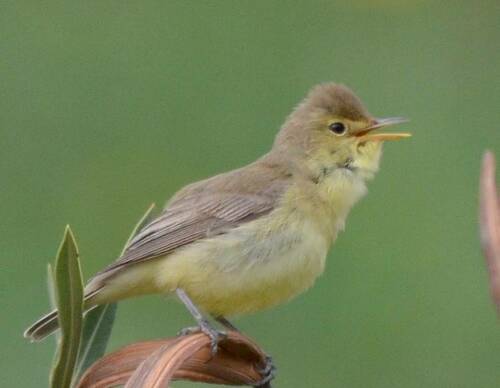 Melodious Warbler
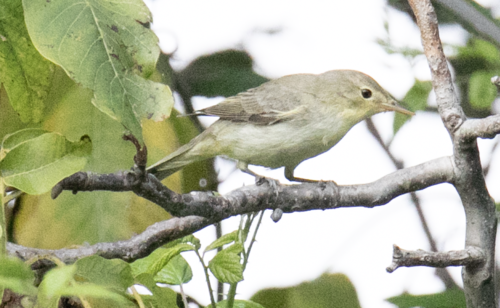 Icterine Warbler
In short
The most reliable field mark between Melodious Warbler and Icterine Warbler is the color of the upperparts and legs: Melodious Warbler shows a plainer, browner back and brown legs, while Icterine Warbler is distinctly greyish-green above with grey to bluish legs. In the field, Icterine often shows a pale wing panel (from pale-edged secondaries and tertials) and a faint yellowish supercilium, both lacking or much less marked in Melodious. Underparts are yellower in Melodious, paler and more uniform in Icterine. Structure is also subtly different: Icterine is longer-winged with a squarer tail and a larger head. These differences are subtle in juveniles but still present. Vocalizations differ, but are best used as supporting evidence.
Identification tips
- Upperparts color: Melodious Warbler is plain brown above; Icterine Warbler is greyish-green. This is visible in all ages and is the first mark to check in good light.
- Leg color: Melodious shows brown legs, while Icterine has grey to bluish legs. This is often visible in perched birds and is a reliable separator.
- Wing panel: Icterine Warbler often shows a pale panel on the closed wing (from pale-edged secondaries and tertials), which is absent or much less marked in Melodious. Look for this especially on perched birds or in photos.
- Supercilium and lores: Icterine has a faint yellowish supercilium and pale lores, giving a slightly 'open-faced' look. Melodious lacks this or is much less marked, appearing plainer-faced.
- Underparts: Melodious is yellower below, especially on the breast and belly, while Icterine is paler, more uniform light yellow. Juvenile Melodious are paler but still yellower than Icterine.
- Tail and wing structure: Icterine has longer wings and a squarer, shorter tail, giving a more elongated, big-headed appearance. Melodious is more compact and rounded.
- Bill: Both have a strong, pointed bill, but Icterine's is broad-based and may appear slightly heavier in profile.
- Song: Melodious sings a fluent, repetitive babbling without mimicry; Icterine's song is more varied and includes mimicry. Use this only if you are confident in song ID.
- Call: Melodious gives a rattling 'trrrr' (like a House Sparrow), a quiet 'tuk', and a chattering 'chret-chet'; Icterine's calls are less well described here, so use with caution.
- Habitat and range: In southwest Europe, Melodious is expected; in central/northern Europe, Icterine is more likely. During migration, both may occur together.
- Jizz in flight: Icterine may look longer-winged and heavier-headed in flight, but this is subtle and best used as a supporting mark.
- Sex and age: Both species are sexually monomorphic; all field marks above apply to both sexes. Juvenile Melodious are paler below but still browner above than Icterine.
- Pitfalls: Poor light can make Icterine look browner or Melodious look greener; always check multiple features. Immature birds can be especially tricky, so prioritize leg color and wing panel.
- Not diagnostic: Behavior and size are not reliable in the field unless you have direct comparison.
- Photos: If possible, use photos to check wing panel and leg color, as these are often missed in brief binocular views.
Size
Both species are medium-sized warblers, with Melodious Warbler averaging about 13.2 g in body mass. Icterine Warbler is described as fairly big for a warbler, with a large head and long wings, but no direct mass data is available. In practice, size alone is not a strong separator in the field, but Icterine may appear slightly longer-winged and heavier-headed, especially when perched.
Plumage
Juvenile and adult Melodious Warblers have a plain brown back and wings, with yellowish underparts that are more saturated than Icterine. Young Melodious are paler below but still browner above than Icterine. Icterine Warbler of all ages shows greyish-green upperparts, a pale yellowish supercilium (though vague), and a pale wing panel formed by the pale edges of the secondaries and tertials. The legs of Icterine are grey to bluish, contrasting with the brown legs of Melodious. The underparts of Icterine are a more uniform, light yellow, while Melodious is yellower and more contrasting. Both species have a strong, pointed bill. Sexes are alike in both, so these marks work for all ages and sexes.
Behaviour
Both species forage among foliage and may flycatch, but Icterine Warbler is described as clumsier than smaller Phylloscopus warblers. No direct behavioral differences between Melodious and Icterine are noted in the sources, so behavior is not a reliable separator.
Habitat
Melodious Warbler breeds in southwest Europe and northwest Africa, while Icterine Warbler breeds across most of mainland Europe except the southwest, where Melodious replaces it. In overlapping migration zones, both can occur together, but breeding range is a strong clue: southwest Europe favors Melodious, central and northern Europe favors Icterine.
Voice
Melodious Warbler's song is a pleasant, fluent, and sustained babbling, less varied than Icterine's and lacking mimicry. Its calls include a rattling 'trrrr', a quiet 'tuk', and a chattering 'chret-chet'. Icterine Warbler's song is more varied and includes mimicry of other birds. In practice, Melodious sounds more repetitive and less inventive than Icterine. Use song as a supporting mark, especially if you are familiar with both.