

Metallic Pigeon vs Mountain Imperial-Pigeon
Columba vitiensis versus Ducula badia
Play a quiz with Metallic Pigeon and Mountain Imperial-Pigeon
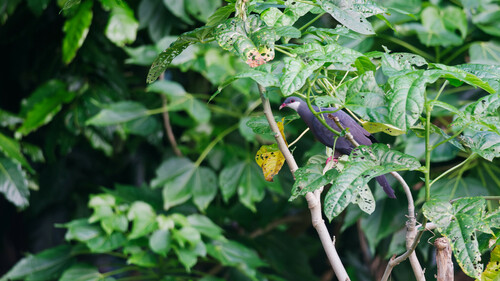 Metallic Pigeon
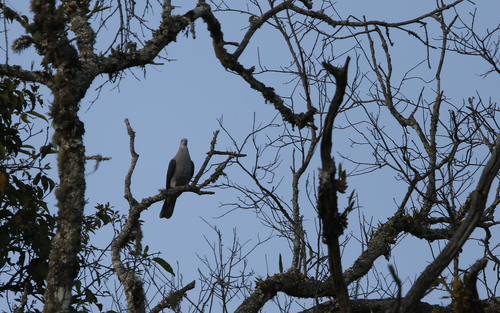 Mountain Imperial-Pigeon
In short
The most reliable field mark is size: Mountain Imperial-Pigeon is much larger and bulkier than Metallic Pigeon, with a longer tail and broader wings. In all plumages, Mountain Imperial-Pigeon shows a distinctive maroon-brown back contrasting with vinous-grey underparts and a white throat, while Metallic Pigeon is smaller, more compact, and has iridescent purple-green crown and upperparts with variable throat color depending on sex and subspecies. Juvenile and adult Metallic Pigeons are generally glossier and more colorful, but can appear duller and greyer in some subspecies and ages, which can cause confusion. Structural differences (especially in flight) and the strong contrast of the Mountain Imperial-Pigeon's back and underparts are key for separation, especially at a distance or in mixed flocks.
Identification tips
- Size is the most immediate clue: Mountain Imperial-Pigeon is much larger and bulkier than Metallic Pigeon, with a longer tail and broader wings. If you get a good look at the bird next to other pigeons or doves, this difference is obvious in all ages and sexes.
- Back color and contrast: Mountain Imperial-Pigeon always shows a maroon-brown back and wings that contrast with its paler, vinous-grey underparts and white throat. Metallic Pigeon lacks this strong back/underpart contrast and is generally darker above with variable iridescence.
- Throat color and sexual dimorphism: In Metallic Pigeon, throat color varies by sex and subspecies—males often have a white throat and cheeks, females and some subspecies have grey. Mountain Imperial-Pigeon always has a white throat, regardless of sex or age.
- Crown and upperparts iridescence: Metallic Pigeon (especially adults and some subspecies) shows a glossy purple-green crown and sometimes iridescent upperparts, which are never present in Mountain Imperial-Pigeon.
- Underpart color: Metallic Pigeon underparts are variable—dull chestnut, vinaceous, or purple-green gloss, depending on subspecies and wear. Mountain Imperial-Pigeon underparts are always vinous-grey and never chestnut or strongly purple.
- Tail pattern: Mountain Imperial-Pigeon has a blackish tail with a grey horizontal line; Metallic Pigeon’s tail is less distinctly marked and more uniformly dark.
- Wing and flight shape: In flight, Mountain Imperial-Pigeon shows broad, rounded wings and a long tail, giving a slow, deep wingbeat. Metallic Pigeon is more compact, with shorter wings and tail, and a quicker, less ponderous flight.
- Perched jizz: Mountain Imperial-Pigeon appears elongated and heavy-billed when perched, often upright with a long tail drooping. Metallic Pigeon is more compact and less upright.
- Iris, bill, and orbital skin: Metallic Pigeon has a yellowish-red iris, yellow bill, and red orbital skin—these details may be visible at close range. Mountain Imperial-Pigeon’s bare part colors are not described here, so use with caution.
- Juvenile confusion: Juvenile Metallic Pigeons are duller but may still show some iridescence and throat color dimorphism. Juvenile Mountain Imperial-Pigeon is not described, but likely resembles adults in pattern, maintaining the maroon back and pale underparts.
- Habitat context: If you are in a high-elevation, extensive old-growth forest in mainland Southeast Asia, Mountain Imperial-Pigeon is more likely. On islands or in more localized forests, especially in the Pacific, Metallic Pigeon is more probable.
- Group size and behavior: Large flocks (dozens to hundreds) at water sources are more typical of Mountain Imperial-Pigeon. Metallic Pigeon is usually seen singly or in small groups.
- Vocalization: If you hear a deep, resonant boom at close range, it is Mountain Imperial-Pigeon. Silence or other calls are not diagnostic for Metallic Pigeon.
- Subspecies pitfalls: Some Metallic Pigeon subspecies (e.g., C. v. griseogularis, C. v. metallica) have grey throats in both sexes, which can cause confusion with Mountain Imperial-Pigeon. Use size, back color, and structure to separate them in these cases.
- Lighting and wear: Iridescence in Metallic Pigeon can appear dull in poor light or worn plumage, making them look greyer and more similar to Mountain Imperial-Pigeon. Always check for structural and size differences if color is ambiguous.
Size
Mountain Imperial-Pigeon is the largest pigeon in its range, measuring 43–51 cm in length [wikipedia], with a noticeably long tail and broad, rounded wings. Metallic Pigeon is smaller, up to 37 cm [wikipedia], and more compact overall. When seen together or with familiar pigeons, the size difference is striking: Mountain Imperial-Pigeon appears much bulkier and longer, with a more elongated silhouette both perched and in flight. This size gap is consistent across all ages and sexes.
Plumage
-
Juvenile/Immature: Metallic Pigeon juveniles are duller than adults but still show some iridescence on the crown and upperparts, and their throat color varies by sex and subspecies (white or grey, sometimes with a malar spot). Mountain Imperial-Pigeon juveniles are not described in detail, but all ages share the basic pattern of vinous-grey underparts, a white throat, and a maroon-brown back and wings, with a blackish tail and slate-grey underwing.
-
Adult: Metallic Pigeon adults are highly variable by subspecies, but typically have an iridescent purple-green crown, black wing and uppertail coverts, and a white or grey throat (sexually dimorphic in some subspecies). Underparts can be dull chestnut, vinaceous, or glossed purple-green. Mountain Imperial-Pigeon adults always show a contrasting maroon-brown back and wings, vinous-grey head/neck/underparts, and a white throat. The tail is blackish with a grey line, and the underwing is slate-grey. The maroon back and large size are diagnostic for Mountain Imperial-Pigeon.
-
Flight views: Mountain Imperial-Pigeon in flight shows broad wings, a long tail, and the strong contrast of maroon upperparts and pale underparts. Metallic Pigeon appears more compact, with darker wings and less contrast between upperparts and underparts, though some iridescence may be visible in good light.
Behaviour
Mountain Imperial-Pigeon is usually solitary but can gather in groups of up to 20, especially when roosting or moving through mountains. It often flies high over the canopy with slow, deep wingbeats, and displays by puffing up its throat and performing vertical flights. Metallic Pigeon is predominantly arboreal, and while its display is not described in detail here, it is generally less conspicuous in flight and more likely to be seen perched in the mid- to upper canopy. Both species may descend to the ground to drink, but Mountain Imperial-Pigeon is more likely to be seen in large flocks at water sources.
Habitat
Mountain Imperial-Pigeon is found in a wide range of forested habitats across southeastern Asia, from lowland to montane forests, but prefers old-growth and is most common above 500 m elevation. It can be seen from sea level up to 2,550 m, especially in the Himalayas and on Sumatra. Metallic Pigeon has a patchier distribution, with subspecies found on various islands in the Pacific and Southeast Asia, and is generally more localized. Both species are forest pigeons, but Mountain Imperial-Pigeon is more likely in extensive, mature forests and at higher elevations, while Metallic Pigeon is often restricted to islands or specific regions.
Voice
Mountain Imperial-Pigeon gives a deep, resonant boom that is only detectable at close range. No vocalization is described for Metallic Pigeon in the provided notes. Thus, voice is only useful if the Mountain Imperial-Pigeon’s booming call is heard at close range; otherwise, silence is not diagnostic.
Metallic Pigeon · Mountain Imperial-Pigeon · My Tricky Birds