

Middle Spotted Woodpecker vs Great Spotted Woodpecker
Dendrocoptes medius versus Dendrocopos major
Play a quiz with Middle Spotted Woodpecker and Great Spotted Woodpecker
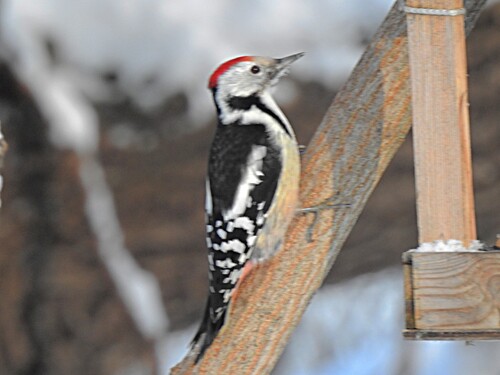 Middle Spotted Woodpecker
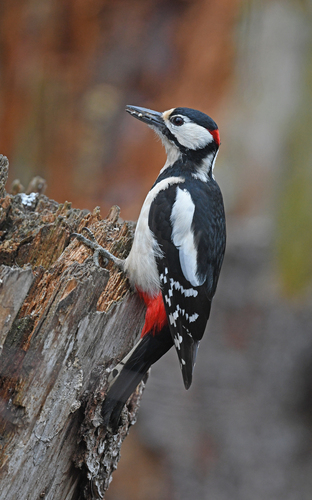 Great Spotted Woodpecker
In short
The most reliable field mark to separate Middle Spotted from Great Spotted Woodpecker is the red crown and absence of a black moustachial stripe in Middle Spotted, versus the Great Spotted's black moustachial stripe and, in adults, a red nape patch (males only). Both species have similar black-and-white upperparts and white oval wing patches, making confusion likely, especially with immatures. Middle Spotted also shows a shorter, finer bill and a more rounded, pale head, while Great Spotted appears bulkier and has a stronger bill. Juvenile Great Spotted Woodpeckers can be especially confusing due to their red crown, but careful attention to facial pattern and bill structure will help. In flight or at a distance, flank streaking (Middle Spotted) and the extent and location of red on the head and vent are key.
Identification tips
- Red crown vs. red nape: Middle Spotted Woodpecker (all ages/sexes) shows a solid red crown, while adult male Great Spotted has a red nape patch (not crown); females lack red on the head. Juvenile Great Spotted can show a red crown, so use with caution in young birds.
- Moustachial stripe: Great Spotted (all ages) has a black moustachial stripe running from the base of the bill down the cheek; Middle Spotted lacks this stripe entirely. This is often the most reliable facial mark.
- Bill shape: Middle Spotted has a noticeably shorter, finer bill compared to the strong, robust bill of Great Spotted. This is best seen in profile or when both species are present.
- Head shape and color: Middle Spotted has a more rounded, pale head, giving a softer look; Great Spotted's head is more angular and contrasting, especially in adults.
- Flank streaking: Middle Spotted shows dark streaks on the flanks (sides of the breast), which are absent or much less marked in Great Spotted.
- Vent color: The vent (area under the tail) is pink in Middle Spotted and scarlet in Great Spotted. This can be visible when the bird is climbing or in flight.
- Upperparts and wing pattern: Both have black-and-white upperparts with white oval wing patches and barred wings, so these features are not diagnostic. Do not rely on upperwing pattern alone.
- Juvenile confusion: Juvenile Great Spotted Woodpeckers have a red crown and less well-defined markings, but still show a black moustachial stripe (sometimes incomplete). Middle Spotted juveniles lack any black on the face and have streaked flanks.
- Sex differences: Only male Great Spotted has a red nape patch; females have no red on the head. Middle Spotted shows a red crown in both sexes.
- Gloss and contrast: Great Spotted adults are glossier and more crisply marked, especially in northern populations. Middle Spotted appears paler and less contrasting.
- Size and jizz: Great Spotted is heavier and bulkier, but size is subtle and not always reliable.
- Bill length in flight: If seen in flight, Great Spotted's longer bill may be evident, especially in side profile.
- Habitat context: Both can occur in similar woodlands; do not use habitat alone for separation.
- Vocalizations: Not covered in the notes; do not rely on voice for separation here.
- Beware Syrian Woodpecker confusion: Both species can be confused with Syrian Woodpecker, but this is not the focus here. Always check for moustachial stripe and crown/nape color.
Size
Both species are close in length (Middle Spotted: 20–22 cm; Great Spotted: 20–24 cm), but Great Spotted Woodpecker is heavier (adult mass ~89 g) and appears bulkier overall. Middle Spotted looks slightly smaller in the field, mainly due to its shorter, finer bill and more rounded head. Size alone is unreliable except in direct comparison, but Great Spotted often gives a more robust impression.
Plumage
- Juveniles: Both species' juveniles can show red on the crown, but Great Spotted juveniles have a red crown that is less extensive in young females, with less well-defined markings and a pinkish lower belly. Middle Spotted juveniles retain the red crown but lack any black moustachial stripe, and show dark streaks on the flanks.
- Adults: Middle Spotted adults have a solid red crown (not just a nape patch), lack a black moustachial stripe, and show dark streaking on the flanks and a pink vent. Great Spotted adults have a black moustachial stripe, a red nape patch in males (females lack red on the head), and a scarlet lower belly/undertail. Both have black-and-white upperparts with white oval wing patches and white barring on the wings, but Great Spotted is glossier and more crisply marked, especially in northern forms.
- Flight views: Both show white oval wing patches and barred wings, but Middle Spotted's flank streaking and lack of black on the face are clues. The vent area is pink (Middle Spotted) vs. scarlet (Great Spotted).
Behaviour
Behavior is broadly similar: both species climb trunks and branches, forage by pecking and probing, and may drum. No strong behavioral differences are noted in the sources for field separation.
Habitat
Both species occur in European woodlands, but the notes do not specify diagnostic habitat differences for field separation. Context may help locally, but is not reliable on its own.
Middle Spotted Woodpecker · Great Spotted Woodpecker · My Tricky Birds