

North Island Robin vs South Island Robin
Petroica longipes versus Petroica australis
Play a quiz with North Island Robin and South Island Robin
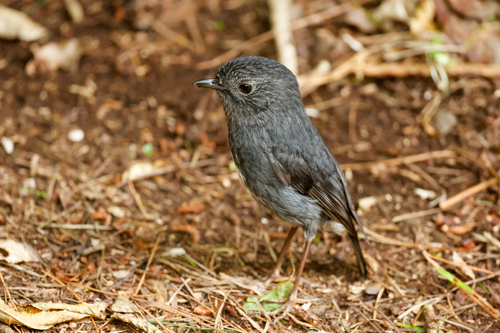 North Island Robin
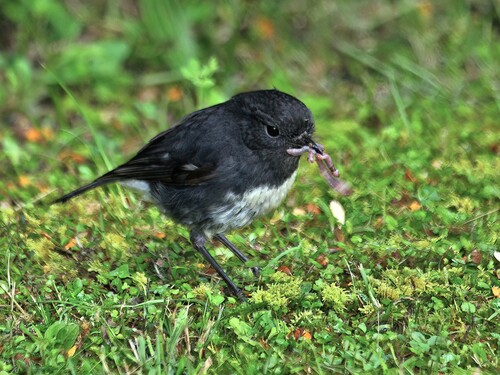 South Island Robin
In short
The most reliable field mark between North Island Robin and South Island Robin is the extent and color of the pale patch on the lower breast: South Island Robin (especially adult males) shows a larger, more yellowish-white patch, while North Island Robin's is smaller and paler. Adult male North Island Robins are nearly black above with a small white spot at the base of the bill, whereas South Island males are dark grey with a more prominent pale lower chest. Females and juveniles of both species are much more similar, being greyer and with variable pale breast patches, making separation difficult in the field. Structural differences are subtle, and both species are similar in size and shape, so careful attention to breast patch size and color, and subtle differences in overall darkness, are key. Juvenile and female plumages are a major pitfall, as they overlap considerably.
Identification tips
- Breast Patch Size and Color (Adults): The most reliable field mark is the size and color of the pale patch on the lower breast. South Island Robin males have a larger, yellowish-white patch, while North Island Robin's is smaller and paler. This is best seen on perched birds in good light.
- Overall Darkness (Adult Males): North Island Robin males are almost black above, contrasting with the dark grey of South Island Robin males. This difference is subtle but can be useful in direct comparison.
- White Spot at Bill Base: North Island Robin often shows a small white spot at the base of the bill, which can be flashed during interactions. South Island Robin may show this, but it is less prominent.
- Pale Streaking on Upperparts: North Island Robin may show pale streaking on the upperparts, which is less pronounced or absent in South Island Robin. This is subtle and best seen at close range.
- Juvenile and Female Pitfall: Juveniles and females of both species are very similar—greyish with variable pale breast patches. Newly independent South Island juveniles may lack a pale patch, but this is not always reliable. Do not rely on breast patch alone in these ages.
- Sexual Dimorphism: Males are darker and slightly larger in both species, but this does not help separate the two.
- Size: Both species are similar in size and structure; do not use size as a separator.
- Flight and Wing Pattern: No distinctive upperwing or flight pattern differences are described for any age; do not use wing pattern for separation.
- Habitat and Range: Use range only if you are certain of your location—North Island Robin is only on the North Island, South Island Robin only on the South and Stewart Islands. Translocated populations may complicate this.
- Behavior: Both species behave similarly; do not use behavior for separation.
- Voice: Songs and calls are not described as reliably different in the field.
- Contextual Clues: If observing a pair, note that males are darker and have a more distinct breast patch in both species, but the size and color of the patch remain the best mark.
- Mixed Flocks: If both species are present (e.g., in managed sanctuaries), rely on breast patch size/color and overall darkness of adult males.
- Lighting Conditions: Subtle differences in darkness and breast patch color may be lost in poor light; prioritize close, well-lit views.
- When in Doubt: If faced with a female or juvenile, acknowledge that field separation may not be possible without range information or genetic analysis.
Size
Both species are sparrow-sized and very similar in overall proportions. South Island Robin is described as 10–18 cm in length and about 35 g in weight, which is representative for both species. Males are slightly larger than females in both species, but this is not a reliable field mark for separation. No meaningful size difference is noted between North and South Island Robins in the field.
Plumage
- Juveniles and Females: Both species' juveniles and females are greyish with variable pale patches on the breast and throat, and can be extremely difficult to separate visually. Newly independent juveniles may lack a well-defined pale breast patch, especially in South Island Robin, but this is not always reliable.
- Adult Males: North Island Robin males are almost black above with a small white spot at the base of the bill and a small, pale (not yellowish) patch on the lower breast. South Island Robin males are dark grey (not black) with a larger, yellowish-white lower chest patch. The pale area on the North Island Robin is always smaller than on South Island Robin.
- Upperparts: North Island Robin shows pale streaking on the upperparts, which is less pronounced or absent in South Island Robin.
- Bill Base: Both species may show a white spot at the base of the bill, but it is more consistently visible in North Island Robin, where it can be flashed in interactions.
Behaviour
Both species are ground-feeding insectivores, often seen hopping or running along the forest floor and perching upright on low branches. Males may be more territorial and conspicuous, especially during the breeding season. There is no strong behavioral difference noted for field separation. Both sexes may cache food and show similar foraging strategies, though males may dominate females at food sources.
Habitat
Habitat is not a reliable separator in the field unless you are certain of your location: North Island Robin is endemic to the North Island, while South Island Robin is found only on the South Island and Stewart Island. Both prefer native forest habitats and are often found in similar ecological niches. If you are within the known range of only one species, this can be helpful, but in translocated or managed populations, range overlap may occur.
Voice
Vocalizations are not described as diagnostic between these two species in the sources. Both produce loud, clear songs and calls, with males singing more during the breeding season. South Island Robin males are noted for long, continuous songs, but this is not stated as unique to the species.