

Northern Royal Albatross vs Southern Giant-Petrel
Diomedea sanfordi versus Macronectes giganteus
Play a quiz with Northern Royal Albatross and Southern Giant-Petrel
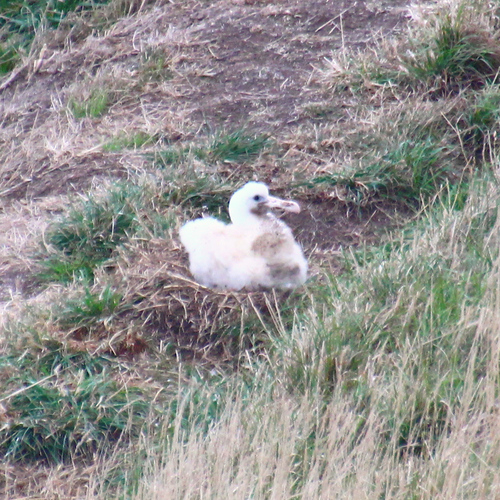 Northern Royal Albatross
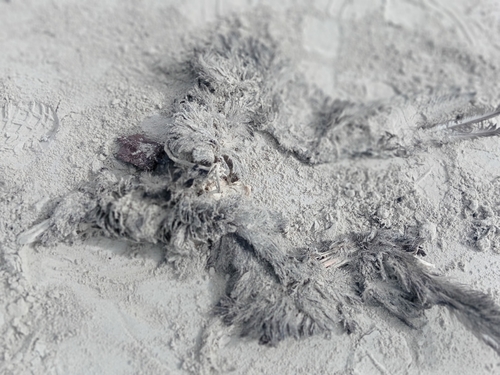 Southern Giant-Petrel
In short
The most reliable field mark between Northern Royal Albatross and Southern Giant-Petrel is the upperwing pattern: juvenile and immature Northern Royal Albatrosses show all-dark upperwings with only scattered white flecks, while Southern Giant-Petrels (especially dark morphs) have mottled brown wings with a paler leading edge and base of inner primaries. In flight, the albatross appears larger, with extremely long, narrow wings and a clean white body, while the petrel has a hunchbacked profile and a heavier, shorter-winged look. Bill color is also distinctive: the albatross has a pink bill with a black cutting edge, whereas the petrel’s bill is yellowish with a green tip. Light-morph petrels can be confusingly pale, but always lack the albatross’s massive wingspan and crisp white tail. These differences are most apparent in flight and at close range, but can be used at a distance with care.
Identification tips
- Upperwing pattern in flight (juveniles/immatures): Northern Royal Albatross shows all-dark upperwings with scattered white flecks on the coverts; Southern Giant-Petrel (dark morph) has mottled brown wings with a paler leading edge and base of inner primaries (especially visible from below).
- Overall size and wingspan: Albatrosses are much larger, with extremely long, narrow wings and a massive wingspan (up to 3 meters); petrels are large but noticeably smaller and bulkier.
- Bill color: Northern Royal Albatross has a pink bill with a black cutting edge; Southern Giant-Petrel has a yellowish bill with a green tip (never pink).
- Head and body color (adults): Adult albatrosses have a white head and body (with some dark speckling in immatures); dark-morph petrels are mottled brown with a paler head and neck, while light-morph petrels are mostly white but with scattered dark specks.
- Tail pattern: Albatrosses have a white tail with a black-brown tip; petrels do not show this crisp tail pattern.
- Flight profile: Albatrosses glide with stiff, slightly arched wings and a streamlined body; petrels have a hunchbacked, heavy-headed look and more frequent wingbeats.
- Leg color: Albatrosses have pale pink legs; petrels have greyish-brown legs (not always visible in the field).
- Behavior on land: Petrels are often seen walking or running on land, especially near carcasses; albatrosses are rarely seen on land except at breeding colonies.
- Light morph confusion: Light-morph Southern Giant-Petrels can appear very white, but always lack the albatross’s massive wingspan, clean white tail, and pink bill.
- Juvenile confusion: Juvenile albatrosses are white-headed with dark upperwings; juvenile petrels are sooty brown overall and lack the clean white head.
- Habitat context: Albatrosses are more likely to be seen far offshore or near breeding colonies; petrels are more often seen near shore, scavenging, or following ships.
- Association with carcasses: Petrels often gather at carcasses or refuse; albatrosses do not scavenge in this way.
- Jizz at a distance: Even at range, the albatross’s longer, narrower wings and more buoyant flight help separate it from the heavier, more labored petrel.
- Group composition: If seen with other seabirds, the albatross will usually be the largest by far; petrels may be among other large Procellariiformes but rarely dwarf them as albatrosses do.
- Bill structure: Both have tubular nostrils, but the albatross’s bill is more slender and evenly tapered; the petrel’s is heavier and more hooked at the tip.
Size
Northern Royal Albatross is substantially larger, with a wingspan of 270–305 cm (106–120 in) and a body mass typically 6.2–8.2 kg (14–18 lb) [wikipedia]. Southern Giant-Petrel is smaller, with a wingspan of 185–205 cm (73–81 in) and an average adult mass of about 4.4 kg [wikidata], though there is considerable size variation by colony and sex. The albatross’s size is especially apparent in direct comparison or when seen with other seabirds.
Plumage
Juvenile and immature Northern Royal Albatrosses have all-dark upperwings with only scattered white flecks on the coverts, and a white head, neck, and underparts. Their tail is white with a black-brown tip, and the underwing is white with a dark trailing edge. As they age, the head, back, and rump whiten further, but the upperwing remains mostly dark until full adulthood. In contrast, Southern Giant-Petrel (dark morph) juveniles are sooty brown overall, gradually paling with age; adults show a mottled brown body with a paler leading edge to the wing and a lighter base to the inner primaries on the underside. The light morph is mostly white with sparse black speckling, but even then, the wing pattern is never as clean or as sharply contrasting as in the albatross. The petrel’s bill is always yellowish with a green tip, while the albatross’s bill is pink with a black cutting edge. The albatross never shows the hunchbacked, heavy look of a giant petrel.
Behaviour
Northern Royal Albatrosses are more graceful and buoyant in flight, gliding with stiff, slightly arched wings and rarely flapping. They are less likely to be seen walking on land except at breeding colonies. Southern Giant-Petrels are powerful but less elegant, with a hunchbacked, heavy-headed flight profile and more frequent wingbeats. Petrels are often seen walking or running on land or scavenging at carcasses, which albatrosses rarely do.
Habitat
Both species are pelagic and can overlap at sea, but Northern Royal Albatrosses breed mainly on the Chatham Islands and Taiaroa Head, and are most often seen near these colonies or on long oceanic flights. Southern Giant-Petrels breed further south and are more often associated with subantarctic islands and Antarctic waters, though their range overlaps with the albatross at sea. Petrels are more likely to be seen close to shore, especially near carcasses or fishing vessels.
Northern Royal Albatross · Southern Giant-Petrel · My Tricky Birds