

Northern Shoveler vs Sand Martin
Spatula clypeata versus Riparia riparia
Play a quiz with Northern Shoveler and Sand Martin
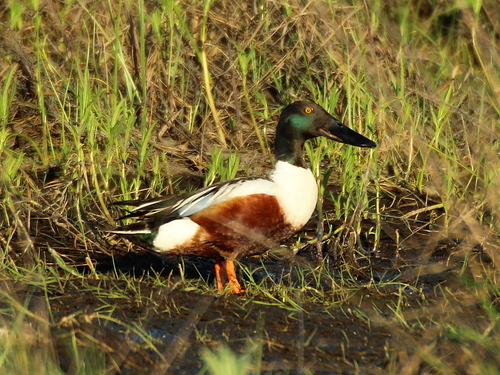 Northern Shoveler
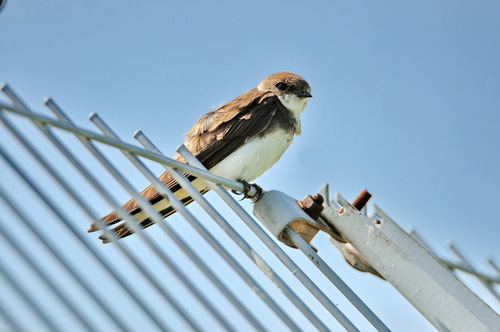 Sand Martin
In short
The most reliable way to separate Northern Shoveler from Sand Martin in any plumage or age is by structure: the shoveler’s huge, spatulate bill is unique among ducks and utterly unlike the tiny, pointed bill of a sand martin. In flight, even immature shovelers show broad, rounded wings and a heavy body, while sand martins are small, slender, and quick-winged. Female and eclipse-plumage shovelers can look dull brown, but always have the oversized bill and orange legs. Sand martins never show any hint of a duck-like silhouette, and their brown-and-white plumage with a narrow breast band is distinctive among swallows. If you’re unsure, focus first on bill shape and flight style, then check for the shoveler’s orange legs or the martin’s breast band.
Identification tips
- Bill shape: Shoveler has a huge, broad, spatulate bill (all ages/sexes); sand martin has a tiny, pointed bill. This is the single most reliable mark.
- Leg color: Shoveler’s legs are bright orange-red (both sexes, all ages); sand martin’s legs are brown and never conspicuous.
- Wing pattern in flight: Shoveler (all ages) shows a pale blue forewing panel, especially obvious in males, and a green speculum bordered by white; sand martin has plain brown upperwings with no panels or iridescence.
- Breast band: Sand martin (all ages) has a narrow brown band across the white breast; shoveler never shows any breast band.
- Body shape and size: Shoveler is large, heavy, and broad-winged; sand martin is small, slim, and short-winged.
- Flight style: Shoveler flies with steady, direct wingbeats and appears heavy; sand martin is quick, agile, and jerky in flight.
- Plumage confusion: Female and eclipse shoveler can look dull brown, but always have the big bill and orange legs; sand martin is always brown above, white below, with the breast band.
- Perching and behavior: Sand martin perches on wires or vertical banks; shoveler only perches on the ground or in water.
- Habitat: Shoveler is always on or near water (marshes, lakes); sand martin is aerial, often over water but never swimming or dabbling.
- Juvenile marks: Young sand martins have rufous-tipped wing coverts and secondaries, but this is subtle and not seen in shovelers.
- Voice: Sand martin gives a gravelly twittering in flight; shoveler is mostly silent.
- Sex/season: Male shovelers in breeding plumage are striking with green head, white breast, chestnut flanks; females and eclipse males are duller but still have the bill and wing pattern.
- Group context: Sand martins often in flocks, especially near nesting banks; shovelers in small groups or pairs on water.
- Feeding behavior: Shoveler swings bill side-to-side on water; sand martin catches insects in the air.
- Pitfalls: Dull female/eclipse shovelers can be mistaken for brown passerines at a distance, but bill and size always give them away. Sand martins are never seen on water or with a duck-like bill.
Size
Northern Shoveler is a large dabbling duck: 44–52 cm long, wingspan 70–84 cm, and weighs 500–800 g [wikipedia][avonet]. In contrast, Sand Martin is a tiny swallow: 12–13 cm long, wingspan 26.5–29 cm, and weighs only 11–16 g (up to 19.5 g pre-migration) [wikipedia][avonet]. The shoveler is more than three times the length and up to 50 times the weight of a sand martin. Even a distant shoveler will appear much bulkier and heavier than any swallow.
Plumage
Juvenile and immature sand martins have rufous tips to the wing coverts and margins to the secondaries, but always show a brown back, white underparts, and a narrow brown breast band, which is present in all ages. In flight, their upperparts remain plain brown, lacking any contrasting wing panels or speculum. Northern Shoveler females and eclipse males are mottled brown above and below, similar to female mallards, but show a pale blue forewing in flight (all ages/sexes), and the bill is always broad and spatulate. Adult male shovelers in breeding plumage are unmistakable with a dark green head, white breast, and chestnut flanks, plus a striking pale blue forewing and green speculum bordered by white. Female shovelers have a duller, grey forewing and lack the strong contrast of the male, but still show the blue-grey tones in flight. No sand martin ever shows a blue or green wing panel or any duck-like pattern.
Behaviour
Northern Shoveler is a dabbling duck, usually seen swimming on water, often swinging its bill side-to-side to strain food, and rarely perches except on the ground or in shallow water. Its flight is steady and direct, with broad, rounded wings and a heavy body. Sand Martin is a highly aerial swallow, almost always seen flying with quick, jerky wingbeats, often in flocks, and perches on wires or vertical surfaces near nesting banks. Sand martins never dabble or swim, and shovelers never exhibit swallow-like flight or perch on wires.
Habitat
Shovelers are found on mud-bottomed marshes, lakes, and wetlands, often with abundant aquatic invertebrates. They are rarely seen away from water. Sand Martins breed in sandy banks near rivers, lakes, or coasts, where they dig nest burrows, and are often seen feeding over open water or fields, but never on the water itself. If you see a bird swimming or dabbling, it is not a sand martin; if it is flying high and catching insects, it is not a shoveler.
Voice
Sand Martin gives a continuous, gravelly twittering in flight and a harsh alarm when threatened. Northern Shoveler is generally quiet, with no distinctive call noted in the provided sources. If you hear a twittering flock, it is sand martins; shovelers are mostly silent.