

Northern Tropical Pewee vs Eastern Wood-Pewee
Contopus bogotensis versus Contopus virens
Play a quiz with Northern Tropical Pewee and Eastern Wood-Pewee
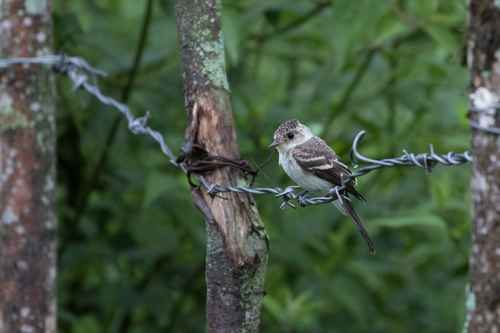 Northern Tropical Pewee
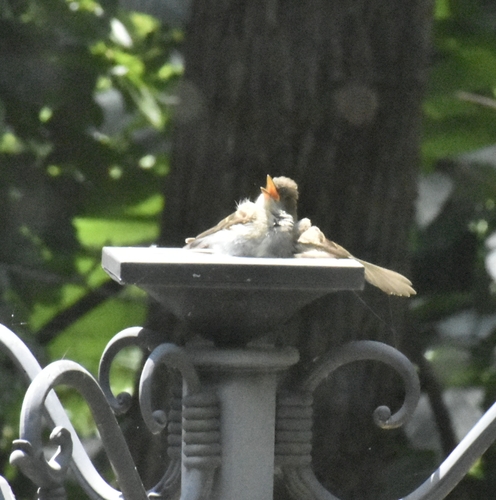 Eastern Wood-Pewee
In short
The most reliable field mark between Northern Tropical Pewee and Eastern Wood-Pewee is the juvenile wing pattern: juvenile Northern Tropical Pewees have browner upperparts and broad pale cinnamon-buff tips to the wing coverts, while Eastern Wood-Pewee juveniles lack these rich buffy wing markings. For adults, both species show two pale wingbars, but the Northern Tropical Pewee is generally duskier and more olive above, with a thinner white eye-ring and a slightly shorter, blunter wingtip. Bill color is subtly different, with the lower mandible tending more orangey in Northern Tropical Pewee and yellowish in Eastern Wood-Pewee. In the field, Eastern Wood-Pewee often appears longer-winged and more slender, especially in flight or when perched upright. Vocalizations are distinct, but not always heard where ranges overlap. Habitat overlap is possible in Central America, but Eastern Wood-Pewee is a migrant and more likely in North American woodlands during breeding season.
Identification tips
- Juvenile wing coverts: Juvenile Northern Tropical Pewee shows broad, pale cinnamon-buff tips to the wing coverts, giving a warm, buffy look to the upperwing. Juvenile Eastern Wood-Pewee lacks this, with plainer, paler wingbars. Use this mark for recently fledged or first-year birds, especially in late summer and fall.
- Primary projection: Eastern Wood-Pewee has longer primary projection, giving a more pointed and slender wingtip, especially obvious when perched or in flight. Northern Tropical Pewee's wingtip is shorter and blunter. This is most useful on perched adults.
- Crown and face: Northern Tropical Pewee has a dark blackish gray crown with a slight crest and a thin white eye-ring, set off against a grayish olive face. Eastern Wood-Pewee's crown is less contrasting, and the eye-ring is less distinct.
- Upperparts color: Northern Tropical Pewee is sooty olive-gray above, with brownish olive rump and uppertail coverts. Eastern Wood-Pewee is gray-olive above, lacking the sooty or brownish tones.
- Wingbars: Both species have two pale wingbars, but Northern Tropical Pewee's are thin and grayish white to brownish gray, while Eastern Wood-Pewee's are pale and can appear slightly broader. In worn plumage, both may look less distinct, so use with caution.
- Bill color: Northern Tropical Pewee has a yellowish or orangey lower mandible, while Eastern Wood-Pewee's is yellowish. This is subtle and best seen in good light.
- Underparts: Both are pale below, but Northern Tropical Pewee may show a whiter or yellowish tinge, and a pale brown undertail. Eastern Wood-Pewee is light below with an olive wash on the breast.
- Tail behavior: Northern Tropical Pewee often 'shivers' its tail upon landing, a subtle behavioral clue not noted for Eastern Wood-Pewee.
- Vocalizations: If you hear a clear, whistled 'pee-a'wee' or 'pe-wee' with a rising note, it's Eastern Wood-Pewee. Northern Tropical Pewee's call is not described here, but it does not match this pattern.
- Habitat and range: In North America during breeding season, Eastern Wood-Pewee is expected. In Central and northern South America, especially outside migration, Northern Tropical Pewee is more likely. Overlap is possible in Central America during migration—use plumage and structure then.
- Perch height: Eastern Wood-Pewee often perches higher in the canopy, while Northern Tropical Pewee typically stays at mid-level or edge perches.
- Aggression: Eastern Wood-Pewee can be quite territorial and aggressive, chasing other birds. Northern Tropical Pewee is less often observed doing so.
- Nest height: If you find a nest, Eastern Wood-Pewee's is usually higher (average 9 m or more), while Northern Tropical Pewee's is lower (2–14 m).
- Sexes: Both species are sexually monomorphic; plumage marks work for both sexes.
- Season: If you are seeing a Contopus in North America before late April, it is unlikely to be Eastern Wood-Pewee, which arrives later than similar species.
Size
Eastern Wood-Pewee is slightly larger on average, measuring 13.5–15 cm in length and weighing about 14 g, compared to Northern Tropical Pewee's 12–14 cm and 8–14 g. The difference is subtle and not always apparent in the field, but Eastern Wood-Pewee tends to look a bit longer-winged and more slender, especially due to its longer primary projection. Both species are small flycatchers and overlap in size, so structure is more useful than absolute measurements.
Plumage
- Juvenile/immature birds: Juvenile Northern Tropical Pewee is distinctly browner above than adult, with broad pale cinnamon-buff tips to the wing coverts, creating a strong contrast and a warm, buffy look to the upperwing. Juvenile Eastern Wood-Pewee lacks these rich buffy edges, instead showing plainer, paler wingbars and a less contrasting upperwing.
- Adults: Both species have two pale wingbars, but Northern Tropical Pewee's are thin and grayish white to brownish gray, while Eastern Wood-Pewee's are pale and the wings look longer and more pointed. Northern Tropical Pewee has a dark blackish gray crown with a slight crest, a thin white eye-ring, and a sooty olive-gray back, while Eastern Wood-Pewee is gray-olive above with a less distinct eye-ring and a more uniform face. Underparts are similar, but Northern Tropical Pewee may show a whiter or yellowish tinge below, and a pale brown undertail. Bill color is subtly different: Northern Tropical Pewee's lower mandible is yellowish to orangey, while Eastern Wood-Pewee's is yellowish. Both have a dark upper mandible.
Behaviour
Both species perch upright and sally for insects from exposed branches, often returning to the same perch. Northern Tropical Pewee is noted for 'shivering' its tail upon landing, a subtle behavioral cue. Eastern Wood-Pewee is more likely to be seen higher in the canopy (average nest height is higher) and can be more aggressive and territorial, sometimes chasing other birds. Both species are typically solitary or in pairs, rarely joining mixed flocks.
Habitat
Northern Tropical Pewee is resident from southeastern Mexico to northern South America, favoring forest edges and mid-level perches. Eastern Wood-Pewee breeds in eastern North American deciduous and mixed woods, migrating to Central America and northern South America for winter. Overlap is possible in Central America during migration, but Eastern Wood-Pewee is more likely in North America in spring and summer. Northern Tropical Pewee is more likely in the tropics year-round, especially below the canopy or at forest edge.
Voice
Vocalizations are highly diagnostic but not always heard. Eastern Wood-Pewee gives a distinctive, mournful whistled 'pee-a'wee' and a rising 'pe-wee', which are unique among Contopus in its range. Northern Tropical Pewee's voice is not described in detail in these notes, but it does not match the Eastern Wood-Pewee's song. If you hear the classic 'pee-a'wee', you are hearing Eastern Wood-Pewee.
Northern Tropical Pewee · Eastern Wood-Pewee · My Tricky Birds