
Motmot

Orange River Francolin vs Hartlaub's Spurfowl

Scleroptila gutturalis versus Pternistis hartlaubi

Play a quiz with Orange River Francolin and Hartlaub's Spurfowl
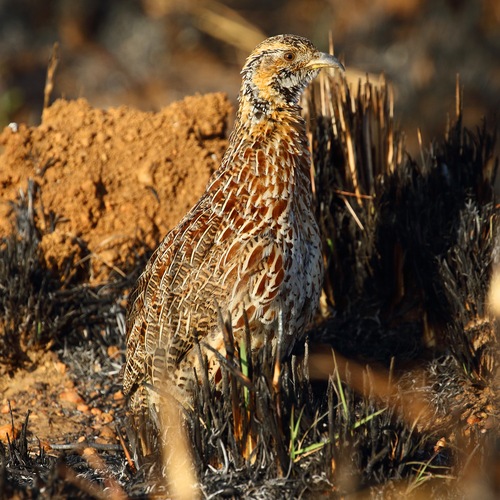
Orange River Francolin (Scleroptila gutturalis) Orange River Francolin
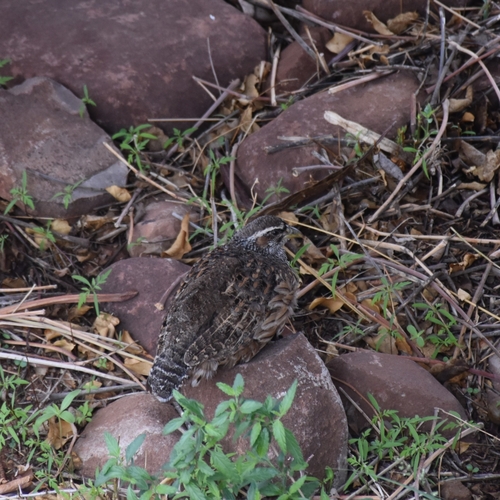
Hartlaub's Spurfowl (Pternistis hartlaubi) Hartlaub's Spurfowl

Media

Loading…

In short

The most reliable field mark to separate Orange River Francolin from Hartlaub's Spurfowl is the strong sexual dimorphism and distinctive head/underpart patterns of Hartlaub's Spurfowl, especially the male's bold white eyestripe and dark-streaked pale grey underparts versus the francolin's more uniform, less contrasting plumage. Hartlaub's Spurfowl is much smaller and has a disproportionately large bill, with males and females showing clear differences in underpart color and streaking. In flight or when flushed, Hartlaub's Spurfowl is reluctant to flush and prefers rocky outcrops, while Orange River Francolin is more likely to be found on grassy slopes. Habitat is also a strong clue: Hartlaub's Spurfowl is restricted to rocky granite/sandstone outcrops in Namibia/Angola, while Orange River Francolin favors grassland and woodland, sometimes on slopes near but not on the rocks.

Identification tips

  1. Sexual dimorphism in Hartlaub's Spurfowl: Males have a bold white eyestripe, dark brownish forehead, and pale grey underparts with heavy dark streaks; females are dull rufous below and lack the eyestripe. Orange River Francolin shows little sexual dimorphism—both sexes are similar and lack strong head/underpart contrast.
  2. Head pattern: Hartlaub's Spurfowl (male) shows a striking white eyestripe and rufous ear coverts, easily seen with binoculars. Orange River Francolin lacks these marks; its head is plainer.
  3. Underpart color and streaking: Male Hartlaub's Spurfowl has pale grey underparts with bold dark streaks; female is plain rufous below. Orange River Francolin's belly is whitish (north) or buff (south), with no heavy streaking.
  4. Bill size and color: Hartlaub's Spurfowl has a disproportionately large bill, especially in females, with a brownish upper mandible and yellow lower mandible. Orange River Francolin's bill is less prominent and lacks this color contrast.
  5. Leg color: Hartlaub's Spurfowl has yellow legs with flattened spurs; leg color is less distinctive in Orange River Francolin.
  6. Size: Hartlaub's Spurfowl is much smaller (male 28 cm, female 25 cm) and lighter than Orange River Francolin. Use this when birds are side by side or with known species.
  7. Juvenile plumage: Juvenile male Hartlaub's Spurfowl resembles adult male but with finer streaks; juvenile female is like adult female. No distinctive juvenile marks are described for Orange River Francolin.
  8. Habitat: Hartlaub's Spurfowl is restricted to rocky outcrops in Namibia/Angola; Orange River Francolin is found in grassland/woodland, sometimes on slopes but not on rocks. Habitat is a strong clue.
  9. Behavior: Hartlaub's Spurfowl is shy, rarely flushes, and prefers to hide among rocks; Orange River Francolin is more likely to flush from grass or open ground.
  10. Flight: When flushed, Hartlaub's Spurfowl flies rapidly and low, often uttering a chattering 'krak'; Orange River Francolin's flight is less described but is likely more typical of open-country francolins.
  11. Geographic range: Hartlaub's Spurfowl is endemic to a small region (northcentral/northwestern Namibia, southwestern Angola); Orange River Francolin has a much wider range in southern and eastern Africa.
  12. Context with other species: Where both occur, Hartlaub's Spurfowl stays on rocks, Orange River Francolin on grassy slopes nearby. If you see a small, streaky, big-billed bird on rocks, it's Hartlaub's Spurfowl.
  13. Group size: Hartlaub's Spurfowl is usually in pairs or small family groups (up to four); Orange River Francolin may be in larger coveys.
  14. No strong upperwing/flight pattern difference: Neither species has a distinctive juvenile or adult upperwing pattern described; rely on ground marks and behavior.
  15. Plumage pitfalls: Female Hartlaub's Spurfowl (dull rufous below) could be mistaken for a pale francolin, but note the habitat, size, and bill structure to avoid confusion.

Size

Hartlaub's Spurfowl is notably smaller than Orange River Francolin. Male Hartlaub's Spurfowl averages 28 cm in length and 245–290 g, with females even smaller at 25 cm and 210–240 g [wikipedia]. Orange River Francolin is larger, though precise measurements are not provided in the notes, it is described as larger and more robust than Hartlaub's Spurfowl. Hartlaub's Spurfowl also has a disproportionately large bill for its size, especially in females.

Plumage

No distinctive age-specific upperwing or flight pattern is described for either species, so separation relies on ground views and overall plumage. Adult male Hartlaub's Spurfowl shows a dark brownish forehead, bold white eyestripe, rufous ear coverts, brown-grey upperparts with dark bars/streaks, and pale grey underparts with extensive dark streaks. The female is dull rufous below, lacking the male's streaking and head pattern. Juvenile males resemble adult males but with finer upperpart streaks; juvenile females are similar to adult females. In contrast, Orange River Francolin shows less sexual dimorphism and is more uniform: northern birds have a neck-line that does not reach the eye and a whitish belly, while southern birds have a neck-line reaching the eye and a buff belly. The francolin lacks the spurfowl's bold eyestripe and strong underpart streaking. Both sexes of francolin are similar, with no strong head or underpart contrast.

Behaviour

Hartlaub's Spurfowl is highly inconspicuous, rarely flushing, and prefers to hide between boulders on rocky outcrops. When flushed, it flies rapidly with a chattering call. It is usually seen in pairs or small family groups. Orange River Francolin is more likely to be found on open grassy slopes or woodland, and is less strictly tied to rocks. The francolin may flush more readily from grassland, and is less secretive than the spurfowl.

Habitat

Habitat is a key separator. Hartlaub's Spurfowl is endemic to rocky granite and sandstone outcrops ('koppies') in northcentral/northwestern Namibia and southwestern Angola, always associated with rocky terrain and surrounding semidesert steppe. Orange River Francolin is found in grassland and woodland, sometimes on slopes leading up to rocky outcrops but not on the rocks themselves. If seen on a rocky outcrop in Namibia/Angola, Hartlaub's Spurfowl is likely; on grassy slopes or open woodland, especially outside this region, Orange River Francolin is expected.

Voice

Hartlaub's Spurfowl, when flushed, gives a rapid, chattering 'krak' call. No vocalization is described for Orange River Francolin in the provided notes, so this is only weakly diagnostic.

Submit a better description

Use the same sections as the comparison. Your text is published immediately.

The most reliable field mark to separate Orange River Francolin from Hartlaub's Spurfowl is the strong sexual dimorphism and distinctive head/underpart patterns of Hartlaub's Spurfowl, especially the male's bold white eyestripe and dark-streaked pale grey underparts versus the francolin's more uniform, less contrasting plumage. Hartlaub's Spurfowl is much smaller and has a disproportionately large bill, with males and females showing clear differences in underpart color and streaking. In flight or when flushed, Hartlaub's Spurfowl is reluctant to flush and prefers rocky outcrops, while Orange River Francolin is more likely to be found on grassy slopes. Habitat is also a strong clue: Hartlaub's Spurfowl is restricted to rocky granite/sandstone outcrops in Namibia/Angola, while Orange River Francolin favors grassland and woodland, sometimes on slopes near but not on the rocks.

  1. Sexual dimorphism in Hartlaub's Spurfowl: Males have a bold white eyestripe, dark brownish forehead, and pale grey underparts with heavy dark streaks; females are dull rufous below and lack the eyestripe. Orange River Francolin shows little sexual dimorphism—both sexes are similar and lack strong head/underpart contrast.
  2. Head pattern: Hartlaub's Spurfowl (male) shows a striking white eyestripe and rufous ear coverts, easily seen with binoculars. Orange River Francolin lacks these marks; its head is plainer.
  3. Underpart color and streaking: Male Hartlaub's Spurfowl has pale grey underparts with bold dark streaks; female is plain rufous below. Orange River Francolin's belly is whitish (north) or buff (south), with no heavy streaking.
  4. Bill size and color: Hartlaub's Spurfowl has a disproportionately large bill, especially in females, with a brownish upper mandible and yellow lower mandible. Orange River Francolin's bill is less prominent and lacks this color contrast.
  5. Leg color: Hartlaub's Spurfowl has yellow legs with flattened spurs; leg color is less distinctive in Orange River Francolin.
  6. Size: Hartlaub's Spurfowl is much smaller (male 28 cm, female 25 cm) and lighter than Orange River Francolin. Use this when birds are side by side or with known species.
  7. Juvenile plumage: Juvenile male Hartlaub's Spurfowl resembles adult male but with finer streaks; juvenile female is like adult female. No distinctive juvenile marks are described for Orange River Francolin.
  8. Habitat: Hartlaub's Spurfowl is restricted to rocky outcrops in Namibia/Angola; Orange River Francolin is found in grassland/woodland, sometimes on slopes but not on rocks. Habitat is a strong clue.
  9. Behavior: Hartlaub's Spurfowl is shy, rarely flushes, and prefers to hide among rocks; Orange River Francolin is more likely to flush from grass or open ground.
  10. Flight: When flushed, Hartlaub's Spurfowl flies rapidly and low, often uttering a chattering 'krak'; Orange River Francolin's flight is less described but is likely more typical of open-country francolins.
  11. Geographic range: Hartlaub's Spurfowl is endemic to a small region (northcentral/northwestern Namibia, southwestern Angola); Orange River Francolin has a much wider range in southern and eastern Africa.
  12. Context with other species: Where both occur, Hartlaub's Spurfowl stays on rocks, Orange River Francolin on grassy slopes nearby. If you see a small, streaky, big-billed bird on rocks, it's Hartlaub's Spurfowl.
  13. Group size: Hartlaub's Spurfowl is usually in pairs or small family groups (up to four); Orange River Francolin may be in larger coveys.
  14. No strong upperwing/flight pattern difference: Neither species has a distinctive juvenile or adult upperwing pattern described; rely on ground marks and behavior.
  15. Plumage pitfalls: Female Hartlaub's Spurfowl (dull rufous below) could be mistaken for a pale francolin, but note the habitat, size, and bill structure to avoid confusion.

Hartlaub's Spurfowl is notably smaller than Orange River Francolin. Male Hartlaub's Spurfowl averages 28 cm in length and 245–290 g, with females even smaller at 25 cm and 210–240 g [wikipedia]. Orange River Francolin is larger, though precise measurements are not provided in the notes, it is described as larger and more robust than Hartlaub's Spurfowl. Hartlaub's Spurfowl also has a disproportionately large bill for its size, especially in females.

No distinctive age-specific upperwing or flight pattern is described for either species, so separation relies on ground views and overall plumage. Adult male Hartlaub's Spurfowl shows a dark brownish forehead, bold white eyestripe, rufous ear coverts, brown-grey upperparts with dark bars/streaks, and pale grey underparts with extensive dark streaks. The female is dull rufous below, lacking the male's streaking and head pattern. Juvenile males resemble adult males but with finer upperpart streaks; juvenile females are similar to adult females. In contrast, Orange River Francolin shows less sexual dimorphism and is more uniform: northern birds have a neck-line that does not reach the eye and a whitish belly, while southern birds have a neck-line reaching the eye and a buff belly. The francolin lacks the spurfowl's bold eyestripe and strong underpart streaking. Both sexes of francolin are similar, with no strong head or underpart contrast.

Hartlaub's Spurfowl is highly inconspicuous, rarely flushing, and prefers to hide between boulders on rocky outcrops. When flushed, it flies rapidly with a chattering call. It is usually seen in pairs or small family groups. Orange River Francolin is more likely to be found on open grassy slopes or woodland, and is less strictly tied to rocks. The francolin may flush more readily from grassland, and is less secretive than the spurfowl.

Habitat is a key separator. Hartlaub's Spurfowl is endemic to rocky granite and sandstone outcrops ('koppies') in northcentral/northwestern Namibia and southwestern Angola, always associated with rocky terrain and surrounding semidesert steppe. Orange River Francolin is found in grassland and woodland, sometimes on slopes leading up to rocky outcrops but not on the rocks themselves. If seen on a rocky outcrop in Namibia/Angola, Hartlaub's Spurfowl is likely; on grassy slopes or open woodland, especially outside this region, Orange River Francolin is expected.

Hartlaub's Spurfowl, when flushed, gives a rapid, chattering 'krak' call. No vocalization is described for Orange River Francolin in the provided notes, so this is only weakly diagnostic.

Discard your changes?

You have unsaved edits. If you leave now, those changes will be lost.

Orange River Francolin · Hartlaub's Spurfowl · My Tricky Birds