

Pied Avocet vs Curlew Sandpiper
Recurvirostra avosetta versus Calidris ferruginea
Play a quiz with Pied Avocet and Curlew Sandpiper
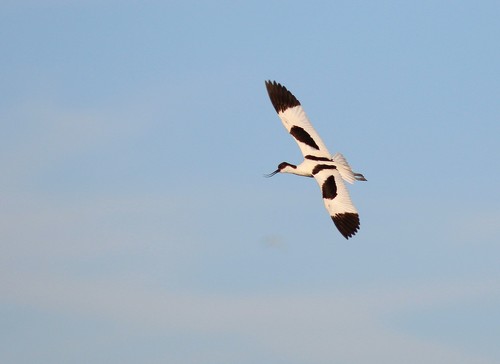 Pied Avocet
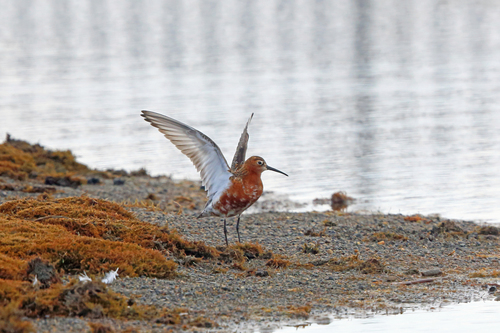 Curlew Sandpiper
In short
The most reliable field mark to separate Pied Avocet from Curlew Sandpiper is overall structure: Avocet is much larger, with long blue legs and a strikingly long, thin, and strongly upturned bill, while Curlew Sandpiper is a small, compact wader with a shorter, decurved bill and dark legs. In flight, Avocet shows bold black-and-white wings with black shoulders and wingtips, while Curlew Sandpiper has a white wing stripe and a prominent white rump. Juvenile and non-breeding Curlew Sandpipers are especially prone to confusion, but Avocet’s size, bill shape, and sharp black-and-white pattern are always distinctive. If you see a black-and-white wader with an upturned bill, it is an Avocet; if the bird is smaller, with a white wing stripe and white rump, and lacks the bold black-and-white pattern, it is a Curlew Sandpiper.
Identification tips
- Size is the first check: Avocet is nearly twice as long and three times as heavy as Curlew Sandpiper. If the bird is large and stands out among other waders, suspect Avocet.
- Bill shape is diagnostic: Avocet’s bill is extremely long, thin, and strongly upturned. Curlew Sandpiper’s bill is much shorter, slender, and decurved (downcurved), never upturned. This is visible even at a distance.
- Leg color and length: Avocet has long, blue legs that extend well beyond the tail in flight and are obvious when wading. Curlew Sandpiper has short, dark grey to black legs that never extend past the tail in flight.
- Flight pattern and wing marks (all ages): Avocet in flight shows bold black-and-white wings with black shoulders and wingtips, and a white tail. Curlew Sandpiper shows a white wing stripe and a bright white rump, with no black shoulder or cap.
- Juvenile confusion: Juvenile Avocet, though duller, still has the black-and-white pattern and upturned bill. Juvenile Curlew Sandpiper is scaly above with buff tones, white below, and always shows the white wing stripe and rump in flight.
- Head pattern: Avocet has a solid black cap extending to the nape; Curlew Sandpiper has a white supercilium (eyebrow) and a more mottled or plain crown, never a solid black cap.
- Body shape and posture: Avocet stands tall, with long neck and legs, and often appears elegant and upright. Curlew Sandpiper is compact, crouched, and moves quickly.
- Plumage seasonality: Avocet shows no seasonal plumage change; always black-and-white. Curlew Sandpiper is plain grey above and white below in winter, reddish below in breeding season, but never black-and-white.
- Tail and rump in flight: Avocet’s tail is white, legs extend far beyond it. Curlew Sandpiper’s rump is bright white, often visible as a flash in flight, and tail is pale grey.
- Feeding behavior: Avocet sweeps its bill side-to-side in shallow water; Curlew Sandpiper probes with its bill, picking at the surface or mud.
- Habitat context: If the bird is in a dense colony or open brackish lagoon, Avocet is more likely. On tidal mudflats with other small waders, Curlew Sandpiper is typical.
- Group association: Avocet often forms loose colonies or groups, sometimes with terns and gulls. Curlew Sandpiper is usually in mixed flocks of small waders.
- Sexual dimorphism is not useful in the field: Both species have subtle sex differences, but these are not reliable for field ID.
- Iris color (close views): Avocet males have reddish-brown irises, females hazel-brown; Curlew Sandpiper has dark brown irises. Only useful at very close range.
- When in doubt, focus on bill and wing pattern: Even if plumage is worn or dull, Avocet’s upturned bill and black-and-white wings are unique. Curlew Sandpiper’s white wing stripe and rump, and decurved bill, are never matched by Avocet.
Size
Pied Avocet is a large wader, measuring 42–46 cm in length with a wingspan of 67–77 cm and weighing 267–382 g [wikipedia][avonet]. Curlew Sandpiper is much smaller, at 18–23 cm long, wingspan 38–46 cm, and weight 44–117 g [wikipedia][avonet]. Avocet is nearly twice as long and three times as heavy as Curlew Sandpiper. Even at a distance, Avocet’s size and long legs are obvious compared to the compact, short-legged Curlew Sandpiper.
Plumage
- Juvenile/immature birds in flight: Pied Avocet juveniles have dingy grey wing coverts and back/scapulars vermiculated with reddish-brown, but still show the bold black-and-white wing pattern, especially black shoulders and wingtips. Curlew Sandpiper juveniles are scaly above with buff-tinged fringing, a white rump, and a white wing stripe; in flight, the white stripe across the wing and white rump are key, lacking any black shoulder or cap.
- Adults in flight: Avocet adults show a striking black cap, black shoulders and wingtips, and white elsewhere on the wing and tail; legs extend well beyond the tail. Curlew Sandpiper adults in non-breeding plumage are plain grey above, white below, with a white supercilium, white rump, and white wing stripe. In breeding plumage, Curlew Sandpiper is rufous below but still shows the white wing stripe and rump in flight.
- On the ground: Avocet is boldly black-and-white with a black cap and upturned bill; Curlew Sandpiper is plain grey above and white below in winter, or rufous below in summer, with a decurved bill and white supercilium. Juvenile Curlew Sandpiper is scaly and buff-tinged above, never black-and-white.
Behaviour
Pied Avocet often feeds by sweeping its upturned bill side-to-side through shallow water, sometimes in small groups, and is typically seen wading in open lagoons or marshes. It stands tall and walks with long strides. Curlew Sandpiper feeds by probing in mud with a more typical sandpiper gait, often in mixed flocks with other small waders, and moves with shorter, quicker steps. Avocet’s feeding behavior and posture are more graceful and deliberate, while Curlew Sandpiper is more active and less conspicuous.
Habitat
Pied Avocet favors coastal lagoons, saltmarshes, and shallow brackish waters, often in open, unvegetated areas. It is usually found in colonies or loose groups. Curlew Sandpiper is a long-distance migrant, found on tidal mudflats, saltpans, and estuarine shores during migration and winter. While both may overlap on mudflats, Avocet is more tied to brackish lagoons and marshes, and its presence in large, open water areas is distinctive. Curlew Sandpiper is rarely found in the same dense, open colonies as Avocet.