

Plume-toed Swiftlet vs Black-nest Swiftlet
Collocalia affinis versus Aerodramus maximus
Play a quiz with Plume-toed Swiftlet and Black-nest Swiftlet
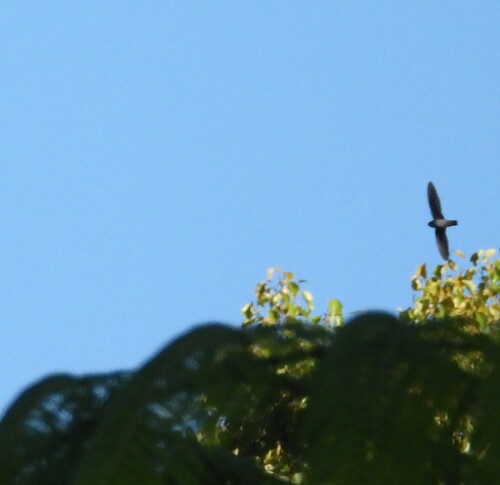 Plume-toed Swiftlet
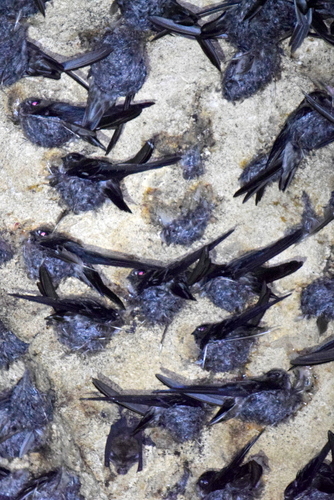 Black-nest Swiftlet
In short
The most reliable field mark between Plume-toed Swiftlet and Black-nest Swiftlet is the presence of a dark, glossy greenish-blue back and wings with no pale rump or tail spots on Plume-toed, versus the generally duller, less glossy appearance of Black-nest, which also lacks pale rump and tail spots. Plume-toed is smaller and more compact, with a square tail and a unique tuft of feathers on the rear toe (hallux), while Black-nest is larger and longer-winged. Both species can appear similar in flight, especially at a distance, but careful attention to size, gloss, and subtle plumage details can help separate them. Juvenile-specific upperwing patterns are not described for either species, so focus on adult and general plumage and structure.
Identification tips
- Size and structure: Plume-toed Swiftlet is distinctly smaller and more compact than Black-nest. In direct comparison, look for a noticeably shorter body and tail.
- Tail shape: Plume-toed has a square tail, which can be seen in good flight views. Black-nest's tail is also square or only slightly notched, so this is supportive but not definitive.
- Upperparts gloss: Plume-toed shows a strong dark greenish-blue gloss on the back and upper wings in good light. Black-nest is generally duller and lacks this intense gloss.
- Rump and tail spots: Both species lack a pale rump and white tail spots, so the absence of these marks does not help separate them; beware of confusing with other swiftlets that do show these features.
- Underparts pattern: Plume-toed has dark grey on the throat and upper breast, merging into large, pale grey chevrons on the lower breast and flanks, with the belly often white. Black-nest is more uniformly dark below, with less contrast and less obvious chevrons.
- Hallux tuft: Only Plume-toed has a tuft of small feathers on the rear toe (hallux), but this is almost never visible in the field and is not a practical field mark.
- Flight style: Plume-toed's smaller size gives it a more fluttery, agile flight with rapid, shallow wingbeats. Black-nest appears steadier and more powerful in flight.
- Habitat and range: If in lowland forest on the Malay Peninsula, Sumatra, or Borneo, both species are possible, but Plume-toed is more restricted to lowlands. Black-nest is more widespread and also occurs in montane forests.
- No juvenile/immature wing pattern difference: There are no described juvenile-specific upperwing or tail marks for either species, so all ages are separated by adult-like features.
- No pale rump or tail spots: If you see a pale rump or tail spots, you are looking at a different swiftlet species.
- No reliable vocal differences described: Vocalizations are not described in the notes and should not be relied upon for separation.
- Context in mixed flocks: In mixed swiftlet flocks, use size and gloss to pick out Plume-toed among larger, duller Black-nest Swiftlets.
- Lighting conditions: The greenish-blue gloss of Plume-toed is best seen in good light; in poor light, both species may appear uniformly dark, making separation difficult.
- Beware of overlap with other swiftlets: Both species can be confused with other Collocalia and Aerodramus swiftlets; always rule out pale rump and tail spots before focusing on these two.
- No sexual dimorphism: Both sexes look alike in each species, so sex is not a useful field mark.
Size
Plume-toed Swiftlet is noticeably smaller, measuring 9–10 cm in length [wikipedia], and appears compact in the hand or at close range. Black-nest Swiftlet is larger, though precise measurements are not provided in the notes; it is generally described as a medium-large swiftlet. In mixed flocks, Plume-toed will look distinctly smaller and shorter-tailed compared to Black-nest.
Plumage
- Juvenile/immature plumage: No specific upperwing or age-related flight marks are described for either species, so separation relies on adult-like features even in young birds.
- Adults: Plume-toed Swiftlet shows a uniform dark greenish-blue gloss on the back and upper wings, with a square tail and no pale rump or white tail spots. Its underparts are dark grey on the throat and upper breast, merging into large grey chevrons on the lower breast and flanks, usually becoming white on the belly. Black-nest Swiftlet is generally duller overall, lacking the strong greenish-blue gloss; its underparts are less distinctly chevroned and more uniformly dark. Both species lack pale rump patches and tail spots, so this is not a separating feature.
- Hallux tuft: Only Plume-toed has a visible tuft of small feathers on the rear toe (hallux), but this is rarely visible in the field.
Behaviour
Both species are aerial insectivores and spend most of their time on the wing, often in mixed flocks. Plume-toed Swiftlet, being smaller, may appear more fluttery and agile, with rapid, shallow wingbeats. Black-nest Swiftlet, being larger, typically shows steadier, more powerful flight. Both species rarely perch in the open, so most views will be of birds in flight.
Habitat
Plume-toed Swiftlet is found on eastern Indian Ocean islands, the Malay Peninsula, Sumatra, and lowland Borneo, favoring subtropical or tropical moist lowland forests. Black-nest Swiftlet has a broader range, including Brunei, Indonesia, Malaysia, Myanmar, the Philippines, Singapore, Thailand, and Vietnam, and occurs in both lowland and montane moist forests. In areas of overlap (Malay Peninsula, Borneo), habitat alone is not diagnostic, but Plume-toed is more restricted to lowlands.