

Pomarine Skua vs Great Skua
Stercorarius pomarinus versus Stercorarius skua
Play a quiz with Pomarine Skua and Great Skua
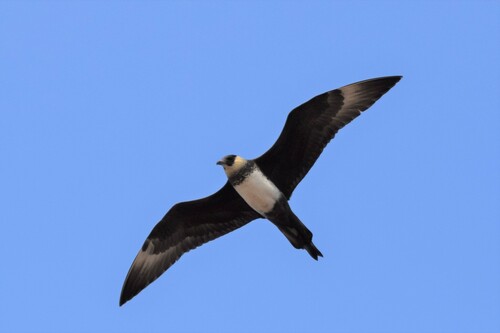 Pomarine Skua
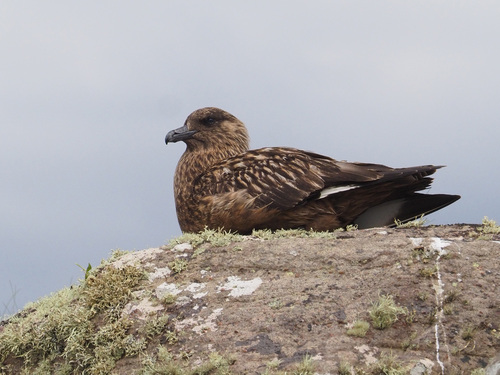 Great Skua
In short
The most reliable field mark to separate Pomarine Skua from Great Skua is overall size and structure: Great Skua is much heavier and bulkier, with a barrel chest and a short, blunt tail, while Pomarine Skua is slimmer, with a longer, more pointed tail in adults and a less imposing build. In flight, Great Skua appears powerful and broad-winged, whereas Pomarine Skua is still robust but less massive, with a more measured flight. Both show white wing flashes, but Pomarine Skua's is a diagnostic double flash on the underwing. Juveniles of both can be tricky, but Great Skua juveniles are unstreaked below and warmer brown, while Pomarine juveniles are variable and can be confusingly similar to other skuas. Use structure and flight style as your primary clues, especially at a distance.
Identification tips
- Size and bulk: Great Skua is much heavier and bulkier than Pomarine Skua; use this when you have a good sense of scale (e.g., with gulls for comparison).
- Tail shape in adults: Breeding adult Pomarine Skuas have long, twisted central tail feathers ('spoons'), absent in Great Skua, whose tail is always short and blunt. This is the single best mark for adult Pomarine in breeding plumage.
- Underwing pattern: Pomarine Skua shows a diagnostic double white flash on the underwing (all morphs, all ages), while Great Skua has a single white flash. This is best seen in good light during flight.
- Wing structure and flight: Great Skua is broader-winged, with a powerful, direct flight and a barrel-chested look; Pomarine is still robust but less massive, with a more measured flight.
- Plumage in adults: Light-morph Pomarine adults have white underparts and a yellowish-white head and neck with a black cap; Great Skua adults are streaked grey-brown with a black cap and never show white underparts or pale head.
- Juvenile/immature plumage: Juvenile Great Skua is a warm brown overall, unstreaked below; Pomarine juveniles are variable and can be confusing, but often show more streaking or contrast, and never as uniformly warm brown as Great Skua.
- Bill and head: Great Skua has a heavier, more powerful bill and a more massive head; Pomarine's bill is proportionally slimmer.
- Behavior: Great Skua is more aggressive and forceful in piracy, sometimes physically attacking large birds; Pomarine is less aggressive and more measured in its attacks.
- Habitat context: In the breeding season, Great Skua is found on northern Atlantic islands and coasts; Pomarine Skua breeds in the high Arctic and is more strictly pelagic in winter.
- Voice: Great Skua's loud, harsh 'hah-hah-hah-hah' differs from Pomarine's chattering or 'which-yew' calls, but use this only if you hear the bird well.
- Flight jizz: Great Skua sometimes recalls a buzzard in flight, with a broad, powerful wingbeat; Pomarine is less buzzard-like, with a steadier, more measured flight.
- White wing flash: Both species show white in the wings, but the double flash of Pomarine (especially on the underwing) is unique.
- Sex differences: Not diagnostic in the field for either species.
- Seasonal context: Outside the breeding season, both may be seen offshore, but Pomarine is more likely in tropical oceans, Great Skua in the North Atlantic.
- Common pitfalls: Juvenile Pomarine can be confused with juvenile Great Skua and other skuas; always use structure and underwing pattern in addition to plumage.
Size
Great Skua is dramatically heavier (average adult mass ~1835g vs. Pomarine Skua ~694g) and appears much larger and more powerful in the field. Great Skua is roughly the size of a herring gull, with a massive, barrel-shaped body and broad wings. Pomarine Skua is still a large skua but noticeably slimmer and less bulky, with a proportionally longer tail (especially in breeding adults) and a less imposing presence. The difference is usually obvious when seen side by side or with familiar seabirds for scale.
Plumage
Juvenile and immature plumages are often the source of confusion. Juvenile Great Skuas are a warm brown overall and lack streaking on the underparts, while Pomarine Skua juveniles are more variable and can be difficult to distinguish from other skuas, including Parasitic Jaeger. Both species show white flashes in the wings, but Pomarine Skua (all ages and morphs) has a diagnostic double white flash on the underwing, while Great Skua has a single white wing flash. Adult Pomarine Skuas are highly variable: light morphs have a brown back, white underparts, yellowish-white head and neck with a black cap; dark morphs are dark brown overall. All adult Pomarines in breeding plumage have elongated, twisted central tail feathers ('spoons'), which are never present in Great Skua. Adult Great Skuas are streaked greyish-brown with a black cap and lack the white underparts or pale head of light-morph Pomarine. Their tail is always short and blunt. In summary, look for the double underwing flash and tail shape in adults, and overall coloration and underpart streaking in juveniles.
Behaviour
Great Skua is less agile but more aggressive and forceful, often using brute strength to rob or attack other seabirds, sometimes even physically grappling with large birds like gannets. Its flight is powerful and direct, sometimes likened to a buzzard. Pomarine Skua is also a kleptoparasite but is less forceful, with a more measured flight and less aggressive piratical behavior. Both species will defend nests aggressively, but Great Skua's size and aggression make its attacks particularly intimidating.
Habitat
Both species are pelagic outside the breeding season, but Great Skua breeds on coastal moorlands and rocky islands in the North Atlantic, especially in northern Europe. Pomarine Skua is a migrant, breeding in the high Arctic and wintering at sea in tropical oceans. In migration and winter, both can be seen offshore, but Great Skua is more likely to be encountered near northern breeding grounds, while Pomarine is more strictly oceanic in winter.
Voice
Great Skua gives a harsh 'hah-hah-hah-hah' and various quacking or croaking calls, which are loud and intimidating. Pomarine Skua has harsh chattering calls and a 'which-yew' sound. Both are vocal when agitated, but their calls are not usually the primary field mark for separation unless heard well at close range.