

Pomarine Skua vs South Polar Skua
Stercorarius pomarinus versus Stercorarius maccormicki
Play a quiz with Pomarine Skua and South Polar Skua
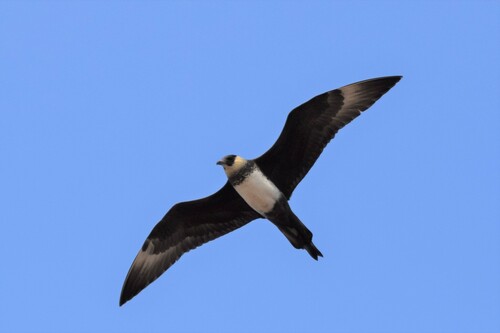 Pomarine Skua
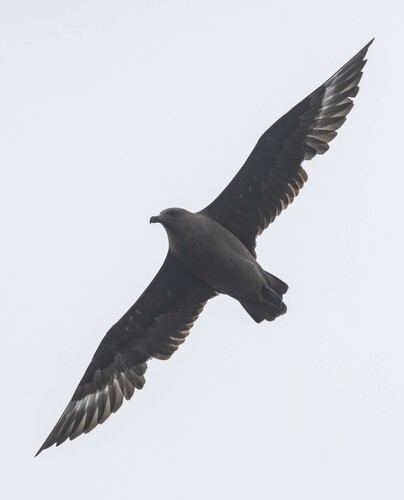 South Polar Skua
In short
The most reliable field mark between Pomarine Skua and South Polar Skua is overall structure: South Polar is much bulkier and heavier-bodied, with a massive barrel chest and a more powerful, direct flight, while Pomarine is still large but slimmer and broader-winged. In adults, Pomarine’s breeding plumage shows long, spoon-shaped central tail feathers, which South Polar never has. Both species can show a white wing flash, but Pomarine’s is a diagnostic double flash on the underwing, whereas South Polar’s is a single, bold white patch. Juveniles and dark morphs are especially tricky, but Pomarine is generally less massive and shows a more measured, less forceful flight. Head and body contrast is stronger in South Polar, especially in pale morphs.
Identification tips
- Overall bulk and chest: South Polar Skua is much heavier and barrel-chested, with a massive, top-heavy look in all plumages. Pomarine is slimmer and less imposing, with a broader wing but not the same chest bulk. This is most apparent in side-by-side views or when a bird is perched.
- Flight style: South Polar’s flight is direct and powerful, reflecting its mass; Pomarine’s is more measured and less forceful, with a broader-winged, less top-heavy jizz. Use this in dynamic, distant views.
- Tail shape (breeding adults): Pomarine Skua in breeding plumage shows long, twisted, spoon-shaped central tail feathers. South Polar never shows this feature. Outside breeding, tail shape is less diagnostic.
- Underwing pattern: Pomarine Skua of all morphs shows a diagnostic double white flash on the underwing; South Polar has a single, bold white patch. This is most useful in good flight views.
- Head and body contrast (adults): South Polar (especially pale morphs) shows a strong contrast between a pale (whitish or straw-brown) head and darker body. Pomarine’s head is yellowish-white with a black cap, but the contrast is less stark overall.
- Bill base (juveniles/dark morphs): South Polar juveniles and dark morphs have a blue bill base, which can help in close views. Pomarine lacks this feature.
- Plumage tone (juveniles/dark morphs): South Polar is colder brown overall; Pomarine is variable but often lacks the cold, ashy tone of South Polar.
- White wing flash (all ages): Both species show a white wing flash, but Pomarine’s is a double flash on the underwing, while South Polar’s is a single, bold patch. This can be subtle in poor light or distant views.
- Head cap (adults): Pomarine adults have a black cap on a yellowish-white head; South Polar’s head is pale but lacks a true cap.
- Size in context: If seen with gulls, South Polar will appear much larger and bulkier than Pomarine, which is itself larger than most gulls but not as massive as South Polar.
- Behavior when pirating: South Polar is more forceful and less agile than Pomarine when chasing other birds.
- Voice: Pomarine has harsh chattering calls and a which-yew sound; South Polar’s voice is not distinctive in the notes, so use with caution.
- Habitat: Both are pelagic and overlap at sea; do not rely on habitat unless breeding location is known.
- Pitfalls with juveniles: Juvenile and dark morph Pomarine can be nearly indistinguishable from South Polar at a distance; use structure and flight style as primary clues.
- Morph variation: Both species have pale, intermediate, and dark morphs, but head/body contrast and tail shape (in breeding Pomarine) remain key.
Size
South Polar Skua is significantly heavier (body mass ~1349g vs Pomarine’s ~694g [wikidata]), with a more robust, barrel-chested build. Pomarine Skua is still large but noticeably slimmer and less imposing, with a broader wing but lacking the sheer bulk and chest of South Polar. In direct comparison, South Polar appears more powerful and top-heavy, especially in flight or when perched side-by-side.
Plumage
- Juveniles and dark morphs: Both species are difficult to separate at this age, but Pomarine juveniles can be nearly indistinguishable from South Polar at a distance. South Polar juveniles and dark morphs have a colder brown tone and a blue bill base (if seen well), while Pomarine juveniles are variable but tend to lack the strong head/body contrast of South Polar.
- Adults (light/pale morphs): Pomarine adults (light morph) have a brown back, mainly white underparts, a yellowish-white head and neck with a black cap, and a diagnostic double white flash on the underwing. South Polar adults (pale morph) are greyish brown above, with a whitish or straw-brown head and underparts, and the contrast between the pale head and darker body is strong and distinctive. The wing flash in South Polar is a single, bold white patch.
- Tail: Breeding Pomarine adults have very long, twisted, spoon-shaped central tail feathers, which are never present in South Polar. Outside breeding, Pomarine’s tail is shorter but still lacks the heavy, blunt look of South Polar’s tail.
Behaviour
South Polar Skua’s flight is direct and powerful, reflecting its greater mass and barrel chest. It uses brute force rather than agility when harassing other birds. Pomarine Skua, while still strong, has a more measured and less forceful flight, appearing broader-winged and less top-heavy. Both species are kleptoparasitic, but South Polar’s piratical behavior is more forceful and less agile than Pomarine’s.
Habitat
Both species are pelagic outside the breeding season and can appear in similar oceanic contexts. Pomarine Skua is a migrant that winters at sea in tropical oceans, while South Polar Skua breeds in the Antarctic and disperses widely at sea. Habitat is not reliably diagnostic unless breeding grounds are known.
Voice
Pomarine Skua has harsh chattering calls and a distinctive which-yew sound. South Polar Skua’s vocalizations are not described in detail in the notes, so voice is not a reliable separator in most field situations.