

Purple-throated Carib vs Antillean Crested Hummingbird
Eulampis jugularis versus Orthorhyncus cristatus
Play a quiz with Purple-throated Carib and Antillean Crested Hummingbird
 Purple-throated Carib
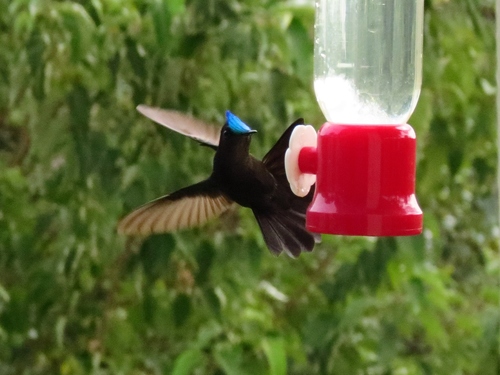 Antillean Crested Hummingbird
In short
The most reliable field mark is the presence of a prominent green or blue-tipped crest on the Antillean Crested Hummingbird male—completely absent in Purple-throated Carib of any age or sex. Immature Purple-throated Caribs show an orange throat with red speckles, while Antillean Crested Hummingbird immatures lack this and instead resemble duller versions of adults. The Carib is noticeably larger and bulkier, with a longer, more decurved bill (especially in females), while the Antillean Crested Hummingbird is smaller, more compact, and has a short, straight bill. In flight or perched, tail and wing coloration also differ, but the crest and size are the quickest field checks.
Identification tips
- Crest presence (males): Only Antillean Crested Hummingbird males have a prominent green or blue-tipped crest. If you see a crest, it's not a Purple-throated Carib.
- Bill shape: Purple-throated Carib has a longer, more decurved bill (especially in females); Antillean Crested Hummingbird's bill is short and straight in both sexes.
- Size and bulk: Carib is much larger and heavier-bodied; Crested is noticeably smaller and more compact. If you see both together, size is obvious.
- Throat color (adults): Carib has a fiery purplish red throat and chest; Crested male has sooty black underparts, and female has light grey underparts.
- Juvenile/immature throat: Immature Carib shows orange throat with red speckles; Crested immatures lack this and are generally duller with pale grey underparts.
- Tail color and pattern: Carib has a metallic greenish blue tail; Crested has a blackish, rounded tail, with females showing broad whitish-grey tips on outer feathers.
- Upperparts: Carib's crown and back are velvety black; Crested's upperparts are metallic bronzy-green.
- Sexual dimorphism: Carib sexes look alike except for bill; Crested shows strong sexual dimorphism—males with crest and dark underparts, females without crest and with pale underparts.
- Perched jizz: Carib appears robust, with a heavy, slightly hunched look; Crested is more upright and dainty.
- Feeding height: Carib often feeds higher in the canopy; Crested is more often at lower levels or in open areas.
- Vocalization: If you hear repeated "tsip" or "tslee-tslee" calls, suspect Crested; Carib is less vocal or less distinctive.
- Habitat context: Dense forest canopy favors Carib; gardens, edges, and open woodlands favor Crested.
- Female confusion: Female Carib's longer, more decurved bill and lack of pale tail tips help separate from female Crested.
- Subspecies crest color: If you see a crest with blue, gold, or violet tips, it's always Crested, but beware local variation in crest color.
- No crest, but small size: If the bird is very small, compact, and lacks a crest, check for other Crested features—female and young males can lack obvious crests but will still be much smaller than Carib.
Size
Purple-throated Carib is substantially larger (11–12 cm, 7–12 g) compared to the Antillean Crested Hummingbird (no direct measurement given here, but universally described as much smaller and lighter [wikipedia]). Carib is robust and heavy-bodied for a hummingbird, while Antillean Crested is compact and light. This size difference is usually obvious if both species are seen in the same area or at the same feeder.
Plumage
- Juvenile/Immature: Immature Purple-throated Caribs have an orange throat and chest with red speckles—unique among local hummingbirds and not found in Antillean Crested Hummingbird of any age. Immature Antillean Crested Hummingbirds lack a crest and have light grey underparts and a bronzy-green crown and upperparts, with the outer tail feathers broadly tipped whitish grey in females.
- Adult Male: Purple-throated Carib males and females are similar: velvety black crown and back, fiery purplish red throat and chest, bright golden green wings, metallic greenish blue tail. Antillean Crested Hummingbird males have a short, straight black bill, a prominent green or blue-tipped crest, dull metallic bronze-green upperparts, sooty black underparts, and a black rounded tail. The Carib's throat is much more colorful and extensive than the Crested's sooty black.
- Adult Female: Female Carib is like the male but with a longer, more decurved bill. Female Antillean Crested Hummingbird lacks a crest, has metallic bronzy-green upperparts, light grey underparts, and a tail with broad whitish-grey tips on the outer feathers.
- Tail: Carib tail is metallic greenish blue, while Antillean Crested Hummingbird tail is blackish, rounded, and in females, the outer feathers are tipped pale.
Behaviour
Both species are territorial and aggressive at flowers, but the Antillean Crested Hummingbird is noted for especially bold, even antagonistic, behavior towards not only other hummingbirds but also non-competitor birds, reptiles, and insects. Purple-throated Carib males defend flower territories year-round, females only outside breeding season. Feeding behavior is similar, but the Carib often feeds higher in the canopy. The Crested is more likely to be seen darting around lower vegetation and even attacking lizards or insects.
Habitat
Both species are found throughout the Lesser Antilles and can overlap in range. Purple-throated Carib is more often associated with mid-levels to treetops of flowering trees, while Antillean Crested Hummingbird is more flexible, occurring from gardens and open woodlands to forest edges and even urban parks. If seen in dense, high canopy, Carib is more likely; in open, shrubby, or edge habitats, Crested is more likely.
Voice
Antillean Crested Hummingbird gives short, sharp "tsip" or "tzip" notes and a repeated "tslee-tslee-tslee" series. No distinctive vocalizations are described for Purple-throated Carib in the provided notes, so voice is more helpful for confirming Crested than for ruling out Carib.
Purple-throated Carib · Antillean Crested Hummingbird · My Tricky Birds