

Pycroft's Petrel vs Fairy Prion
Pterodroma pycrofti versus Pachyptila turtur
Play a quiz with Pycroft's Petrel and Fairy Prion
 Pycroft's Petrel
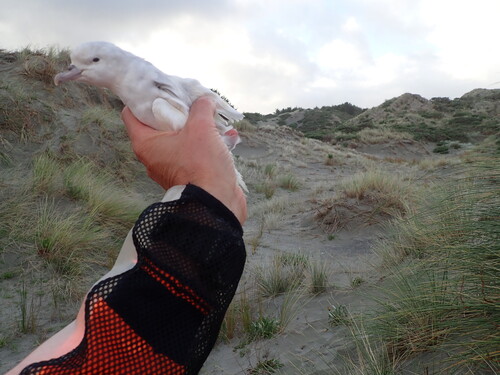 Fairy Prion
In short
The most reliable field mark between Pycroft's Petrel and Fairy Prion is the bill and face pattern: Pycroft's Petrel has a dark patch around the eye and a more typical petrel bill, while Fairy Prion shows a pale blue bill and lacks a strong eye patch. In flight, both show a dark 'M' pattern on the upperwings, but Fairy Prion's blue-grey tones and wedge-shaped tail with a dark tip are distinctive. Size is similar, but Pycroft's Petrel is slightly heavier. Context can help: Pycroft's Petrel breeds only on a few New Zealand islands, while Fairy Prion is widespread in the Southern Hemisphere.
Identification tips
- Bill color and shape: Fairy Prion has a pale blue bill, while Pycroft's Petrel has a darker, more typical petrel bill. This is most useful at close range or in good light.
- Facial pattern: Pycroft's Petrel shows a dark patch around the eye, creating a masked look. Fairy Prion lacks this, appearing more open-faced.
- Breast band: Pycroft's Petrel can show a faint grey band across the breast, absent in Fairy Prion. This is subtle and may be missed at distance.
- Upperwing pattern: Both have a dark 'M' across the back and wings, but Fairy Prion's is set on a bluer-grey background, while Pycroft's Petrel is more neutral grey.
- Tail shape and pattern: Fairy Prion has a wedge-shaped tail with a dark tip, which can be visible in flight or when perched. Pycroft's Petrel's tail is less distinctly marked and not as wedge-shaped.
- Underparts: Both are white below, but Pycroft's Petrel may show a faint breast band; otherwise, underparts are not strongly diagnostic.
- Leg color: Fairy Prion has blue legs and feet, but this is rarely visible in the field.
- Size and jizz: Pycroft's Petrel is slightly heavier and may appear a bit bulkier, but this is not a strong field mark unless seen side by side.
- Flight style: No strong differences are described, but both are agile and buoyant in flight.
- Habitat and range: If seen away from northern New Zealand, Fairy Prion is far more likely. Pycroft's Petrel is highly localized to a few islands.
- Breeding context: At colonies, Pycroft's Petrel gives a ti-ti-ti-ti call, while Fairy Prion coos softly. These are not usually heard at sea.
- Confusion risk: Both can be confused with other small petrels and prions; always check bill color and face pattern first.
- Sex and age: No strong sexual dimorphism; age-related marks are not described as diagnostic in the sources.
- Lighting pitfalls: In poor light, the blue-grey of Fairy Prion may be hard to judge, so rely on bill and face pattern.
- Pitfall: The 'M' pattern is present in both, so do not use this alone for identification.
Size
Both species are small seabirds, but Pycroft's Petrel is slightly heavier (159 g vs. 139 g [wikidata]). Length is almost identical (Pycroft's Petrel: 26 cm, Fairy Prion: 25 cm [wikipedia]). Wingspan is only given for Fairy Prion (56 cm), but overall, size is not a strong separator in the field. If seen together, Pycroft's Petrel may appear a touch bulkier, but this is subtle and easily missed.
Plumage
Both species share a grey upperpart with a dark 'M' pattern across the back and wings, and white underparts. On close view, Pycroft's Petrel shows a faint grey breast band and a dark patch around the eye, which is not present in Fairy Prion. Fairy Prion has a blue-grey tone to the upperparts, a pale blue bill, and a wedge-shaped tail with a dark tip, while Pycroft's Petrel's tail is less distinctly marked. Juvenile and immature plumages are not described in detail for either species in the sources, so rely on adult-type field marks. In all plumages, the Fairy Prion's bill color and tail pattern are helpful, while Pycroft's Petrel's face pattern is more pronounced.
Behaviour
Both species are pelagic and often seen in flight over the ocean. Fairy Prion is known to coo softly when returning to nests at night, while Pycroft's Petrel gives a ti-ti-ti-ti call at breeding colonies. Foraging behavior is similar, with both species feeding on small marine prey at or near the surface. No major behavioral differences are described that would be diagnostic at sea.
Habitat
Pycroft's Petrel breeds only on a handful of small islands off northern New Zealand, making it highly localized. Fairy Prion is much more widespread, breeding on many subantarctic and temperate islands across the Southern Hemisphere, including New Zealand, Australia, and the South Atlantic. Away from breeding sites, both occur at sea, but Fairy Prion is far more likely outside the immediate New Zealand region.
Voice
Pycroft's Petrel gives a ti-ti-ti-ti call at breeding colonies, but this is rarely heard at sea. Fairy Prion returns to the nest with a soft cooing call, but is generally silent at sea as well. Vocalizations are not reliable for separation unless at colonies.