

Red-bellied Fruit-Dove vs Claret-breasted Fruit-Dove
Ptilinopus greyi versus Ptilinopus viridis
Play a quiz with Red-bellied Fruit-Dove and Claret-breasted Fruit-Dove
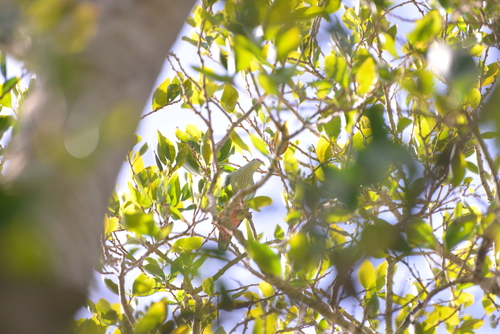 Red-bellied Fruit-Dove
 Claret-breasted Fruit-Dove
In short
The most reliable way to separate Red-bellied Fruit-Dove from Claret-breasted Fruit-Dove is by the location and color of the main reddish patch: Red-bellied has a purplish-red patch on the central belly and crown, while Claret-breasted shows a dark red-brown patch on the throat and upper breast, plus a bluish-grey face and shoulder. Juvenile Red-bellied Fruit-Doves lack the red belly and crown, making them much plainer green and potentially confusing with other green fruit-doves, but Claret-breasted juveniles are not described as lacking their breast patch. Both are mainly green overall, but the Claret-breasted’s bluish-grey face and shoulder are unique. Range is a strong clue: Red-bellied is found in New Caledonia, Santa Cruz Islands, and Vanuatu, while Claret-breasted is in the Moluccas, New Guinea, and the Solomons. Structure and size are similar and not helpful for separation.
Identification tips
- Location of reddish patch: Red-bellied Fruit-Dove has a purplish-red patch on the central belly, while Claret-breasted Fruit-Dove has a dark red-brown patch on the throat and upper breast. Always check where the color is concentrated.
- Crown color: Red-bellied Fruit-Dove shows a purplish-red crown in adults. Claret-breasted has a bluish-grey face and forecrown, never red.
- Shoulder color: Claret-breasted Fruit-Dove has a bluish-grey patch on the shoulder, which Red-bellied lacks. This is visible in perched birds and sometimes in flight.
- Juvenile confusion: Juvenile Red-bellied Fruit-Doves lack both the red belly patch and the red crown, appearing overall green. They can be mistaken for other green fruit-doves, but Claret-breasted juveniles are not described as losing their breast patch, so a bird with a plain green belly and crown is more likely a young Red-bellied.
- Sex differences: Both sexes of Red-bellied are similar, but females have a slightly smaller belly patch. This is subtle and not a strong field mark.
- Overall green plumage: Both are mainly green, so do not rely on overall color alone.
- Face and forecrown: Claret-breasted’s bluish-grey face and forecrown are unique and diagnostic if seen well.
- Range: If you are in New Caledonia, Santa Cruz Islands, or Vanuatu, you are almost certainly seeing Red-bellied. In the Moluccas or New Guinea, it will be Claret-breasted. In the Solomons, check plumage carefully.
- Habitat: Both prefer lowland forests, so habitat alone is not diagnostic within overlapping range.
- Structure and size: Both are similar in size and shape; do not use these features for separation.
- Flight views: No distinctive upperwing or flight pattern differences are described for either species, so rely on head and underpart color even in flight.
- Perched views: Focus on the location of the reddish patch (belly vs. breast) and the presence or absence of bluish-grey on the face and shoulder.
- Pitfalls: Immature Red-bellied can be easily overlooked as other green fruit-doves due to lack of red patches; always consider age when a bird seems too plain.
- No vocal differences described: Do not rely on voice for separation based on current information.
- Community tip: If you see a green fruit-dove with a reddish belly and crown, it is Red-bellied; if the red is on the upper breast and the face is bluish-grey, it is Claret-breasted.
Size
Both species are similar in size, with the Claret-breasted Fruit-Dove noted at 20–21 cm in length. No direct measurement is given for Red-bellied Fruit-Dove, but both are typical small Ptilinopus fruit-doves and appear similar in the field. Size is not a reliable field mark for separating these two species.
Plumage
- Juvenile/immature birds: Juvenile Red-bellied Fruit-Dove lacks the purplish-red patch on both the belly and crown, appearing overall green and thus more easily confused with other green fruit-doves. No specific description is given for juvenile Claret-breasted, but the adult’s breast patch is a key mark.
- Adults: Red-bellied Fruit-Dove is overall green with a purplish-red crown and a purplish-red patch on the central belly (smaller in females). Claret-breasted Fruit-Dove is also mainly green but has a well-defined dark red-brown patch on the throat and upper breast, a bluish-grey face and forecrown, and a bluish-grey patch on the shoulder. The location of the reddish patch (belly vs. upper breast) and the presence of bluish-grey on the face/shoulder are the most diagnostic differences. Both sexes of Red-bellied are similar, but the belly patch is slightly smaller in females.
Behaviour
No behavioral differences are described that would reliably separate these two species. Both are typical fruit-doves of lowland forests, likely feeding on fruit in the canopy and behaving similarly.
Habitat
Red-bellied Fruit-Dove is found in lowland forests of New Caledonia, Santa Cruz Islands (Solomons), and Vanuatu, and is common in most of its range. Claret-breasted Fruit-Dove is found in the Moluccas, New Guinea, and the Solomon Islands archipelago, also in subtropical or tropical moist lowland forests. Overlap is possible in the Solomons, but otherwise, range is a strong separator. If you are outside the Solomons, the species present is almost certainly the one with the local range.
Red-bellied Fruit-Dove · Claret-breasted Fruit-Dove · My Tricky Birds