
Red Knot vs Ruff
Calidris canutus versus Calidris pugnax
Play a quiz with Red Knot and Ruff
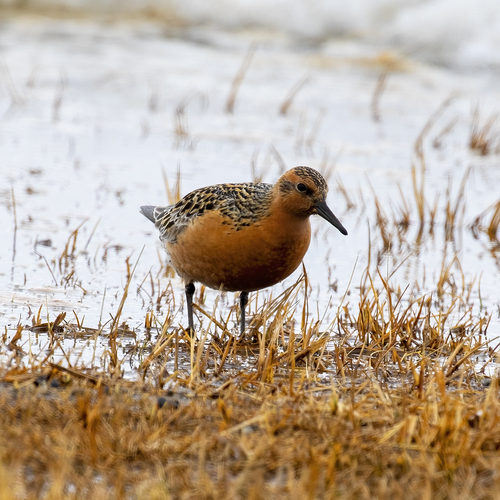 Red Knot
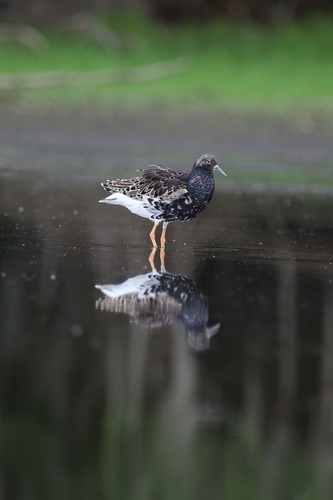 Ruff
In short
The most reliable field mark to separate Red Knot from Ruff is the upperwing and tail pattern in flight: Red Knot shows a bold white wing bar and a solid grey rump and tail, while Ruff has only a thin, indistinct white wing bar and distinctive white ovals on the sides of the tail. On the ground, Red Knot is compact and low-slung with short, dark legs and a medium-length straight bill, while Ruff appears pot-bellied, longer-necked, and stands taller on long, often colorful legs. Juvenile and winter birds of both species can look superficially similar, but careful attention to structure, leg color, and flight pattern will clinch the ID. Breeding plumage differences are dramatic in adult male Ruff (with ornate ruffs and tufts), but females and non-breeding birds require close scrutiny.
Identification tips
- Flight pattern (all ages): Red Knot shows a bold, broad white wing bar and a plain grey rump and tail in flight. Ruff has only a thin, faint wing bar and distinctive white ovals at the sides of the tail. This is the most reliable mark, especially for immatures and non-breeding birds.
- Leg length and color: Red Knot has short, dark greenish legs at all ages. Ruff has much longer legs, greenish in juveniles and pink to orange (sometimes reddish) in adults, especially males in breeding season.
- Structure and posture: Red Knot is compact, with a short neck and a 'low-slung' crouched stance. Ruff is pot-bellied, with a longer neck, small head, and stands more upright and taller.
- Bill: Red Knot's bill is medium-length, straight, and about as long as its head. Ruff's bill is similar in length but may appear slightly longer and finer, especially in females.
- Breeding plumage (adults): Male Ruff in breeding plumage is unmistakable with its ornate ruff and head tufts. Female Ruff and Red Knot are less distinctive, but Red Knot males have a rich cinnamon underpart color, while female Ruff is more muted with black blotching.
- Juvenile upperparts: Red Knot juveniles show submarginal lines and brown coverts; Ruff juveniles have a neat, scaly upperpart pattern with strong buff below.
- Underpart color (non-breeding): Both are pale grey in winter, but Red Knot is more uniform, while Ruff may show more contrast and a slightly scaly look.
- Feeding behavior: Red Knot moves steadily with a crouched, probing action; Ruff often stands upright and may be seen in larger, more active flocks.
- Habitat preference: Red Knot is more strictly coastal, especially on migration and wintering grounds. Ruff is more likely inland or in freshwater marshes, though overlap occurs.
- Wingbeat in flight: Ruff has a deeper, slower wingbeat than Red Knot, which flies more directly and evenly.
- Sexual dimorphism: Only male Ruff shows extravagant breeding plumage; female Ruff and Red Knot are more subtly marked.
- Size impression: Both are similar in mass and length, but Ruff looks taller and more elongated due to its structure.
- Voice: Red Knot gives a low 'knutt' or 'knuup-knuup' in flight; Ruff's calls are not distinctive for separation.
- Pitfalls: Female Ruff and Red Knot can be very similar in non-breeding plumage; rely on structure, leg color, and flight pattern for separation.
- Seasonal context: If you see a bird with a ruff and head tufts, it is a male Ruff in breeding plumage. Otherwise, use the above marks, especially in autumn and winter when both species are plain.
Size
Red Knot and Ruff are nearly identical in mass (about 137 g for Red Knot, 136 g for Ruff [wikidata]), and their lengths overlap (Red Knot 23–26 cm, Ruff female 22–26 cm [wikipedia]). However, Ruff typically looks taller and more elongated due to its longer neck and legs, while Red Knot is more compact and 'low-slung.' In mixed flocks, Ruff may stand out for its pot-bellied, upright stance, especially when compared to the more horizontal, squat posture of Red Knot.
Plumage
- Juvenile/First-winter: Red Knot juveniles have distinctive submarginal lines and brown coverts, while Ruff juveniles show a neat, scale-like pattern on the upperparts with dark feather centers and a strong buff tinge below. In flight, Red Knot of all ages displays a broad, clean white wing bar and a plain grey rump and tail; Ruff shows only a thin, faint wing bar and white ovals at the tail sides.
- Adult non-breeding: Both are mostly pale grey above and below, but Red Knot is more uniformly pale grey, while Ruff (especially females) may show more contrast and a slightly scaly effect on the upperparts.
- Adult breeding: Red Knot is mottled grey above with a rich cinnamon face, throat, and breast, fading to a pale rear belly. Ruff males are unmistakable in full breeding plumage with extravagant ruffs and head tufts (not present in females or juveniles), while females show grey-brown upperparts with white-fringed, dark-centered feathers and variable black blotching below.
- Leg color: Red Knot always has short, dark greenish legs; Ruff legs are much longer and vary from greenish (juvenile) to pink, orange, or even reddish (adult males in breeding season).
Behaviour
Red Knot typically forages in a low, crouched posture, often moving steadily and probing mud with its bill. It is less gregarious when feeding, and its short legs give it a 'low-slung' look. Ruff is highly gregarious, especially outside the breeding season, and often forms large flocks. It stands more upright, moves with a pot-bellied gait, and its longer legs and neck give it a taller, more elegant appearance. In flight, Ruff has a deeper, slower wingbeat compared to the more direct, even flight of Red Knot.
Habitat
Red Knot breeds in Arctic tundra and migrates to coastal mudflats and estuaries. Ruff breeds in marshes and wet meadows across northern Eurasia and winters in a broader range of wetlands, including inland marshes and flooded fields, as well as coastal areas. In migration and winter, both can occur together on mudflats, but Ruff is more likely inland or in freshwater habitats, while Red Knot is more strictly coastal.
Voice
Red Knot is generally quiet when feeding, but in flight flocks gives a low monosyllabic 'knutt' or a disyllabic 'knuup-knuup.' Its display song is a fluty 'poor-me.' Ruff's calls and display sounds are not detailed in the notes, but vocal differences are not a primary field mark for separation.