
Motmot

Rufous-tailed Scrub Robin vs Thrush Nightingale

Cercotrichas galactotes versus Luscinia luscinia

Play a quiz with Rufous-tailed Scrub Robin and Thrush Nightingale
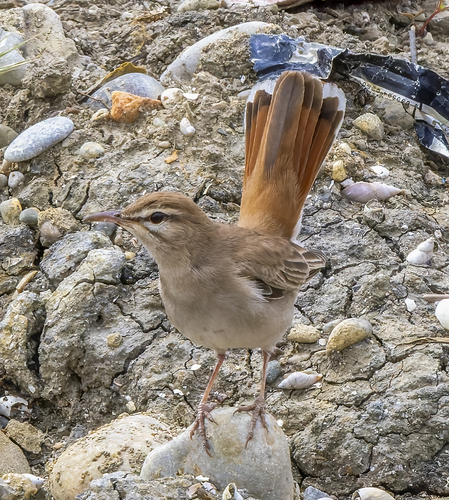
Rufous-tailed Scrub Robin (Cercotrichas galactotes) Rufous-tailed Scrub Robin
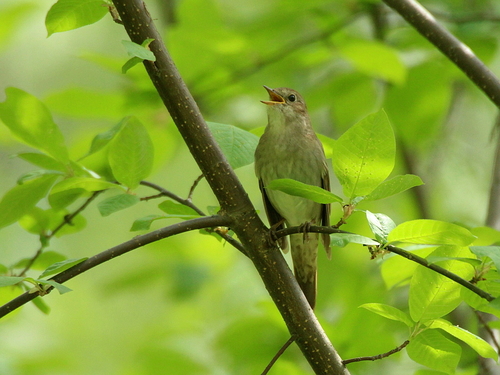
Thrush Nightingale (Luscinia luscinia) Thrush Nightingale

Media

Loading…

In short

The most reliable field mark to separate Rufous-tailed Scrub Robin from Thrush Nightingale is the Scrub Robin’s long, bright rufous tail with bold black and white patterning, which it often fans and flicks—this is never shown by the more uniformly dark, short-tailed Thrush Nightingale. Juvenile Scrub Robins are paler and sandy-brown, while juvenile Thrush Nightingales are darker and heavily mottled. Structurally, Scrub Robins are longer-legged and more upright, often perching in exposed spots, whereas Thrush Nightingales are stockier, shorter-legged, and skulk in dense cover. Both can appear similar in size, but the Scrub Robin’s tail and posture are distinctive even at a distance.

Identification tips

  1. Tail pattern and behavior: The Scrub Robin’s long, bright rufous tail with bold black and white markings (especially visible when fanned or flicked) is unique—Thrush Nightingale’s tail is shorter, duller, and lacks strong patterning. This mark works for all ages and is especially obvious in flight or when the bird fans its tail.
  2. Supercilium and face: Scrub Robin shows a strong, creamy-white supercilium and a dark eye-stripe, giving a striking facial contrast. Thrush Nightingale’s face is plain brownish-black with no strong supercilium—this is a reliable perched-view mark for adults and juveniles.
  3. Overall coloration: Scrub Robin is warm, rich brown above with a rufous rump and tail; Nightingale is cold, dark brown with a slight olive tinge and no rufous except a dull tail. Juvenile Scrub Robins are paler and sandier, while juvenile Nightingales are darker and more mottled.
  4. Underparts: Scrub Robin’s underparts are buffish white, with a paler central belly and undertail coverts. Nightingale’s are pale buff or whitish but heavily mottled or spotted brown, especially on the breast and sides of the throat. Juvenile Nightingales are especially spotted below.
  5. Legs and stance: Scrub Robin has long, pale brown legs and stands upright, often perching high or in the open. Nightingale has shorter, brown legs and a more crouched, thrush-like stance, usually in cover.
  6. Wing pattern: Scrub Robin’s wing feathers are dark brown with buff and chestnut fringes and white-tipped secondaries; Nightingale’s wings are uniformly dark brown, lacking rufous or white fringing. This is subtle but can help in good light.
  7. Perching behavior: Scrub Robin is often seen on wires, posts, or bush tops, frequently in the open. Nightingale almost never perches in the open, preferring dense undergrowth.
  8. Tail movement: Scrub Robin frequently fans, bobs, and flicks its tail, sometimes drooping and flicking its wings. Nightingale does not show these behaviors.
  9. Habitat: Scrub Robin is found in dry, open, bushy areas; Nightingale in damp, dense woodland or scrub. Context is a strong clue.
  10. Song delivery: Scrub Robin sings from exposed perches; Nightingale sings from deep cover. If you hear a song from a bush top or wire, suspect Scrub Robin.
  11. Flight jizz: Scrub Robin appears longer and more elongated in flight due to its tail; Nightingale is compact and thrush-like.
  12. Juvenile confusion: If the bird is very mottled and dark below, especially with a cloudy breast, it is likely a juvenile Nightingale. If paler and sandy, with a rufous tail, it is a juvenile Scrub Robin.
  13. Bill: Both have brown bills, but Scrub Robin’s lower mandible base is greyish—this is subtle and rarely diagnostic in the field.
  14. Season: Both are migratory, but Scrub Robin is much rarer north of the Mediterranean; Nightingale is commoner in central and eastern Europe in summer.
  15. Size impression: Scrub Robin appears larger and more elongated due to its tail and legs, but actual body size is similar.

Size

Both species are similar in overall length (about 15–16 cm), but the Rufous-tailed Scrub Robin is slightly heavier (body mass ~22.7 g [wikidata]) and appears longer and lankier, with a proportionally longer tail and legs. The Thrush Nightingale is more compact, with a shorter tail and a bulkier, rounder body. In the field, the Scrub Robin’s tail length and upright stance make it look larger and more elongated than the more hunched, thrush-like Nightingale.

Plumage

Juvenile and adult Rufous-tailed Scrub Robins are rich brownish-chestnut above with a distinctly rufous rump and uppertail coverts, and a long, rounded tail that is bright rufous-chestnut with black bands and white tips—this tail pattern is visible in all ages, though juveniles are paler and sandier overall. The Scrub Robin also shows a bold, creamy-white supercilium and a dark eye-stripe. In contrast, Thrush Nightingales of all ages are uniformly dark brown above with a slight olive tinge, lacking any rufous tones except for a duller rufous-brown tail; their upper tail-coverts are less olivaceous, and the tail is never as bright or patterned as the Scrub Robin’s. Juvenile Nightingales are darker and more mottled, especially below, with a cloudy, spotted breast and sometimes barred undertail coverts. The Scrub Robin’s underparts are buffish white, paler centrally, while the Nightingale’s are pale buff or whitish with brown mottling and a generally greyer, cloudier look. In flight, the Scrub Robin’s tail pattern is obvious, while the Nightingale’s is plain and dark.

Behaviour

Rufous-tailed Scrub Robins are often seen in open, dry country, perching conspicuously on bushes, wires, or posts, and frequently fanning, bobbing, or flicking their long tails. They move with a more upright, alert posture and are often on the ground but in open view. Thrush Nightingales are much more secretive, preferring to skulk in dense undergrowth, rarely perching in the open, and moving with a lower, more crouched stance. Scrub Robins can be seen flaring their tails and drooping/flicking their wings, behaviors not shown by Nightingales.

Habitat

Rufous-tailed Scrub Robins inhabit dry, open areas with scattered bushes and shrubs, often in Mediterranean or semi-arid landscapes. They are more likely to be found in exposed, sunlit spots. Thrush Nightingales breed in damp forests and dense undergrowth, especially near water, and are rarely seen in open or arid habitats. If the bird is in a dry, bushy area, Scrub Robin is far more likely; if in dense, moist woodland, Nightingale is the default.

Voice

Both species have rich, varied songs, but the Scrub Robin’s is described as lark-like, often disjointed and sometimes clear and loud, sometimes soft, with a sad tone. It is typically delivered from an exposed perch. The Thrush Nightingale’s song is also powerful and varied but more solemn and less musical than the Common Nightingale’s, and is usually delivered from deep cover. Song alone is not always diagnostic, but context and delivery position can help.

Submit a better description

Use the same sections as the comparison. Your text is published immediately.

The most reliable field mark to separate Rufous-tailed Scrub Robin from Thrush Nightingale is the Scrub Robin’s long, bright rufous tail with bold black and white patterning, which it often fans and flicks—this is never shown by the more uniformly dark, short-tailed Thrush Nightingale. Juvenile Scrub Robins are paler and sandy-brown, while juvenile Thrush Nightingales are darker and heavily mottled. Structurally, Scrub Robins are longer-legged and more upright, often perching in exposed spots, whereas Thrush Nightingales are stockier, shorter-legged, and skulk in dense cover. Both can appear similar in size, but the Scrub Robin’s tail and posture are distinctive even at a distance.

  1. Tail pattern and behavior: The Scrub Robin’s long, bright rufous tail with bold black and white markings (especially visible when fanned or flicked) is unique—Thrush Nightingale’s tail is shorter, duller, and lacks strong patterning. This mark works for all ages and is especially obvious in flight or when the bird fans its tail.
  2. Supercilium and face: Scrub Robin shows a strong, creamy-white supercilium and a dark eye-stripe, giving a striking facial contrast. Thrush Nightingale’s face is plain brownish-black with no strong supercilium—this is a reliable perched-view mark for adults and juveniles.
  3. Overall coloration: Scrub Robin is warm, rich brown above with a rufous rump and tail; Nightingale is cold, dark brown with a slight olive tinge and no rufous except a dull tail. Juvenile Scrub Robins are paler and sandier, while juvenile Nightingales are darker and more mottled.
  4. Underparts: Scrub Robin’s underparts are buffish white, with a paler central belly and undertail coverts. Nightingale’s are pale buff or whitish but heavily mottled or spotted brown, especially on the breast and sides of the throat. Juvenile Nightingales are especially spotted below.
  5. Legs and stance: Scrub Robin has long, pale brown legs and stands upright, often perching high or in the open. Nightingale has shorter, brown legs and a more crouched, thrush-like stance, usually in cover.
  6. Wing pattern: Scrub Robin’s wing feathers are dark brown with buff and chestnut fringes and white-tipped secondaries; Nightingale’s wings are uniformly dark brown, lacking rufous or white fringing. This is subtle but can help in good light.
  7. Perching behavior: Scrub Robin is often seen on wires, posts, or bush tops, frequently in the open. Nightingale almost never perches in the open, preferring dense undergrowth.
  8. Tail movement: Scrub Robin frequently fans, bobs, and flicks its tail, sometimes drooping and flicking its wings. Nightingale does not show these behaviors.
  9. Habitat: Scrub Robin is found in dry, open, bushy areas; Nightingale in damp, dense woodland or scrub. Context is a strong clue.
  10. Song delivery: Scrub Robin sings from exposed perches; Nightingale sings from deep cover. If you hear a song from a bush top or wire, suspect Scrub Robin.
  11. Flight jizz: Scrub Robin appears longer and more elongated in flight due to its tail; Nightingale is compact and thrush-like.
  12. Juvenile confusion: If the bird is very mottled and dark below, especially with a cloudy breast, it is likely a juvenile Nightingale. If paler and sandy, with a rufous tail, it is a juvenile Scrub Robin.
  13. Bill: Both have brown bills, but Scrub Robin’s lower mandible base is greyish—this is subtle and rarely diagnostic in the field.
  14. Season: Both are migratory, but Scrub Robin is much rarer north of the Mediterranean; Nightingale is commoner in central and eastern Europe in summer.
  15. Size impression: Scrub Robin appears larger and more elongated due to its tail and legs, but actual body size is similar.

Both species are similar in overall length (about 15–16 cm), but the Rufous-tailed Scrub Robin is slightly heavier (body mass ~22.7 g [wikidata]) and appears longer and lankier, with a proportionally longer tail and legs. The Thrush Nightingale is more compact, with a shorter tail and a bulkier, rounder body. In the field, the Scrub Robin’s tail length and upright stance make it look larger and more elongated than the more hunched, thrush-like Nightingale.

Juvenile and adult Rufous-tailed Scrub Robins are rich brownish-chestnut above with a distinctly rufous rump and uppertail coverts, and a long, rounded tail that is bright rufous-chestnut with black bands and white tips—this tail pattern is visible in all ages, though juveniles are paler and sandier overall. The Scrub Robin also shows a bold, creamy-white supercilium and a dark eye-stripe. In contrast, Thrush Nightingales of all ages are uniformly dark brown above with a slight olive tinge, lacking any rufous tones except for a duller rufous-brown tail; their upper tail-coverts are less olivaceous, and the tail is never as bright or patterned as the Scrub Robin’s. Juvenile Nightingales are darker and more mottled, especially below, with a cloudy, spotted breast and sometimes barred undertail coverts. The Scrub Robin’s underparts are buffish white, paler centrally, while the Nightingale’s are pale buff or whitish with brown mottling and a generally greyer, cloudier look. In flight, the Scrub Robin’s tail pattern is obvious, while the Nightingale’s is plain and dark.

Rufous-tailed Scrub Robins are often seen in open, dry country, perching conspicuously on bushes, wires, or posts, and frequently fanning, bobbing, or flicking their long tails. They move with a more upright, alert posture and are often on the ground but in open view. Thrush Nightingales are much more secretive, preferring to skulk in dense undergrowth, rarely perching in the open, and moving with a lower, more crouched stance. Scrub Robins can be seen flaring their tails and drooping/flicking their wings, behaviors not shown by Nightingales.

Rufous-tailed Scrub Robins inhabit dry, open areas with scattered bushes and shrubs, often in Mediterranean or semi-arid landscapes. They are more likely to be found in exposed, sunlit spots. Thrush Nightingales breed in damp forests and dense undergrowth, especially near water, and are rarely seen in open or arid habitats. If the bird is in a dry, bushy area, Scrub Robin is far more likely; if in dense, moist woodland, Nightingale is the default.

Both species have rich, varied songs, but the Scrub Robin’s is described as lark-like, often disjointed and sometimes clear and loud, sometimes soft, with a sad tone. It is typically delivered from an exposed perch. The Thrush Nightingale’s song is also powerful and varied but more solemn and less musical than the Common Nightingale’s, and is usually delivered from deep cover. Song alone is not always diagnostic, but context and delivery position can help.

Discard your changes?

You have unsaved edits. If you leave now, those changes will be lost.

Rufous-tailed Scrub Robin · Thrush Nightingale · My Tricky Birds