
Motmot

Rufous-winged Buzzard vs Grey-faced Buzzard

Butastur liventer versus Butastur indicus

Play a quiz with Rufous-winged Buzzard and Grey-faced Buzzard
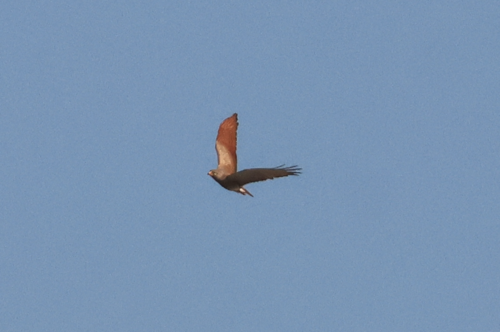
Rufous-winged Buzzard (Butastur liventer) Rufous-winged Buzzard
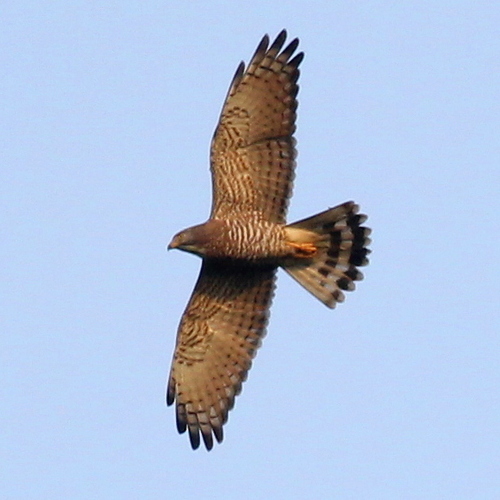
Grey-faced Buzzard (Butastur indicus) Grey-faced Buzzard

Media

Loading…

In short

The most reliable field mark between Rufous-winged Buzzard and Grey-faced Buzzard is the combination of tail and underpart pattern: Rufous-winged Buzzard shows a bright rufous uppertail and mostly grey underparts, while Grey-faced Buzzard has a barred brown tail and white underparts with bold brown bars. Juveniles of both can be confusing, but the Rufous-winged is always rufous-toned above and lacks the Grey-faced's white throat and dark moustache. In flight, note the Rufous-winged's rufous-chestnut upperwings and tail from above, versus the Grey-faced's ashy brown barred tail and more translucent, pointed wings. Both are similar in size and shape, but context and subtle plumage cues are key.

Identification tips

  1. Tail color and pattern (all ages): Rufous-winged Buzzard always has a bright rufous uppertail, visible both perched and in flight. Grey-faced Buzzard has an ashy brown tail with horizontal bars; never rufous.
  2. Underpart barring (adult and juvenile): Grey-faced Buzzard shows bold brown bars on white underparts and underwings, especially in adults and older juveniles. Rufous-winged Buzzard has grey underparts with some streaking but lacks strong barring.
  3. Throat and face pattern (adult and juvenile): Grey-faced Buzzard has a white throat with a dark moustache and mesial stripe, even in juveniles. Rufous-winged lacks the white throat and moustache, showing a more uniform grey or brown-grey head.
  4. Upperwing and flight feather color (in flight): Rufous-winged Buzzard shows rufous-chestnut flight feathers from above, contrasting with the greyish body. Grey-faced Buzzard's upperwings are brown, and the wings look more translucent and pointed in flight.
  5. Supercilium (juvenile): Both juveniles have a white supercilium, but in Rufous-winged it is set on a browner, duller head, while in Grey-faced the face is more patterned and contrasts with the white throat.
  6. Underwing coverts (in flight): Rufous-winged Buzzard has white underwing coverts contrasting with greyish flight feathers. Grey-faced Buzzard's underwings are barred, matching the underparts.
  7. Size and structure: Both are similar in size, but Grey-faced can appear slightly larger and longer-winged. Wing shape is more pointed and narrow in Grey-faced, especially noticeable in flight.
  8. Tail shape: Both have similar tail shapes, but the color and barring are more useful than shape.
  9. Habitat and range: If seen in Indochina, Java, or Sulawesi in forest or second growth, Rufous-winged is more likely. In northern Asia or during migration/winter in open habitats, Grey-faced is more likely.
  10. Seasonal context: Grey-faced Buzzard is migratory; large numbers in migration season or in non-breeding areas suggest this species. Rufous-winged is resident and less likely to be seen in flocks.
  11. Voice: Rufous-winged gives a shrill 'pit-piu' call; Grey-faced's call is not distinctive in these notes.
  12. Head color: Rufous-winged has a grey head (adult) or brown-grey (juvenile); Grey-faced has a grey head and neck, but with a more contrasting white throat and dark facial markings.
  13. Uppertail color (perched): Even when perched, the rufous uppertail of Rufous-winged can be a clincher if visible.
  14. Plumage tone: Rufous-winged is rufous-grey above, never as brown as Grey-faced, which is brown above with ashy tones on the tail.
  15. Pitfalls: Juvenile Rufous-winged can look dull and brown, but always lacks the strong barring and facial pattern of Grey-faced. In poor light, check for the tail color and underpart pattern before relying on overall tone.

Size

Rufous-winged Buzzard is slightly smaller, measuring 38–43 cm in length, while Grey-faced Buzzard is 41–46 cm. Both are small raptors with similar proportions, so size alone is not a reliable separator in the field. Both sexes are similar in size within each species. [wikipedia]

Plumage

Juveniles: Rufous-winged Buzzard juveniles are duller and browner than adults, with a brown-grey head and a white supercilium, but still show rufous tones on the upperparts and tail. Grey-faced Buzzard juveniles are brown and mottled above, pale below with brown streaks, and have a broad white supercilium and brown face. Both can look similar at a distance, but the Rufous-winged always has a rufous uppertail and lacks the bold brown barring on the underparts typical of Grey-faced.

Adults: Rufous-winged Buzzard adults have a grey head and underparts with streaking, rufous-grey upperparts, and a bright rufous uppertail. In flight, they show rufous-chestnut flight feathers above, grey body and white underwing coverts below. Grey-faced Buzzard adults have a grey head, breast and neck, white throat, dark moustache and mesial stripe, brown back and upperwings, and brown-barred white underparts and underwings. Their tail is ashy brown with horizontal bars, and the wings are pointed and narrow, appearing translucent in flight. The Rufous-winged's rufous tail and upperwing contrast with the Grey-faced's ashy brown and barred pattern. Both are monomorphic.

Behaviour

Both species are typical buzzards, often seen soaring or perched in open areas near forest edges. The Grey-faced Buzzard is migratory and may be seen in flocks during migration, while Rufous-winged is a resident and more often solitary or in pairs. Flight style is similar, but Grey-faced may appear more slender-winged and agile due to its pointed wings.

Habitat

Rufous-winged Buzzard is a resident of deciduous forests and second growth up to 800 m in Indochina, Java, and Sulawesi. Grey-faced Buzzard breeds in Manchuria, Korea, and Japan, and winters in Southeast Asia. In winter, their ranges can overlap, but Rufous-winged is more tied to forested habitats, while Grey-faced may be seen in a wider variety of open and edge habitats during migration and winter.

Voice

Rufous-winged Buzzard gives a shrill 'pit-piu' call. No distinctive vocalization is noted for Grey-faced Buzzard in these sources, so voice is not a reliable separator.

Submit a better description

Use the same sections as the comparison. Your text is published immediately.

The most reliable field mark between Rufous-winged Buzzard and Grey-faced Buzzard is the combination of tail and underpart pattern: Rufous-winged Buzzard shows a bright rufous uppertail and mostly grey underparts, while Grey-faced Buzzard has a barred brown tail and white underparts with bold brown bars. Juveniles of both can be confusing, but the Rufous-winged is always rufous-toned above and lacks the Grey-faced's white throat and dark moustache. In flight, note the Rufous-winged's rufous-chestnut upperwings and tail from above, versus the Grey-faced's ashy brown barred tail and more translucent, pointed wings. Both are similar in size and shape, but context and subtle plumage cues are key.

  1. Tail color and pattern (all ages): Rufous-winged Buzzard always has a bright rufous uppertail, visible both perched and in flight. Grey-faced Buzzard has an ashy brown tail with horizontal bars; never rufous.
  2. Underpart barring (adult and juvenile): Grey-faced Buzzard shows bold brown bars on white underparts and underwings, especially in adults and older juveniles. Rufous-winged Buzzard has grey underparts with some streaking but lacks strong barring.
  3. Throat and face pattern (adult and juvenile): Grey-faced Buzzard has a white throat with a dark moustache and mesial stripe, even in juveniles. Rufous-winged lacks the white throat and moustache, showing a more uniform grey or brown-grey head.
  4. Upperwing and flight feather color (in flight): Rufous-winged Buzzard shows rufous-chestnut flight feathers from above, contrasting with the greyish body. Grey-faced Buzzard's upperwings are brown, and the wings look more translucent and pointed in flight.
  5. Supercilium (juvenile): Both juveniles have a white supercilium, but in Rufous-winged it is set on a browner, duller head, while in Grey-faced the face is more patterned and contrasts with the white throat.
  6. Underwing coverts (in flight): Rufous-winged Buzzard has white underwing coverts contrasting with greyish flight feathers. Grey-faced Buzzard's underwings are barred, matching the underparts.
  7. Size and structure: Both are similar in size, but Grey-faced can appear slightly larger and longer-winged. Wing shape is more pointed and narrow in Grey-faced, especially noticeable in flight.
  8. Tail shape: Both have similar tail shapes, but the color and barring are more useful than shape.
  9. Habitat and range: If seen in Indochina, Java, or Sulawesi in forest or second growth, Rufous-winged is more likely. In northern Asia or during migration/winter in open habitats, Grey-faced is more likely.
  10. Seasonal context: Grey-faced Buzzard is migratory; large numbers in migration season or in non-breeding areas suggest this species. Rufous-winged is resident and less likely to be seen in flocks.
  11. Voice: Rufous-winged gives a shrill 'pit-piu' call; Grey-faced's call is not distinctive in these notes.
  12. Head color: Rufous-winged has a grey head (adult) or brown-grey (juvenile); Grey-faced has a grey head and neck, but with a more contrasting white throat and dark facial markings.
  13. Uppertail color (perched): Even when perched, the rufous uppertail of Rufous-winged can be a clincher if visible.
  14. Plumage tone: Rufous-winged is rufous-grey above, never as brown as Grey-faced, which is brown above with ashy tones on the tail.
  15. Pitfalls: Juvenile Rufous-winged can look dull and brown, but always lacks the strong barring and facial pattern of Grey-faced. In poor light, check for the tail color and underpart pattern before relying on overall tone.

Rufous-winged Buzzard is slightly smaller, measuring 38–43 cm in length, while Grey-faced Buzzard is 41–46 cm. Both are small raptors with similar proportions, so size alone is not a reliable separator in the field. Both sexes are similar in size within each species. [wikipedia]

Juveniles: Rufous-winged Buzzard juveniles are duller and browner than adults, with a brown-grey head and a white supercilium, but still show rufous tones on the upperparts and tail. Grey-faced Buzzard juveniles are brown and mottled above, pale below with brown streaks, and have a broad white supercilium and brown face. Both can look similar at a distance, but the Rufous-winged always has a rufous uppertail and lacks the bold brown barring on the underparts typical of Grey-faced.

Adults: Rufous-winged Buzzard adults have a grey head and underparts with streaking, rufous-grey upperparts, and a bright rufous uppertail. In flight, they show rufous-chestnut flight feathers above, grey body and white underwing coverts below. Grey-faced Buzzard adults have a grey head, breast and neck, white throat, dark moustache and mesial stripe, brown back and upperwings, and brown-barred white underparts and underwings. Their tail is ashy brown with horizontal bars, and the wings are pointed and narrow, appearing translucent in flight. The Rufous-winged's rufous tail and upperwing contrast with the Grey-faced's ashy brown and barred pattern. Both are monomorphic.

Both species are typical buzzards, often seen soaring or perched in open areas near forest edges. The Grey-faced Buzzard is migratory and may be seen in flocks during migration, while Rufous-winged is a resident and more often solitary or in pairs. Flight style is similar, but Grey-faced may appear more slender-winged and agile due to its pointed wings.

Rufous-winged Buzzard is a resident of deciduous forests and second growth up to 800 m in Indochina, Java, and Sulawesi. Grey-faced Buzzard breeds in Manchuria, Korea, and Japan, and winters in Southeast Asia. In winter, their ranges can overlap, but Rufous-winged is more tied to forested habitats, while Grey-faced may be seen in a wider variety of open and edge habitats during migration and winter.

Rufous-winged Buzzard gives a shrill 'pit-piu' call. No distinctive vocalization is noted for Grey-faced Buzzard in these sources, so voice is not a reliable separator.

Discard your changes?

You have unsaved edits. If you leave now, those changes will be lost.

Rufous-winged Buzzard · Grey-faced Buzzard · My Tricky Birds