

Sclater's Crowned-Pigeon vs Victoria Crowned-Pigeon
Goura sclaterii versus Goura victoria
Play a quiz with Sclater's Crowned-Pigeon and Victoria Crowned-Pigeon
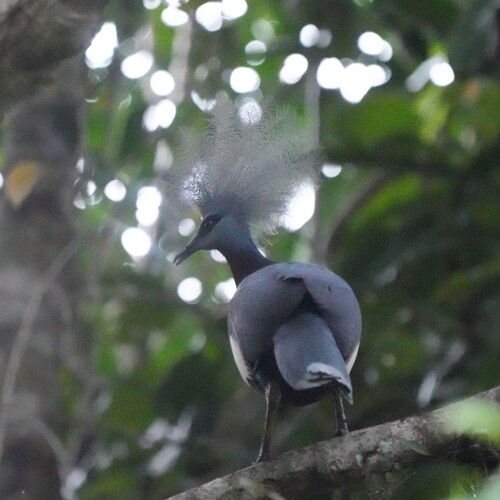 Sclater's Crowned-Pigeon
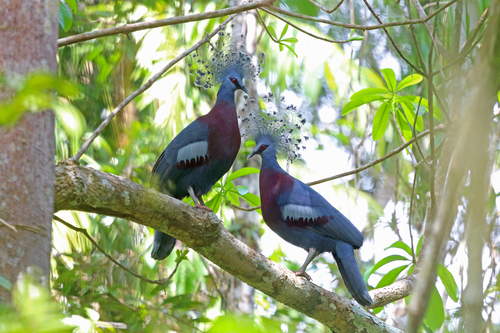 Victoria Crowned-Pigeon
In short
The most reliable way to separate Sclater's Crowned-Pigeon from Victoria Crowned-Pigeon is by the crest: Victoria always shows prominent white tips on its lacy blue crest, while Sclater's has a similar crest but lacks any white. Both are huge, ground-dwelling pigeons with maroon breasts and red eyes, but Victoria is slightly larger and has a distinctive pale blue wing bar with maroon tips, as well as a small black mask on the face. In the field, pay close attention to the crest and wing pattern, especially if the birds are perched or walking, as both species are terrestrial and rarely fly unless disturbed.
Identification tips
- Crest tips (all ages): Look for white tips on the lacy blue crest—present only in Victoria Crowned-Pigeon. Sclater's has a similar crest but always lacks white.
- Wing bar (adults): On perched or walking birds, check for a pale blue wing bar with maroon-tipped feathers on the coverts—distinct in Victoria, absent in Sclater's.
- Facial mask: Victoria shows a small black mask around the eye, which Sclater's lacks. This is subtle but visible at close range.
- Overall coloration: Both are bluish-grey with maroon breasts, but Victoria may appear slightly deeper blue and with a purple-maroon chest, while Sclater's is more uniformly bluish-grey with a very deep maroon breast. This is variable and not always reliable.
- Size: Victoria is marginally larger and bulkier, but size overlap is significant and posture can mislead—use only as supporting evidence.
- Iris color: Both have red irises; this does not help in separation.
- Flight behavior: Both species flush upward with a loud wing clap and may perch for a long time after disturbance. Flight style is not diagnostic.
- Group behavior: Victoria is often seen in small groups or pairs, but Sclater's may also be gregarious—do not rely on flocking for ID.
- Habitat: If you know your location, Sclater's is only in southern New Guinea lowlands, Victoria in the north and nearby islands. They do not overlap.
- Vocalizations: Both have deep, resonant calls; Victoria's 'whooping' call is distinctive but not always heard. Do not rely on voice alone for separation.
- Sex and age: Both sexes are similar in both species. No reliable sex or age-based differences are described for field separation.
- Juvenile/immature birds: No unique juvenile or immature plumage marks are described; use crest and wing bar as for adults.
- Pitfalls: In poor light or at distance, the white crest tips of Victoria may be missed, and the wing bar may be obscured by posture. Always try for a clear view of the crest and wing coverts.
- Captive birds: Both species are kept in captivity; range is not always helpful in zoos or collections—rely on plumage features.
- Summary for quick check: If you see white-tipped crest feathers and a pale blue wing bar with maroon tips, it's Victoria. If the crest is blue and lacy but lacks white, and the wing is uniformly bluish-grey, it's Sclater's.
Size
Victoria Crowned-Pigeon is the largest living pigeon, averaging 73–75 cm in length and 2.39 kg in mass, with some individuals exceeding 80 cm and 3.5 kg. Sclater's Crowned-Pigeon is slightly smaller, at 66–73 cm and 2.00–2.24 kg. Both species are massive compared to other pigeons, but in direct comparison, Victoria is bulkier and longer. However, size alone is not always reliable in the field due to overlap and posture.
Plumage
- Crest (all ages): Victoria Crowned-Pigeon always shows white-tipped lacy blue crest feathers, a unique and instantly recognizable feature. Sclater's Crowned-Pigeon has a similar blue lacy crest but never with white tips.
- Wing coverts (adults): Victoria has a row of paler blue-gray feathers with maroon tips on the wing coverts, forming a distinct pale blue wing bar. Sclater's lacks this pattern and is more uniformly bluish-gray above.
- Breast (adults): Both have deep maroon breasts, but Victoria's is described as deep purple-maroon, while Sclater's is very deep maroon; this is subtle and not always reliable.
- Face (adults): Victoria shows a small black mask around the eye, which Sclater's lacks.
- Iris (adults): Both species have red irises.
- Juvenile/immature plumage: No specific juvenile or immature wing pattern differences are described in the sources; crest and wing bar remain the best marks at all ages.
Behaviour
Both species are terrestrial and walk with an unhurried gait along the forest floor, foraging for fallen fruit. Victoria Crowned-Pigeon is noted for being gregarious, usually in pairs or small groups, and is somewhat shy in the wild but can be quietly approached. Both species flush upward into trees when disturbed and may remain perched for some time. Victoria is known for aggressive displays among males, puffing up the chest and raising wings, but this is not unique among crowned pigeons. In flight, both produce a loud wing clap.
Habitat
Both species are restricted to lowland forests of New Guinea, but Sclater's is confined to the southern lowlands, while Victoria is found in the north and on nearby islands. Their habitats do not overlap in the wild. Both prefer dense forest and are rarely seen far from cover.
Voice
Victoria Crowned-Pigeon is noted for its deep 'whooping' calls (hoota-hoota-hoota), a resounding 'whup-up' territorial call, and a deep, muffled contact call (ummm or hmmm). Sclater's is not described in detail, but all crowned pigeons have similar deep, resonant calls. Vocalizations are not considered reliably diagnostic between these two in the field.
Sclater's Crowned-Pigeon · Victoria Crowned-Pigeon · My Tricky Birds