

Semicollared Flycatcher vs European Pied Flycatcher
Ficedula semitorquata versus Ficedula hypoleuca
Play a quiz with Semicollared Flycatcher and European Pied Flycatcher
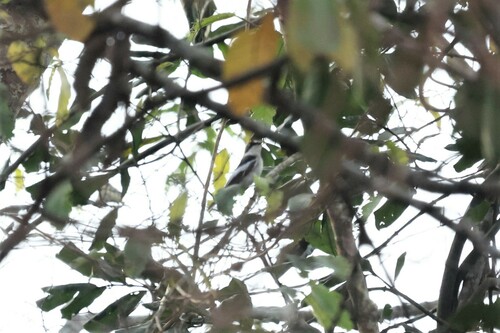 Semicollared Flycatcher
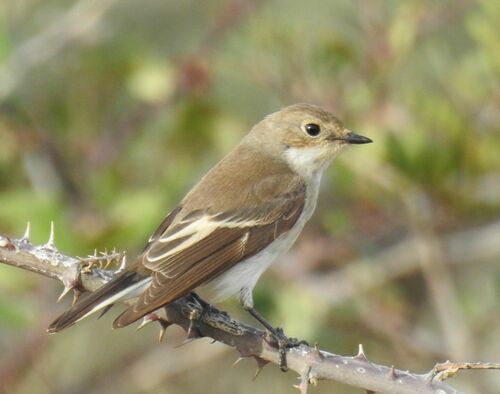 European Pied Flycatcher
In short
The most reliable field mark to separate Semicollared Flycatcher from European Pied Flycatcher is the presence of a distinct white bar on the median coverts, visible in most plumages of Semicollared but typically absent in Pied. Adult breeding males of Semicollared also show a more extensive white half-collar and a larger white forehead patch than Pied, as well as a pale grey rump. However, non-breeding, female, and juvenile birds of both species are very similar and can be extremely difficult to distinguish, especially in the field. Careful attention to the median covert bar and the extent of white on the tail and forehead is essential, but some individuals remain unidentifiable without close or in-hand views.
Identification tips
- White median covert bar: Look for a narrow white bar on the median coverts, especially in non-breeding, female, and juvenile birds. This is typical of Semicollared but usually absent in Pied, except for some first-winters.
- Extent of white collar: In breeding males, Semicollared shows a more extensive white half-collar reaching further back on the neck than Pied. Pied's collar is usually restricted and less obvious.
- Forehead patch size: Semicollared males have a larger white forehead patch than Pied, except for the Iberian subspecies of Pied, which can overlap. In most of Europe, a large patch favors Semicollared.
- Pale grey rump: Breeding male Semicollared often shows a pale grey rump, while Pied's rump is usually darker. Iberian Pied can also have a pale rump, so use with caution in southwest Europe.
- White on tail sides: Both species show white on the tail sides, but it is more extensive in Semicollared. This is best judged in flight or when the tail is spread.
- Wing patch: Both species have a large white wing patch in breeding males, but Semicollared's is often larger and more striking.
- Tertial edges: In non-breeding and female-type birds, Semicollared has narrower white edges to the tertials than Pied, but this is a subtle mark and requires good views.
- Bill shape: Both have a broad, pointed bill typical of flycatchers; not a reliable separator.
- Song: Semicollared's song is intermediate between Collared and Pied, with slow, strained whistles and some rhythm. Pied's is more rhythmic and less whistled. Use only if familiar with both species' songs.
- Habitat: If in montane deciduous woodland in southeastern Europe, consider Semicollared. In most of Europe, especially lowlands and west, Pied is much more likely.
- Season and range: Semicollared is a rare vagrant in western Europe; Pied is common. Always consider location and time of year.
- Hybrid confusion: Both can hybridize with Collared Flycatcher, but hybrids are rare and usually not a field concern when comparing these two.
- Sex and age: Female and juvenile birds are extremely similar; only the covert bar and subtle tertial/wing differences are helpful, and some individuals may not be safely identified in the field.
- Flight views: In flight, look for the extent of white on the tail and the presence of the median covert bar. These are often the best clues for non-males.
- Pitfalls: Beware of first-winter Pied Flycatchers, which can show a white covert bar and overlap with Semicollared. Use a combination of marks and do not rely on a single feature.
Size
Both species are essentially the same size, with a length of 12–13.5 cm. The European Pied Flycatcher has a documented average body mass of 12.0 g, but there is no evidence that Semicollared is consistently larger or smaller in the field. Structural differences are subtle and not reliably diagnostic at a distance.
Plumage
-
Juvenile and non-breeding/female-type plumages: Both species are pale brown above and white below, making them very similar. Semicollared Flycatcher often shows a narrow white bar on the median coverts in these plumages, which is rare in Pied except in some first-winters. The tertial edges are narrower in Semicollared, but this is subtle. Both can show white on the tail sides, but this is more extensive in Semicollared.
-
Adult breeding males: Semicollared is black above and white below, with a white half-collar that extends further back than in Pied, a large white forehead patch (larger than Pied except for the Iberian subspecies), a large white wing patch, and a pale grey rump. Pied breeding males are also black and white, but the white collar is much less extensive, the forehead patch is smaller (except in Iberian birds), and the rump is usually darker. Both have white on the tail sides, but it is more extensive in Semicollared.
Behaviour
Both species are typical aerial insectivores, sallying from perches to catch insects. Semicollared Flycatcher is noted for taking insects more exclusively in flight, while Pied occasionally hunts caterpillars among foliage. This behavioral difference is subtle and not usually diagnostic in the field.
Habitat
Semicollared Flycatcher breeds in montane deciduous forests, especially with oak and hornbeam, in southeastern Europe and northwest Iran, and is a rare vagrant elsewhere. European Pied Flycatcher is widespread across most of Europe and the Western Palearctic, breeding in a variety of woodland habitats. Overlap is possible in southeastern Europe, but Pied is much more likely in lowland and western European settings.
Voice
The song of Semicollared Flycatcher is intermediate between Collared and Pied Flycatchers, with slow, strained whistles and some rhythmic elements. Pied Flycatcher has a distinctive, more rhythmic song. However, song differences are subtle and not always reliable for separation, especially for inexperienced listeners.
Semicollared Flycatcher · European Pied Flycatcher · My Tricky Birds