

Snowy Albatross vs Antipodean Albatross
Diomedea exulans versus Diomedea antipodensis
Play a quiz with Snowy Albatross and Antipodean Albatross
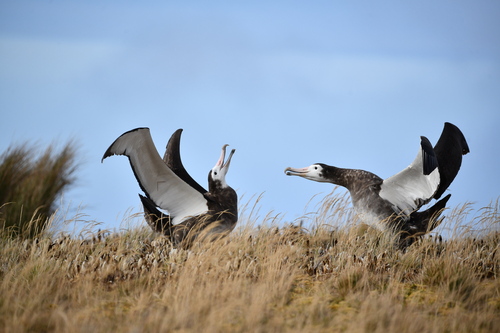 Snowy Albatross
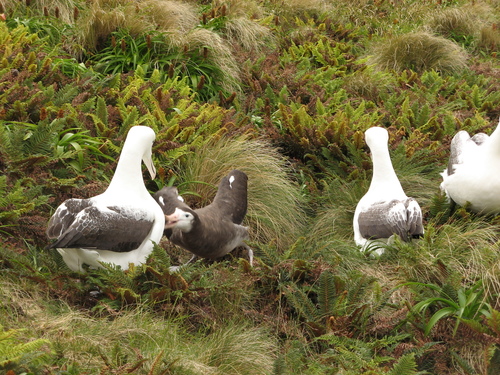 Antipodean Albatross
In short
The most reliable field mark between Snowy Albatross and Antipodean Albatross is the amount of white on the wings and body in adults: Snowy Albatross adults are much whiter overall, especially on the upperwings, while Antipodean Albatrosses retain more brown, particularly in females and immatures. Juveniles and young birds of both species can be very similar, but Antipodean Albatrosses remain darker for life, whereas Snowy Albatrosses become progressively whiter with age. Size is also a clue, with Snowy Albatross being the largest albatross, but this is hard to judge at sea. Bill color is mostly pink in both, but Antipodean can show a dusky tip, especially in immatures and females.
Identification tips
- Overall whiteness (adults): Adult Snowy Albatrosses are much whiter above and below, especially males, with only black on the wingtips and trailing edge. Antipodean adults, even males, retain more brown on the upperparts and wings.
- Brown upperparts (Antipodean): Female and immature Antipodean Albatrosses have extensive brown on the back, upperwings, and a brown breast band (nominate race), while Snowy Albatrosses lose most brown as they age.
- Underwing pattern: Antipodean Albatross has a white underwing with a dark tip; Snowy Albatross adults have cleaner white underwings, with black mainly at the tips and trailing edge.
- Bill color: Both species have pink bills, but Antipodean (especially immatures and females) can show a dusky tip or dark cutting edge, which is rare in Snowy Albatross.
- Juvenile confusion: Juvenile Antipodean and Snowy Albatrosses are very similar, both being mostly chocolate brown above. Separation at this age is extremely difficult and often not possible in the field.
- Progression with age: Snowy Albatrosses become progressively whiter as they mature, while Antipodean Albatrosses remain darker for life. If you see a very white bird, especially with minimal black on the upperwing, it is almost certainly a mature Snowy Albatross.
- Sex differences: In both species, males are whiter than females, but the contrast is stronger in Snowy Albatross. Female Antipodean Albatrosses are especially brown above and on the breast.
- Size: Snowy Albatross is larger and longer-winged, but this is hard to judge unless both are seen together. Use as supporting evidence only.
- Face and throat: Antipodean Albatross has a white face, throat, lower breast, and belly, but so does Snowy Albatross; not a strong separator.
- Tail and cap: Male Antipodean Albatrosses have a darker cap and tail than Snowy, but this is subtle and best used in combination with other marks.
- Bill shape: Both have similar bill shapes; structure is not a reliable separator.
- Context: If seen at a known breeding colony, check the local species list, but at sea, rely on plumage and structure.
- Display behavior: Not useful for separation; both species show similar courtship displays.
- Pitfalls: Beware of immature Snowy Albatrosses, which can look very similar to Antipodean adults. Only very white birds can be confidently called Snowy; browner birds may be either species unless other marks are visible.
- Lighting: Bill color differences (dusky tip in Antipodean) are most obvious in good light or when the bill is seen in profile; backlighting can exaggerate the dark cutting edge.
Size
Snowy Albatross is the largest albatross, with an average body mass of 8190 g [wikidata] and a wingspan that can exceed 3 m. Antipodean Albatross is smaller overall, with a length of about 110 cm, but precise mass data is not provided. In the field, size difference is subtle unless both are seen together, but Snowy Albatross often appears bulkier and longer-winged, especially in adult males. Females of both species are smaller than males, but the difference is more pronounced in Snowy Albatross.
Plumage
- Juveniles/immatures: Both species start out dark brown, especially on the upperparts and wings. Juvenile Antipodean Albatrosses are very similar to young Snowy Albatrosses, making separation difficult at this age.
- Adults: Snowy Albatrosses become much whiter with age, especially males, who show mostly white upperwings with only black tips and trailing edges. Adult Antipodean Albatrosses, even males, never reach the same degree of whiteness; females are distinctly browner, with brown upperparts, brown undertail coverts, and a brown breast band (in the nominate race).
- Underwing: Both have white underwings, but Antipodean Albatross shows a dark tip, while Snowy Albatross adults have cleaner white underwings with black limited to the tips and trailing edge.
- Bill: Both have a pink bill, but Antipodean (especially immatures and females) can show a dusky tip or even a dark cutting edge, which is rare in Snowy Albatross.
Behaviour
Both species are classic oceanic wanderers, soaring for hours without flapping thanks to their long wings. Snowy Albatross, with its larger wingspan, may appear even more buoyant and effortless in flight. Courtship behaviors are similar, involving wing spreading, bill clapping, and vocalizations. Both breed in loose colonies on remote Southern Ocean islands.
Habitat
Both species inhabit the Southern Ocean and breed on isolated island groups. There is significant overlap in range, especially at sea, so habitat is not a reliable field mark for separation. Breeding sites differ by island group, but this is not useful for field identification unless the observer is at a known colony.