

Sooty Albatross vs Light-mantled Albatross
Phoebetria fusca versus Phoebetria palpebrata
Play a quiz with Sooty Albatross and Light-mantled Albatross
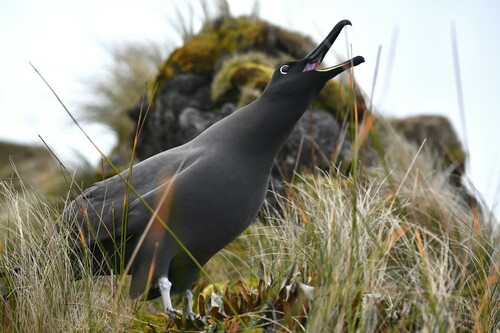 Sooty Albatross
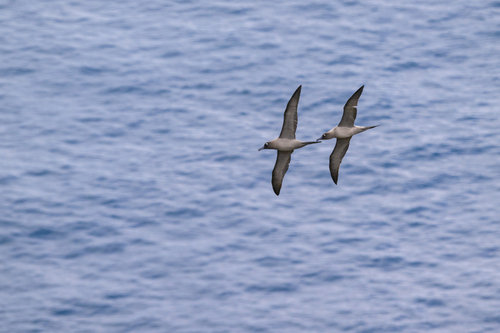 Light-mantled Albatross
In short
The most reliable field mark between Sooty Albatross and Light-mantled Albatross is the mantle and back color: Sooty Albatross is uniformly sooty-brown to sooty-black, while Light-mantled Albatross shows a distinctly paler, silvery-grey mantle and back contrasting with a darker head and underparts. Both species share a slender, long-winged silhouette and similar size, but the Light-mantled's two-tone upperparts are visible even at distance, especially in flight. Eye-ring and bill color details can help at close range, but beware that both species can look very dark in poor light or from below. Juvenile and immature plumages are not strongly differentiated in Sooty Albatross, so mantle color remains the best separation in all ages.
Identification tips
- Pale mantle vs uniform darkness: The single best field mark is the mantle and back color. Light-mantled Albatross always shows a pale, silvery-grey mantle and back contrasting with a dark head and underparts, visible at distance and in all ages. Sooty Albatross is uniformly sooty-brown to sooty-black, with no pale mantle.
- Eye-ring: Sooty Albatross has a bold white ring around almost the entire eye (except the inner corner), visible at close range. Light-mantled has only a thin, short-feathered grey crescent behind the eye, much less conspicuous.
- Bill color: Sooty Albatross has a glossy black bill with a yellow to orange line along the lower jaw. Light-mantled's bill is black with a blue sulcus and a greyish-yellow line on the lower mandible. This is subtle and best seen in good light at close range.
- Head and underparts: Both species have darker heads, but Light-mantled's contrast with the pale mantle is more striking. Sooty's head is only slightly darker than the rest of the body.
- Upperwing and flight pattern: No distinctive age-specific upperwing marks are noted for either species; both have long, narrow wings. Focus on mantle color in flight.
- Juvenile/immature confusion: Immature Sooty Albatrosses look like adults after fledging, so mantle color remains the key mark. Light-mantled immatures also retain the pale mantle.
- Perched birds: On land, Sooty Albatross appears uniformly dark with a white eye-ring; Light-mantled shows the pale mantle and less obvious eye crescent.
- Behavior at colony: Sooty Albatross is shy and less demonstrative; Light-mantled may be seen in more elaborate aerial and tail displays during courtship.
- Vocalizations: If heard, Sooty's 'pee-oo' sky call is distinctive, but Light-mantled's trumpet-like calls and bill snapping are more likely during courtship or threat displays.
- Habitat and context: Both breed on cliffs in the southern oceans; Sooty may nest singly or in small groups, Light-mantled is also colonial. Not a reliable separator.
- Size: Both are similar in size and proportions; do not rely on size for identification.
- Lighting pitfalls: In poor light or from below, both can appear uniformly dark; always look for the mantle contrast in side or top views.
- At sea: Focus on the two-tone (Light-mantled) vs uniform (Sooty) appearance, especially in gliding birds seen from above or the side.
- Bill details: Only use bill color if you have excellent views; otherwise, prioritize plumage.
- Sex and season: No strong sexual dimorphism or seasonal plumage changes are noted for either species; identification marks apply year-round.
Size
Both species are medium-sized albatrosses and are very close in length and wingspan, making size an unreliable separator in the field. The Light-mantled Albatross averages slightly heavier (body mass ~3150 g [wikidata]) than Sooty Albatross (no precise mass given, but described as about 2.5 kg for adults [wikipedia]), but this difference is subtle and not easily judged at sea. Males of both species may be marginally larger than females, but this is not a practical field mark.
Plumage
- Juvenile/immature plumage: Sooty Albatross immatures look nearly identical to adults after losing down, lacking any obvious pale mantle or distinctive upperwing pattern. Light-mantled Albatross, even as immatures, shows the characteristic pale grey mantle and back contrasting with the darker head and underparts. No age-specific upperwing pattern (like triangles or W-shapes) is noted for either species, so mantle color is the key mark at all ages.
- Adult plumage: Sooty Albatross is uniformly sooty-brown to sooty-black, sometimes with a slightly darker head and tail, and a prominent white eye-ring. Light-mantled Albatross is darker on the head and underparts but has a paler, silvery-grey mantle and back, giving a two-tone appearance reminiscent of a Siamese cat. The Light-mantled's eye is partly encircled by a thin, short-feathered grey crescent, less obvious than the Sooty's bold white ring. Bill color differs subtly: Sooty has a glossy black bill with a yellow to orange line on the lower jaw, while Light-mantled has a black bill with a blue sulcus and a greyish-yellow line along the lower mandible.
Behaviour
Both species are highly aerial, often seen gliding low over the ocean with long, narrow wings. Sooty Albatross is noted for synchronized flight patterns and shy, reserved interactions, especially at breeding colonies. Light-mantled Albatross is more likely to perform aerial displays and formation flying during courtship, and uses its tail more in display than Sooty. Both species breed on steep cliffs, but Sooty may nest singly or in small groups, while Light-mantled is also colonial. At sea, behavior is similar and not reliably diagnostic.
Habitat
Both species are pelagic, ranging over the southern oceans and returning to breed on remote islands with steep cliffs. Sooty Albatross is found in the southern Atlantic, southern Indian, and Southern Oceans, breeding on cliff ledges or steep slopes, often in small colonies or singly. Light-mantled Albatross shares much of this range and habitat, breeding on similar cliffy islands. Habitat alone does not reliably separate the two, but Sooty may be slightly more likely to nest in smaller groups or alone.
Voice
Vocalizations are not a strong separator in the field. Sooty Albatross is known for loud, repeating 'pee-oo' sky calls at colonies. Light-mantled Albatross has a loud, shrill, trumpet-like call and can snap its bill or give a throaty 'gaaaa' when threatened. Courtship calls and aerial displays are more prominent in Light-mantled, but at sea, both are generally silent and difficult to distinguish by voice.