

Sooty Gull vs White-eyed Gull
Ichthyaetus hemprichii versus Ichthyaetus leucophthalmus
Play a quiz with Sooty Gull and White-eyed Gull
 Sooty Gull
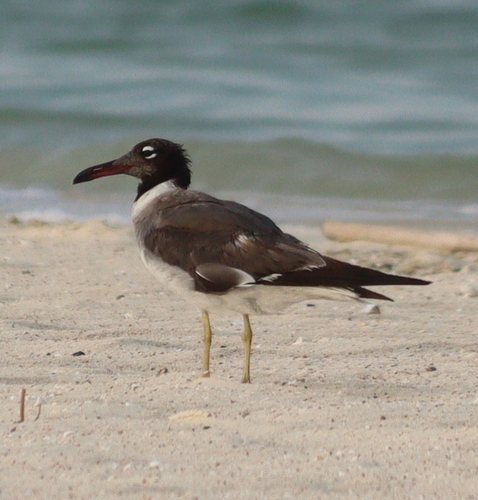 White-eyed Gull
In short
The most reliable field mark between Sooty Gull and White-eyed Gull is the head pattern and bill color in adults: White-eyed Gull shows a striking black hood (breeding) bordered by a white bar and a deep red bill with a black tip, while Sooty Gull lacks the hood and has a more uniformly dark bill. Juvenile and immature plumages differ strongly: juvenile White-eyed Gulls are chocolate-brown with pale-fringed upperparts and a black tail, while Sooty Gull immatures are less distinctly marked. White-eyed Gull is smaller and more delicate, with a longer, thinner bill and yellow legs (brightest in breeding adults). Sooty Gull is more widespread, while White-eyed Gull is restricted to the Red Sea. In flight, check for the White-eyed Gull's white trailing edge to the secondaries and black underwing, versus Sooty Gull's plainer wing pattern.
Identification tips
- Juvenile/immature plumage: Juvenile White-eyed Gulls are chocolate brown on head, neck, and breast, with broad pale fringes to upperparts and a black tail; Sooty Gull immatures are duller brownish-grey without strong pale fringes or chocolate tones. This is the most reliable mark for young birds.
- Flight pattern (all ages): White-eyed Gull shows a white trailing edge to the secondaries and a black underwing; Sooty Gull's wing is more uniformly dark and lacks the crisp white trailing edge. This is best seen in flight or when wings are spread.
- Bill structure: White-eyed Gull has a long, slender bill (black in immatures, deep red with black tip in adults); Sooty Gull's bill is heavier and more uniformly dark, lacking the red base and black tip contrast.
- Leg color: Adult White-eyed Gulls have bright yellow legs (dull in juveniles, brightest in breeding adults); Sooty Gull's leg color is not described as diagnostic, but is not bright yellow.
- Adult head pattern: Breeding White-eyed Gull has a full black hood bordered below by a white bar; Sooty Gull has a plain dark head without a hood or white border. Non-breeding White-eyed Gull's hood is flecked with white, but still contrasts with the rest of the head.
- Tail color: Adult White-eyed Gull has a white tail; juveniles have a black tail. Sooty Gull's tail is not as distinctly marked and does not show this strong contrast.
- Size and shape: White-eyed Gull is smaller, more delicate, and slender-billed; Sooty Gull is larger, bulkier, and heavier-billed. This is most apparent when both species are seen together.
- Eye-crescents: White-eyed Gull has conspicuous white eye-crescents at all ages (the 'white-eye' is not the iris but these crescents); Sooty Gull lacks this feature.
- Upperparts color: Adult White-eyed Gull has medium-dark grey upperparts; Sooty Gull's upperparts are darker and more uniform.
- Habitat and range: If observed outside the Red Sea, a 'White-eyed Gull' is almost certainly a misidentification; Sooty Gull is much more widespread.
- Bill color by age: Immature White-eyed Gulls have a black bill, while adults have a deep red bill with a black tip. Sooty Gull's bill is more uniformly dark at all ages.
- Underparts: Adult White-eyed Gull has a mid-grey breast and white underparts; Sooty Gull's underparts are less distinctly patterned.
- Colony context: White-eyed Gull is strictly colonial on Red Sea islands; Sooty Gull may nest solitarily or among other seabirds, especially in Africa.
- Seasonal change: White-eyed Gull acquires adult plumage at 2–3 years; Sooty Gull's age progression is less well described, so beware of intermediate birds.
- Pitfalls: Non-breeding White-eyed Gull may lose the solid black hood, but flecked white spots and white eye-crescents remain distinctive. Immature Sooty Gulls can appear brownish but lack the strong contrast and pale fringes of White-eyed Gull juveniles.
Size
White-eyed Gull is smaller and lighter than Sooty Gull, with a body mass around 330g [wikidata]. Sooty Gull is distinctly larger and bulkier overall (no precise mass available, but size difference is noted in field guides and community reports). White-eyed Gull also appears more slender and fine-billed, especially noticeable when the two species are seen together.
Plumage
Juvenile and immature plumages are the most diagnostic: juvenile White-eyed Gulls are chocolate brown on the head, neck, and breast, with brown upperparts and upperwings broadly fringed pale, and a black tail. In first winter, White-eyed Gulls start to show greyer feathering but retain a dark tail and lack the adult hood. Sooty Gull immatures are less well described but do not show the strong chocolate tones or pale fringes of White-eyed Gull; their upperparts and wings are duller and more uniform. Adult White-eyed Gulls in breeding plumage have a black hood that extends onto the upper throat and is bordered below by a narrow white bar, with medium-dark grey upperparts and a white trailing edge to the secondaries. Non-breeding adults have a hood flecked with white. Sooty Gull adults lack a hood, showing a plainer dark head and upperparts. In flight, White-eyed Gull shows a black underwing and white trailing edge to the secondaries, while Sooty Gull's wing pattern is less contrasting. The tail of White-eyed Gull is white in adults and black in juveniles, while Sooty Gull's tail is less distinctly marked.
Behaviour
Both species are coastal gulls, often seen scavenging or foraging along shorelines and islands. Sooty Gull may nest solitarily or in loose colonies, sometimes among other seabirds, while White-eyed Gull is more strictly colonial on Red Sea islands. Both species feed on fish, offal, and small marine animals, but White-eyed Gull is more restricted to the Red Sea and nearby coasts.
Habitat
Sooty Gull is widespread across the northwestern Indian Ocean, including the Red Sea, Persian Gulf, and coasts of East Africa, Arabia, and South Asia. White-eyed Gull is endemic to the Red Sea and adjacent coasts only. If seen outside the Red Sea, a 'White-eyed Gull' is almost certainly a misidentification. Sooty Gull can be found in a broader range of coastal habitats, including inshore coral islands and outer reefs, while White-eyed Gull is tightly linked to Red Sea islands.