
Sora vs Purple Gallinule
Porzana carolina versus Porphyrio martinica
Play a quiz with Sora and Purple Gallinule
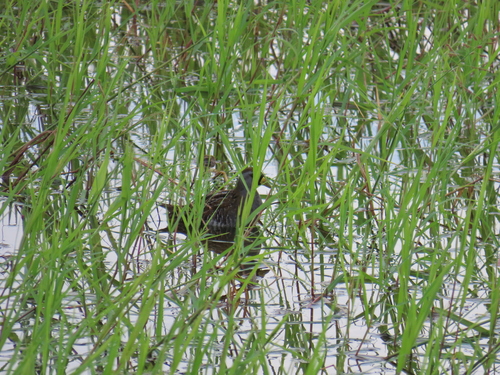 Sora
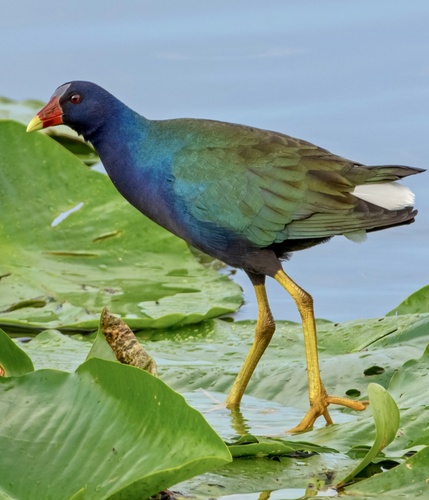 Purple Gallinule
In short
The most reliable field mark for separating Sora from Purple Gallinule is overall size and structure: Sora is a small, short-billed rail with a compact body, while Purple Gallinule is much larger, with a long, bright yellow leg and a striking red-and-yellow bill with a blue forehead shield. Immature gallinules are brownish but still show long legs and a pale shield, while young Soras are smaller, with a short yellow bill and lack the adult's black face. In flight, Purple Gallinule’s legs dangle and its wingspan is much broader. Sora is more likely to be seen skulking or walking near open water, while Purple Gallinule often clambers on floating vegetation. Voice and habitat can help, but size and structure are the fastest field clues.
Identification tips
- Size is the fastest clue: Purple Gallinule is much larger and heavier than Sora—if the bird looks chicken-sized or nearly as big as a Common Gallinule, it is not a Sora.
- Bill and face: Sora has a short, thick yellow bill with a black face and throat in adults; young birds have a pale face and buff breast. Purple Gallinule has a long, red-and-yellow bill with a pale blue shield on the forehead (adults), or a pale bill/shield in immatures. Even in poor light, the shield is a strong gallinule mark.
- Legs and feet: Purple Gallinule’s legs are bright yellow (adults) or brown-yellowish (immatures/juveniles), extremely long, and often visible as the bird walks atop vegetation or dangles them in flight. Sora’s legs are much shorter and less conspicuous.
- Plumage color: Adult Sora is brown above and blue-grey below, with black-and-white barred flanks; Purple Gallinule adult is iridescent purple-blue and green, with a red/yellow bill and blue shield. Immature gallinules are brown-bronze with hints of purple, while young Soras are brown with a whitish face and buff breast.
- Flank pattern: Sora (all ages) shows black-and-white barring on the flanks; Purple Gallinule (all ages) does not.
- Flight appearance: Purple Gallinule flies with legs dangling and a broad wingspan; Sora is compact in flight, with no obvious leg projection.
- Habitat use: Sora prefers dense marsh vegetation and is often heard rather than seen; Purple Gallinule is more likely to be seen walking on floating plants in open marshes.
- Voice: Sora’s loud, descending whinny is distinctive; gallinule is generally quiet and does not give a similar call.
- Face pattern in immatures: Young Sora lacks the adult’s black face but still has a short yellow bill and compact shape; immature gallinule has a pale bill/shield and longer legs.
- Under-tail coverts: Juvenile Purple Gallinule shows white under-tail coverts, which Sora lacks.
- Behavior: Gallinule often struts or displays with wings partly open, especially during courtship; Sora is more secretive and rarely displays.
- Seasonal context: Sora is a migrant in much of its range, especially in spring and fall; Purple Gallinule is more resident in the south but also migrates and can appear as a vagrant.
- Sexes similar in both: Neither species shows strong sexual dimorphism in plumage, so sex is not a reliable field mark.
- Common pitfalls: Immature gallinules can appear drab and brownish, but their size, leg length, and pale shield/bill separate them from Sora. Young Soras are never as large or long-legged as gallinules.
- When in doubt: Focus on size, leg length, and bill/face pattern—these are the most reliable marks across all ages and seasons.
Size
Purple Gallinule is dramatically larger and heavier than Sora. Purple Gallinule averages around 236 g (range 141–305 g) and measures 26–37 cm in length, with a wingspan of 50–61 cm. Sora is much smaller, at 19–30 cm long, weighing 49–112 g, and with a wingspan of 35–40 cm. The gallinule is not only heavier but also appears lankier and longer-legged, while Sora is compact and short-billed. Even immature gallinules are much bulkier than adult Soras.
Plumage
- Juvenile/Immature Sora: Young Soras lack the black facial markings of adults, instead showing a whitish face and buff breast, but retain the short yellow bill and small, compact body. Flanks are barred black and white, and upperparts are brown with dark markings. No distinctive upperwing pattern in flight is noted for Sora.
- Juvenile/Immature Purple Gallinule: Juveniles are light brown with green-bronze hints on wings and back, white under-tail coverts, and a pale bill and shield. Immatures are brown-bronze with some purple on the chest and pale bill/shield. Adults are unmistakable: purple-blue plumage with green/turquoise gloss, bright red-and-yellow bill, pale blue forehead shield, and bright yellow legs/feet. In low light, adults may look dusky, but the shield and leg color remain distinctive.
- Adults: Sora adults are brown above, blue-grey below, with a black face and throat, yellow bill, and black-and-white barred flanks. Purple Gallinule adults are much more colorful, with iridescent purple-blue and green plumage, red/yellow bill, blue shield, and yellow legs.
Behaviour
Sora is typically secretive, walking or swimming near the edges of marshes, often hidden in dense vegetation but sometimes seen near open water. Purple Gallinule is more likely to be seen clambering over floating vegetation, using its very long toes to walk atop lily pads and aquatic plants. In flight, gallinules are awkward, with legs dangling, and rarely fly far; Sora is also reluctant to fly but appears more compact and direct when flushed. Gallinules may be seen strutting or displaying with wings partly open, especially during courtship.
Habitat
Both species are found in marshes and wetlands, but Sora is widespread across North America, often in freshwater marshes with dense emergent vegetation. Purple Gallinule prefers the margins of lakes, rivers, and marshes with floating or emergent plants, especially in the southern U.S., Central and South America. Gallinules are more likely to be seen in open, floating vegetation, while Sora prefers denser cover and is less often seen in the open.
Voice
Sora gives a slow, whistled "ker-whee" or a descending, squeaky "whinny" that slows and drops in pitch. These calls are distinctive and often heard at dawn or dusk. Purple Gallinule is generally quieter and less likely to be detected by voice alone; its calls are not described in the provided notes, but they are not similar to Sora’s whinny. Thus, a loud descending whinny is a strong clue for Sora.