
Motmot

Spotted Crake vs Baillon's Crake

Porzana porzana versus Zapornia pusilla

Play a quiz with Spotted Crake and Baillon's Crake
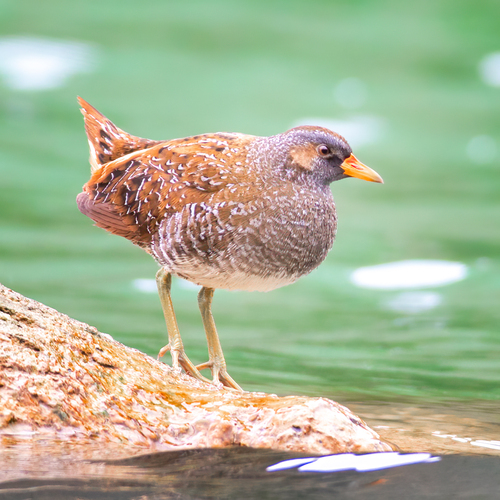
Spotted Crake (Porzana porzana) Spotted Crake
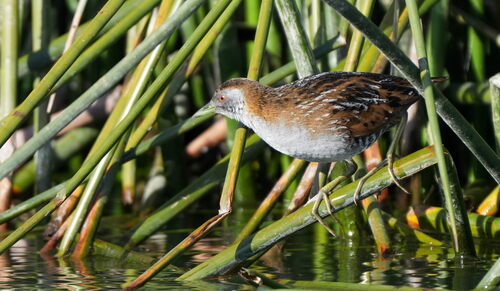
Baillon's Crake (Zapornia pusilla) Baillon's Crake

Media

Loading…

In short

The most reliable field mark to separate Spotted Crake from Baillon's Crake is the bill: Spotted Crake shows a yellow bill with a distinct red base, while Baillon's Crake has a yellow or green bill lacking any red. In addition, Spotted Crake is noticeably larger and heavier, with a bulkier build. Adults and immatures differ in flank and underpart pattern: Spotted Crake has bold white spots on the flanks and a blue-grey (adult) or brown (immature) breast, while Baillon's Crake shows black-and-white barring on the flanks and undertail, and a paler blue-grey breast. Both species can appear similar in poor views, but careful attention to bill color, size, and flank pattern will usually resolve confusion, especially in binocular views.

Identification tips

  1. Bill color: Spotted Crake has a yellow bill with a clear red base (all ages), while Baillon's Crake has a yellow or green bill with no red at the base. This is often visible even in poor light and is the most reliable single feature.
  2. Size and structure: Spotted Crake is much larger and heavier (80 g vs 35 g), with a bulkier, more robust appearance. Baillon's Crake is distinctly petite and delicate. Use this when you have a sense of scale or see both species in the same area.
  3. Flank pattern (adults and immatures): Spotted Crake shows bold white spots on the flanks, contrasting with the dark barring and blue-grey or brown breast. Baillon's Crake has black-and-white barring on the flanks and undertail, with no white spotting. This is a key mark at all ages except chicks.
  4. Breast and underparts (adults): Spotted Crake adults have a blue-grey breast, while Baillon's Crake adults have a paler blue-grey breast and throat, often appearing lighter and less contrasting.
  5. Breast and underparts (immatures): Immature Spotted Crake lacks the blue-grey, showing brown instead, but still has white flank spots. Immature Baillon's Crake is duller than adults but retains extensive black-and-white barring on the underparts.
  6. Undertail pattern: Spotted Crake has a buff undertail, while Baillon's Crake shows black-and-white barring here. This can be seen when the bird flicks its tail or in flight.
  7. Leg color: Both have greenish or olive-green legs with long toes; this is not reliably diagnostic.
  8. Upperparts: Spotted Crake has mainly brown upperparts; Baillon's Crake has ochre-brown upperparts with some black and white streaks. This is subtle and not always reliable.
  9. Crown stripe: Not diagnostic between these two (the crown stripe is used to separate Spotted Crake from Sora).
  10. Chick plumage: Both species' chicks are black and indistinguishable at this age.
  11. Behavior: Both species are secretive, but Baillon's Crake is especially elusive during breeding season, often detected by voice rather than sight.
  12. Habitat: Both occur in marshes and sedge beds; habitat is not a reliable separator.
  13. Voice: Baillon's Crake gives a rattling call in the breeding season; Spotted Crake's call is not described here, so voice is not a primary field mark for separation.
  14. Context: If you see a very small, delicate crake with a plain yellow or green bill and black-and-white barring on the flanks and undertail, it is Baillon's. If the bird is larger, with a yellow bill with a red base and bold white spots on the flanks, it is Spotted Crake.
  15. Fallback: When in doubt, prioritize bill color (red base = Spotted), size (much smaller = Baillon's), and flank/undertail pattern (spots = Spotted, barring = Baillon's).

Size

Spotted Crake is substantially larger and heavier than Baillon's Crake. Spotted Crake measures 19–22.5 cm in length and weighs around 80 g, while Baillon's Crake is much smaller at 15–18 cm and only about 35 g [wikidata]. This difference is often obvious in direct comparison or with experience, as Spotted Crake appears bulkier and more robust, whereas Baillon's Crake is noticeably daintier and more delicate in structure.

Plumage

Juvenile and immature plumages are similar in both species, but with key differences: Spotted Crake immatures lack the adult's blue-grey breast, showing brown instead, but still have white spots on the flanks. Baillon's Crake immatures are duller than adults but show extensive black-and-white barring on the underparts and flanks. In adults, Spotted Crake has brown upperparts, blue-grey breast, and bold white spots on the flanks, while Baillon's Crake has ochre-brown upperparts with some black and white streaks, a paler blue-grey breast and throat, and black-and-white barring on both flanks and undertail. The undertail of Spotted Crake is buff, while Baillon's Crake is barred black and white. Both species' chicks are black and indistinguishable at that age.

Behaviour

Both species are secretive, often probing in mud or shallow water and picking up food by sight. There is no strong behavioral difference in foraging, but Baillon's Crake is noted as being especially elusive during the breeding season, more often heard than seen. Spotted Crake may be slightly more likely to be seen out in the open, but both are best detected by careful scanning of marshy edges.

Habitat

Both species inhabit marshes and sedge beds, often in similar wetland environments. There is no strong habitat separation in the notes, though local abundance may differ by region [ebird]. Both are associated with dense emergent vegetation and shallow water.

Voice

Baillon's Crake is described as noisy in the breeding season, giving a rattling call reminiscent of an edible frog or garganey. No vocal description is provided for Spotted Crake in the notes, so voice is not reliably diagnostic between these two with the given information.

Submit a better description

Use the same sections as the comparison. Your text is published immediately.

The most reliable field mark to separate Spotted Crake from Baillon's Crake is the bill: Spotted Crake shows a yellow bill with a distinct red base, while Baillon's Crake has a yellow or green bill lacking any red. In addition, Spotted Crake is noticeably larger and heavier, with a bulkier build. Adults and immatures differ in flank and underpart pattern: Spotted Crake has bold white spots on the flanks and a blue-grey (adult) or brown (immature) breast, while Baillon's Crake shows black-and-white barring on the flanks and undertail, and a paler blue-grey breast. Both species can appear similar in poor views, but careful attention to bill color, size, and flank pattern will usually resolve confusion, especially in binocular views.

  1. Bill color: Spotted Crake has a yellow bill with a clear red base (all ages), while Baillon's Crake has a yellow or green bill with no red at the base. This is often visible even in poor light and is the most reliable single feature.
  2. Size and structure: Spotted Crake is much larger and heavier (80 g vs 35 g), with a bulkier, more robust appearance. Baillon's Crake is distinctly petite and delicate. Use this when you have a sense of scale or see both species in the same area.
  3. Flank pattern (adults and immatures): Spotted Crake shows bold white spots on the flanks, contrasting with the dark barring and blue-grey or brown breast. Baillon's Crake has black-and-white barring on the flanks and undertail, with no white spotting. This is a key mark at all ages except chicks.
  4. Breast and underparts (adults): Spotted Crake adults have a blue-grey breast, while Baillon's Crake adults have a paler blue-grey breast and throat, often appearing lighter and less contrasting.
  5. Breast and underparts (immatures): Immature Spotted Crake lacks the blue-grey, showing brown instead, but still has white flank spots. Immature Baillon's Crake is duller than adults but retains extensive black-and-white barring on the underparts.
  6. Undertail pattern: Spotted Crake has a buff undertail, while Baillon's Crake shows black-and-white barring here. This can be seen when the bird flicks its tail or in flight.
  7. Leg color: Both have greenish or olive-green legs with long toes; this is not reliably diagnostic.
  8. Upperparts: Spotted Crake has mainly brown upperparts; Baillon's Crake has ochre-brown upperparts with some black and white streaks. This is subtle and not always reliable.
  9. Crown stripe: Not diagnostic between these two (the crown stripe is used to separate Spotted Crake from Sora).
  10. Chick plumage: Both species' chicks are black and indistinguishable at this age.
  11. Behavior: Both species are secretive, but Baillon's Crake is especially elusive during breeding season, often detected by voice rather than sight.
  12. Habitat: Both occur in marshes and sedge beds; habitat is not a reliable separator.
  13. Voice: Baillon's Crake gives a rattling call in the breeding season; Spotted Crake's call is not described here, so voice is not a primary field mark for separation.
  14. Context: If you see a very small, delicate crake with a plain yellow or green bill and black-and-white barring on the flanks and undertail, it is Baillon's. If the bird is larger, with a yellow bill with a red base and bold white spots on the flanks, it is Spotted Crake.
  15. Fallback: When in doubt, prioritize bill color (red base = Spotted), size (much smaller = Baillon's), and flank/undertail pattern (spots = Spotted, barring = Baillon's).

Spotted Crake is substantially larger and heavier than Baillon's Crake. Spotted Crake measures 19–22.5 cm in length and weighs around 80 g, while Baillon's Crake is much smaller at 15–18 cm and only about 35 g [wikidata]. This difference is often obvious in direct comparison or with experience, as Spotted Crake appears bulkier and more robust, whereas Baillon's Crake is noticeably daintier and more delicate in structure.

Juvenile and immature plumages are similar in both species, but with key differences: Spotted Crake immatures lack the adult's blue-grey breast, showing brown instead, but still have white spots on the flanks. Baillon's Crake immatures are duller than adults but show extensive black-and-white barring on the underparts and flanks. In adults, Spotted Crake has brown upperparts, blue-grey breast, and bold white spots on the flanks, while Baillon's Crake has ochre-brown upperparts with some black and white streaks, a paler blue-grey breast and throat, and black-and-white barring on both flanks and undertail. The undertail of Spotted Crake is buff, while Baillon's Crake is barred black and white. Both species' chicks are black and indistinguishable at that age.

Both species are secretive, often probing in mud or shallow water and picking up food by sight. There is no strong behavioral difference in foraging, but Baillon's Crake is noted as being especially elusive during the breeding season, more often heard than seen. Spotted Crake may be slightly more likely to be seen out in the open, but both are best detected by careful scanning of marshy edges.

Both species inhabit marshes and sedge beds, often in similar wetland environments. There is no strong habitat separation in the notes, though local abundance may differ by region [ebird]. Both are associated with dense emergent vegetation and shallow water.

Baillon's Crake is described as noisy in the breeding season, giving a rattling call reminiscent of an edible frog or garganey. No vocal description is provided for Spotted Crake in the notes, so voice is not reliably diagnostic between these two with the given information.

Discard your changes?

You have unsaved edits. If you leave now, those changes will be lost.

Spotted Crake · Baillon's Crake · My Tricky Birds