

Spotted Redshank vs Greater Yellowlegs
Tringa erythropus versus Tringa melanoleuca
Play a quiz with Spotted Redshank and Greater Yellowlegs
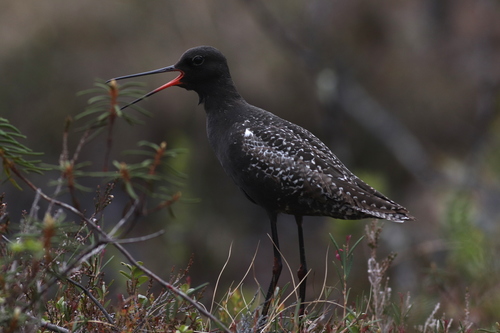 Spotted Redshank
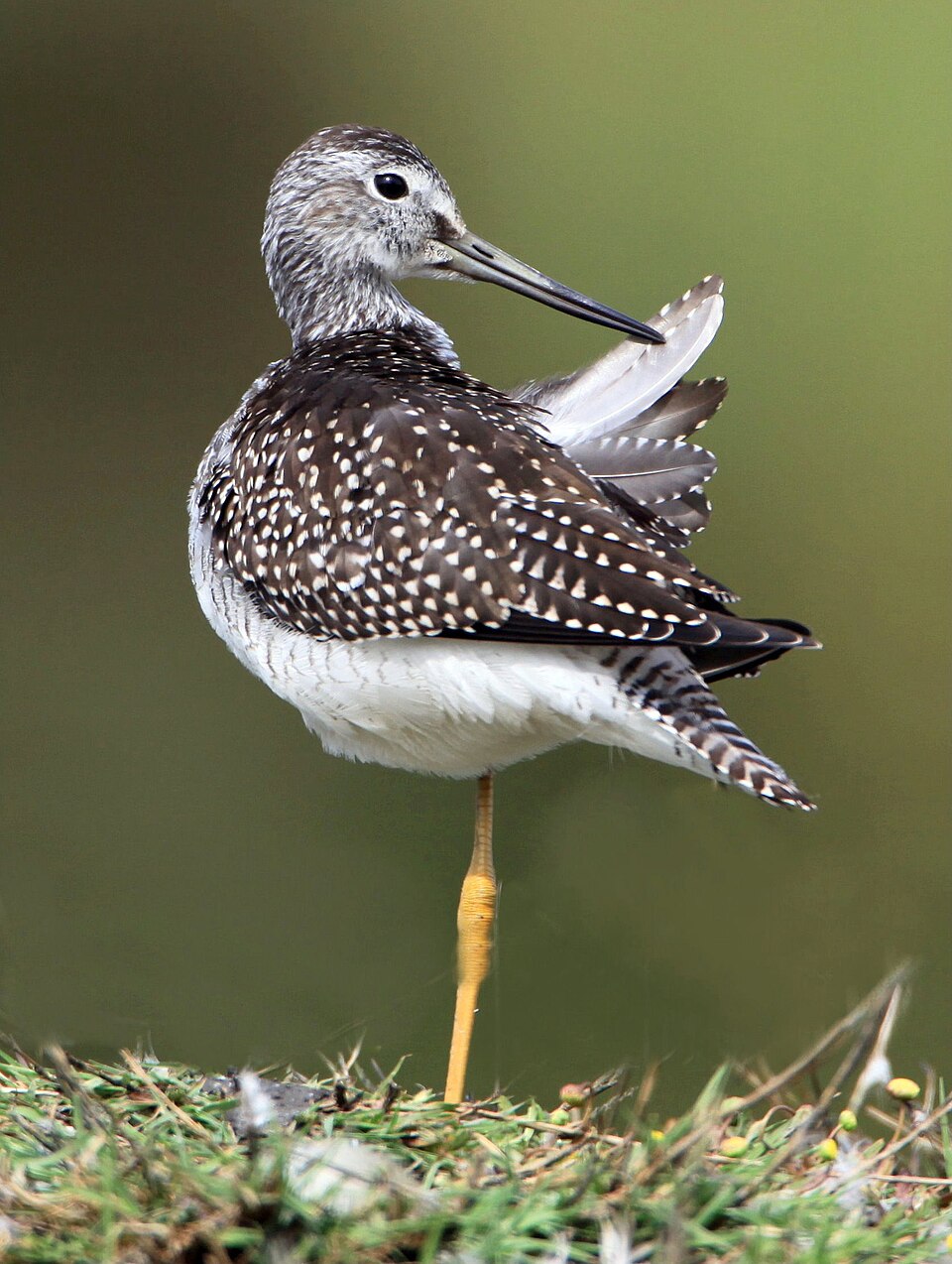 Greater Yellowlegs
In short
The most reliable field mark between Spotted Redshank and Greater Yellowlegs is leg color: Spotted Redshank has red legs (sometimes darkening in breeding plumage), while Greater Yellowlegs always shows bright yellow legs. In flight, Spotted Redshank shows a distinctive white oval on the back, whereas Greater Yellowlegs has a white rump but lacks this oval. Juvenile Spotted Redshank are finely speckled above and barred below, contrasting with the coarser streaking on juvenile Greater Yellowlegs. Both are large, slim Tringa waders, but careful attention to these details—especially leg color and flight pattern—will separate them in most conditions.
Identification tips
- Leg color is the most consistent field mark: Spotted Redshank has red legs (sometimes darkening to grey in breeding plumage), while Greater Yellowlegs always has bright yellow legs. Check leg color in good light—mud or water can obscure this, so confirm with other marks if in doubt.
- Flight pattern: Spotted Redshank shows a distinctive white oval on the back in flight (all ages), while Greater Yellowlegs shows a white rump but lacks the back oval. Look for this mark when birds flush or fly past.
- Juvenile/immature upperparts: Juvenile Spotted Redshank are finely speckled white above, with pale, finely barred underparts. Juvenile Greater Yellowlegs are grey-brown above but with coarser, darker streaking on the breast and neck, and lack the fine speckling.
- Breeding plumage: Spotted Redshank is almost entirely black to dark grey with white spots in breeding season (legs also darken), while Greater Yellowlegs is never black—look for heavy, crisp streaking and spotting on the breast and back, but always with a white belly and yellow legs.
- Bill structure: Both have long, thin bills, but Greater Yellowlegs' bill is often slightly upturned and longer than the head; Spotted Redshank's bill is straight to slightly drooping and also long. Bill shape is subtle and not always reliable at a distance.
- Body structure: Both are slim and long-legged, but Spotted Redshank may appear slightly more elegant and less robust than Greater Yellowlegs. This is subjective and best used with other marks.
- Underpart pattern (non-breeding): Spotted Redshank is paler overall, with less coarse streaking on the breast compared to the dark, crisp breast pattern of Greater Yellowlegs.
- Voice: If heard well, Spotted Redshank gives a creaking, tern-like whistle, while Greater Yellowlegs gives a loud, clear three-note whistle. Alarm calls differ as well, but both can give sharp notes that are confusing at a distance.
- Habitat and range: In Europe and Asia, Spotted Redshank is expected; Greater Yellowlegs is a vagrant. In North America, the reverse is true. Use range only as a supporting clue.
- Molt timing: Spotted Redshank adults molt completely between July and October, with spring body molt March–May. Juveniles have a partial molt August–February. Greater Yellowlegs' molt timing is not detailed here, so do not use this as a separator.
- White rump vs. white back oval: Both show white in the rear in flight, but only Spotted Redshank has the oval on the back. Greater Yellowlegs' white is limited to the rump.
- Confusion with Lesser Yellowlegs: Both species can be confused with Lesser Yellowlegs, but only Greater Yellowlegs is closely similar in structure and plumage. Spotted Redshank is larger and structurally different from Lesser Yellowlegs.
- Sex differences: No strong sexual dimorphism in either species; all marks apply to both sexes.
- Context and flocking: Both may occur singly or in mixed flocks with other waders. Use direct comparison if both are present.
- Pitfalls: Muddy legs, poor light, or distant views can obscure leg color. Rely on a combination of flight pattern, underpart markings, and voice when leg color is not visible.
Size
Both species are among the largest Tringa waders, and their body sizes overlap considerably. Greater Yellowlegs averages slightly heavier (170 g vs. 151.5 g for Spotted Redshank [wikidata]), but both are similar in length (29–31 cm for Spotted Redshank, 29–40 cm for Greater Yellowlegs [wikipedia]). In the field, size alone is not a reliable separator, as both can appear equally tall and slender.
Plumage
- Juveniles/immatures: Spotted Redshank juveniles are grey-brown above with fine white speckling and have pale, finely barred underparts. In contrast, Greater Yellowlegs juveniles are grey-brown above but show a coarser, darker streaking on the breast and neck, and their upperparts lack the fine speckling of Spotted Redshank.
- Adults (non-breeding): Both species are pale below and grey-brown above, but Spotted Redshank is generally paler overall, especially in winter. The white oval on the back of Spotted Redshank is visible in flight in all plumages, while Greater Yellowlegs shows a white rump but not a back oval.
- Adults (breeding): Spotted Redshank is strikingly black to dark grey with white spots in breeding plumage, while Greater Yellowlegs is never black—its breeding plumage features a coarsely streaked breast and neck with much black on the shoulders and back, but always with a white belly and yellow legs.
- Leg color: Spotted Redshank has red legs (sometimes dark grey in breeding), Greater Yellowlegs always has bright yellow legs.
Behaviour
Both species forage in shallow water, often wading actively. Greater Yellowlegs is noted for stirring up water with its bill while feeding. Spotted Redshank may appear slightly more elegant and less frenetic in its movements, but behavioral differences are subtle and not consistently diagnostic.
Habitat
Spotted Redshank breeds in boggy taiga and winters across Eurasia and Africa, while Greater Yellowlegs breeds in boreal wetlands of North America and winters further south into the Americas. In Europe, Spotted Redshank is regular; Greater Yellowlegs is a rare vagrant. In North America, the reverse is true. Both occur in shallow wetlands and muddy margins, so habitat is not a strong separator unless you are far outside the expected range of one species.
Voice
Spotted Redshank gives a creaking whistle 'teu-it' and an alarm 'kyip-kyip-kyip.' Greater Yellowlegs has a much louder, clearer, and harsher three-syllable whistle in flight, with the third syllable lower pitched. Calls are quite different if heard well, but both can give sharp, piping notes that may confuse at a distance.