
Motmot

Spur-winged Goose vs African Pygmy-Goose

Plectropterus gambensis versus Nettapus auritus

Play a quiz with Spur-winged Goose and African Pygmy-Goose
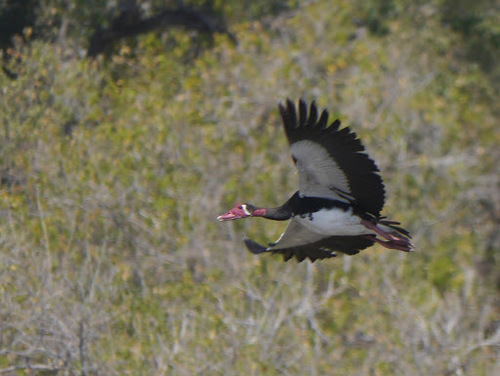
Spur-winged Goose (Plectropterus gambensis) Spur-winged Goose

African Pygmy-Goose (Nettapus auritus) African Pygmy-Goose

Media

Loading…

In short

The Spur-winged Goose and African Pygmy-Goose are dramatically different in size and structure, making them straightforward to separate in most field situations. The Spur-winged Goose is the largest African waterfowl, towering over the tiny, compact African Pygmy-Goose. Adult Spur-winged Geese are mostly black with a white face and large white wing patches, while adult male Pygmy-Geese are strikingly patterned with a white face, black crown, and metallic green and chestnut body. Juvenile and female plumages differ as well, but the size and overall shape are always reliable. Both species have white in the wing, but the context, structure, and plumage details are never truly overlapping.

Identification tips

  1. Size is absolute: Spur-winged Goose is massive, swan-sized; African Pygmy-Goose is tiny, teal-sized. There is no overlap—use this first.
  2. Structure: Spur-winged Goose is long-legged, heavy-bodied, with a long neck and large bill; Pygmy-Goose is compact, short-necked, with a small, stubby bill.
  3. Bill and face: Spur-winged Goose has a red bill and, in males, a large red facial patch and knob; Pygmy-Goose has a yellow (male) or yellow-and-brown (female) bill, with no knob, and a distinctive white (male) or gray (female) face.
  4. Adult male plumage: Spur-winged Goose is mostly black with a white face and large white wing patches; male Pygmy-Goose is boldly patterned with a white face, black crown, green ear patch, chestnut flanks, and metallic green back.
  5. Adult female plumage: Spur-winged Goose female is similar to male but smaller and with less extensive red on the face; Pygmy-Goose female is gray-faced with a brown eye stripe and less contrast overall.
  6. Juvenile plumage: Spur-winged Goose juveniles are still large, dark, and heavy-billed; Pygmy-Goose juveniles are tiny, with a white face, dark crown, and pinkish bill base.
  7. Wing pattern in flight: Spur-winged Goose shows large white patches on otherwise black wings; Pygmy-Goose shows a white bar on the dark, metallic green-black wing.
  8. Leg color: Spur-winged Goose has long, pinkish-red legs; Pygmy-Goose has short, dark-gray to black legs.
  9. Behavior: Spur-winged Goose is often seen grazing on land or resting in open, sometimes in large flocks; Pygmy-Goose is almost always on water, feeding among lilies, and rarely on land.
  10. Habitat: Spur-winged Goose uses a wide range of wetlands and sometimes fields; Pygmy-Goose is closely tied to lily-covered, still waters.
  11. Flight style: Spur-winged Goose is heavy, slow, and labored in flight; Pygmy-Goose is rapid, direct, and agile.
  12. Sexual dimorphism: Spur-winged Goose males are larger and have more extensive red on the face; Pygmy-Goose males and females differ mainly in face color and contrast.
  13. Voice: Spur-winged Goose is usually silent, but males may give a soft bubbling call; Pygmy-Goose is not known for distinctive calls.
  14. Sociality: Spur-winged Goose can be in large flocks, especially outside breeding; Pygmy-Goose is usually in pairs or small groups.
  15. Common pitfalls: Even at a distance, the Spur-winged Goose's size and long legs are unique; confusion is most likely with distant, lone birds, but the size, structure, and habitat should always resolve the ID.

Size

Size is the most immediate and reliable difference. The Spur-winged Goose averages nearly 5 kg (4887.5 g) [wikidata], with a length of 75–115 cm and a wingspan of 150–200 cm [wikipedia]. In contrast, the African Pygmy-Goose is minute, with males averaging about 285 g and females 260 g, and a wing length of just 142–165 mm [wikipedia]. In the field, a Spur-winged Goose is swan-sized, while the African Pygmy-Goose is smaller than most dabbling ducks and can look almost teal- or dove-sized. There is no overlap in size.

Plumage

There are no confusing age-specific upperwing patterns between these two: both have white in the wing, but the Spur-winged Goose's white is in large patches on otherwise black wings, while the African Pygmy-Goose shows a white bar on the distal secondaries against a dark, metallic green-black wing. Adult Spur-winged Geese are mainly black with a white face and large white wing patches; males have a larger red facial patch and a knob at the bill base. African Pygmy-Goose males have a white face with black eye patches, a black crown, powder green ear patches, chestnut flanks, and a metallic green back. Females are duller, with a gray face, brown eye stripe, and less contrast. Juveniles of both are patterned, but the Spur-winged Goose juvenile is still large, dark, and heavy-billed, while the pygmy-goose juvenile is tiny, with a white face and dark crown. Bill color and facial pattern are always different. In flight, the Spur-winged Goose's size and broad wings with large white patches are unmistakable; the pygmy-goose is small, fast, and shows a white wing bar.

Behaviour

Spur-winged Geese are often seen in small to large flocks, grazing or resting by water, and are aggressive during breeding. They are mostly terrestrial, feeding by grazing, and spend much of the day loafing near water. African Pygmy-Geese are more aquatic, typically seen in pairs or small groups, actively feeding on water lilies and floating vegetation, and rarely venturing far from water. Their flight is rapid and direct, and they are less likely to be seen on land.

Habitat

Both species occur in sub-Saharan Africa, but their preferred habitats differ. Spur-winged Geese are found around rivers, lakes, and swamps, often in open wetlands and sometimes in agricultural areas. African Pygmy-Geese are strongly associated with slow-flowing or stagnant water with abundant water lilies, such as quiet inland wetlands, swamps, and river pools. Pygmy-geese are rarely seen away from dense floating vegetation, while Spur-winged Geese are more flexible and may be seen grazing in open fields.

Voice

Spur-winged Goose is generally quiet, with males giving a soft bubbling call ("cherwit") when alarmed or taking flight. African Pygmy-Goose vocalizations are not described in the sources, but neither species is known for prominent calls in the field.

Submit a better description

Use the same sections as the comparison. Your text is published immediately.

The Spur-winged Goose and African Pygmy-Goose are dramatically different in size and structure, making them straightforward to separate in most field situations. The Spur-winged Goose is the largest African waterfowl, towering over the tiny, compact African Pygmy-Goose. Adult Spur-winged Geese are mostly black with a white face and large white wing patches, while adult male Pygmy-Geese are strikingly patterned with a white face, black crown, and metallic green and chestnut body. Juvenile and female plumages differ as well, but the size and overall shape are always reliable. Both species have white in the wing, but the context, structure, and plumage details are never truly overlapping.

  1. Size is absolute: Spur-winged Goose is massive, swan-sized; African Pygmy-Goose is tiny, teal-sized. There is no overlap—use this first.
  2. Structure: Spur-winged Goose is long-legged, heavy-bodied, with a long neck and large bill; Pygmy-Goose is compact, short-necked, with a small, stubby bill.
  3. Bill and face: Spur-winged Goose has a red bill and, in males, a large red facial patch and knob; Pygmy-Goose has a yellow (male) or yellow-and-brown (female) bill, with no knob, and a distinctive white (male) or gray (female) face.
  4. Adult male plumage: Spur-winged Goose is mostly black with a white face and large white wing patches; male Pygmy-Goose is boldly patterned with a white face, black crown, green ear patch, chestnut flanks, and metallic green back.
  5. Adult female plumage: Spur-winged Goose female is similar to male but smaller and with less extensive red on the face; Pygmy-Goose female is gray-faced with a brown eye stripe and less contrast overall.
  6. Juvenile plumage: Spur-winged Goose juveniles are still large, dark, and heavy-billed; Pygmy-Goose juveniles are tiny, with a white face, dark crown, and pinkish bill base.
  7. Wing pattern in flight: Spur-winged Goose shows large white patches on otherwise black wings; Pygmy-Goose shows a white bar on the dark, metallic green-black wing.
  8. Leg color: Spur-winged Goose has long, pinkish-red legs; Pygmy-Goose has short, dark-gray to black legs.
  9. Behavior: Spur-winged Goose is often seen grazing on land or resting in open, sometimes in large flocks; Pygmy-Goose is almost always on water, feeding among lilies, and rarely on land.
  10. Habitat: Spur-winged Goose uses a wide range of wetlands and sometimes fields; Pygmy-Goose is closely tied to lily-covered, still waters.
  11. Flight style: Spur-winged Goose is heavy, slow, and labored in flight; Pygmy-Goose is rapid, direct, and agile.
  12. Sexual dimorphism: Spur-winged Goose males are larger and have more extensive red on the face; Pygmy-Goose males and females differ mainly in face color and contrast.
  13. Voice: Spur-winged Goose is usually silent, but males may give a soft bubbling call; Pygmy-Goose is not known for distinctive calls.
  14. Sociality: Spur-winged Goose can be in large flocks, especially outside breeding; Pygmy-Goose is usually in pairs or small groups.
  15. Common pitfalls: Even at a distance, the Spur-winged Goose's size and long legs are unique; confusion is most likely with distant, lone birds, but the size, structure, and habitat should always resolve the ID.

Size is the most immediate and reliable difference. The Spur-winged Goose averages nearly 5 kg (4887.5 g) [wikidata], with a length of 75–115 cm and a wingspan of 150–200 cm [wikipedia]. In contrast, the African Pygmy-Goose is minute, with males averaging about 285 g and females 260 g, and a wing length of just 142–165 mm [wikipedia]. In the field, a Spur-winged Goose is swan-sized, while the African Pygmy-Goose is smaller than most dabbling ducks and can look almost teal- or dove-sized. There is no overlap in size.

There are no confusing age-specific upperwing patterns between these two: both have white in the wing, but the Spur-winged Goose's white is in large patches on otherwise black wings, while the African Pygmy-Goose shows a white bar on the distal secondaries against a dark, metallic green-black wing. Adult Spur-winged Geese are mainly black with a white face and large white wing patches; males have a larger red facial patch and a knob at the bill base. African Pygmy-Goose males have a white face with black eye patches, a black crown, powder green ear patches, chestnut flanks, and a metallic green back. Females are duller, with a gray face, brown eye stripe, and less contrast. Juveniles of both are patterned, but the Spur-winged Goose juvenile is still large, dark, and heavy-billed, while the pygmy-goose juvenile is tiny, with a white face and dark crown. Bill color and facial pattern are always different. In flight, the Spur-winged Goose's size and broad wings with large white patches are unmistakable; the pygmy-goose is small, fast, and shows a white wing bar.

Spur-winged Geese are often seen in small to large flocks, grazing or resting by water, and are aggressive during breeding. They are mostly terrestrial, feeding by grazing, and spend much of the day loafing near water. African Pygmy-Geese are more aquatic, typically seen in pairs or small groups, actively feeding on water lilies and floating vegetation, and rarely venturing far from water. Their flight is rapid and direct, and they are less likely to be seen on land.

Both species occur in sub-Saharan Africa, but their preferred habitats differ. Spur-winged Geese are found around rivers, lakes, and swamps, often in open wetlands and sometimes in agricultural areas. African Pygmy-Geese are strongly associated with slow-flowing or stagnant water with abundant water lilies, such as quiet inland wetlands, swamps, and river pools. Pygmy-geese are rarely seen away from dense floating vegetation, while Spur-winged Geese are more flexible and may be seen grazing in open fields.

Spur-winged Goose is generally quiet, with males giving a soft bubbling call ("cherwit") when alarmed or taking flight. African Pygmy-Goose vocalizations are not described in the sources, but neither species is known for prominent calls in the field.

Discard your changes?

You have unsaved edits. If you leave now, those changes will be lost.

Spur-winged Goose · African Pygmy-Goose · My Tricky Birds