

Sri Lanka White-eye vs Indian White-eye
Zosterops ceylonensis versus Zosterops palpebrosus
Play a quiz with Sri Lanka White-eye and Indian White-eye
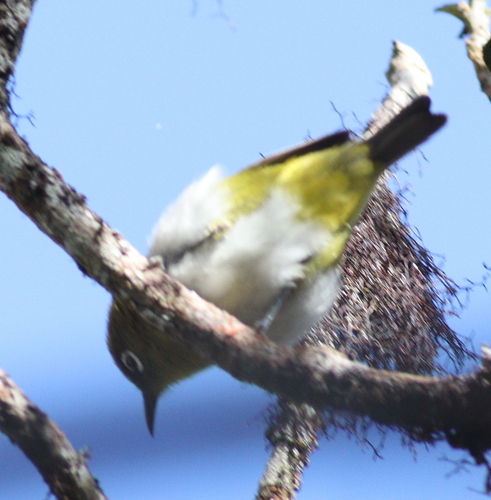 Sri Lanka White-eye
 Indian White-eye
In short
The most reliable field mark to separate Sri Lanka White-eye from Indian White-eye is the combination of overall size and plumage tone: Sri Lanka White-eye is noticeably larger and has a duller, darker olive-green back, with more extensive yellow on the breast and a darker patch between the eye and bill. Indian White-eye is smaller, brighter yellow-green above, and has a more limited yellow restricted to the throat and vent. Both species show a conspicuous white eye-ring, but Sri Lanka White-eye's darker lores and broader yellow breast are key in direct comparison. Immature or juvenile-specific wing pattern differences are not described in the sources, so focus on overall color, size, and facial details.
Identification tips
- Size is a primary separator: Sri Lanka White-eye is about 2–3 cm longer than Indian White-eye. In mixed flocks or overlapping zones, look for the larger, bulkier bird.
- Back color: Sri Lanka White-eye has a dull, dark olive-green back; Indian White-eye is brighter yellow-green above, especially in the Sri Lankan race (egregia).
- Yellow on breast: Sri Lanka White-eye shows more extensive yellow on the breast, blending into the throat and chin, whereas Indian White-eye's yellow is mostly on the throat and vent, with the breast and belly more whitish-grey.
- Facial pattern: Sri Lanka White-eye has a darker patch between the eye and bill (dark lores and a dark streak below the eye), which contrasts with the brighter face of Indian White-eye.
- Eye-ring: Both have a conspicuous white eye-ring, but in Sri Lanka White-eye it is set off by the darker lores, making the ring appear more isolated.
- Belly color: Sri Lanka White-eye has a greyish-white belly, while Indian White-eye's belly is whitish-grey or sometimes yellowish depending on subspecies.
- Bill color: Sri Lanka White-eye has a dark bill with a slaty base to the lower mandible; Indian White-eye's bill is less distinctly marked.
- Leg color: Both species have dark legs; this is not a useful separator.
- Iris color: Sri Lanka White-eye's iris can be yellow to reddish-brown, but this is subtle and rarely diagnostic in the field.
- Flocking behavior: Large, cohesive flocks in the highlands of Sri Lanka are likely Sri Lanka White-eye, especially above 4000 ft.
- Habitat and elevation: In Sri Lanka, Indian White-eye is found at lower elevations (smaller, brighter birds), while Sri Lanka White-eye dominates the highlands.
- No age-specific wing pattern: There are no described differences in juvenile or immature upperwing or flight patterns between these species; focus on size and color.
- Sexes similar: Both species show little sexual dimorphism; all field marks apply to both sexes.
- Subspecies confusion: Indian White-eye in Sri Lanka (race egregia) is smaller and brighter than Sri Lanka White-eye, which helps in direct comparison.
- When in doubt: If the bird is small, bright yellow-green, and at low elevation, it's likely Indian White-eye. If larger, duller, and in the highlands, it's Sri Lanka White-eye.
Size
Sri Lanka White-eye is distinctly larger (about 11 cm in length) compared to the Indian White-eye (8–9 cm). This size difference is usually apparent when both species are seen in the same area, especially in Sri Lanka's central highlands where the two may overlap at certain elevations. The Sri Lanka White-eye also appears bulkier and longer-tailed in direct comparison. No mass or wing length data are provided, but the length difference is consistent across sources.
Plumage
- Adults: Sri Lanka White-eye has dark olive-green upperparts, a paler green rump, and a darker crown and forehead. The yellow on the breast is more extensive, blending into the greenish-yellow chin and throat, and the belly is greyish-white. The lores are dark, and there is a dark streak below the eye, with a slaty base to the lower mandible. Indian White-eye is brighter yellow-green above, with yellow restricted mostly to the throat and vent, and a whitish-grey (sometimes yellowish) belly. The back is brighter and less olive than Sri Lanka White-eye, especially in the Sri Lankan race (egregia). Both species have a white eye-ring, but Sri Lanka White-eye's is set off by the darker lores and more shadowed face.
- Juveniles/immatures: No specific age-related wing or flight pattern differences are described for either species. The main field marks remain those of overall color and facial pattern, not upperwing panels or flight marks.
Behaviour
Sri Lanka White-eye is notably sociable, often forming large flocks outside the breeding season, and is typically seen in the highlands above 4000 ft. Indian White-eye forages in smaller groups and is more widespread in open woodland and gardens at lower elevations. Both species are active, agile, and feed on insects and nectar, but Sri Lanka White-eye's flocking behavior in the highlands can be a useful contextual clue.
Habitat
Sri Lanka White-eye is endemic to Sri Lanka and is mainly found in forests, gardens, and plantations of the central highlands, replacing Indian White-eye above 4000 ft. Indian White-eye is widespread across the Indian subcontinent, occupying open woodland, gardens, and sometimes plantations, but is generally absent from the highest elevations where Sri Lanka White-eye dominates. In Sri Lanka, the Indian White-eye (race egregia) is smaller and occurs at lower elevations with a brighter back and throat.