
Tree Pipit vs Red-throated Pipit
Anthus trivialis versus Anthus cervinus
Play a quiz with Tree Pipit and Red-throated Pipit
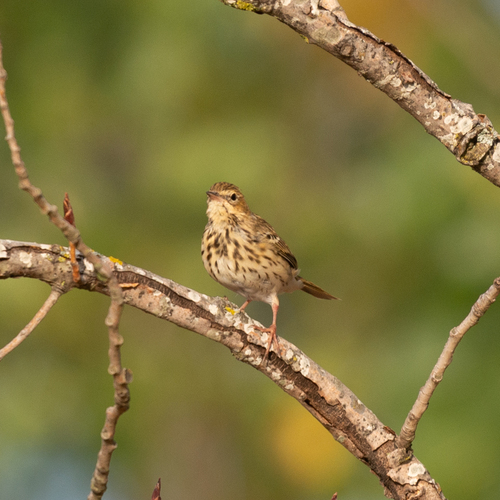 Tree Pipit
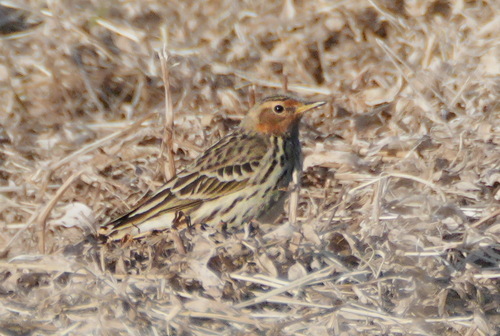 Red-throated Pipit
In short
The most reliable field mark for separating Tree Pipit from Red-throated Pipit is the presence of a brick-red face and throat on adult Red-throated Pipits in breeding plumage—Tree Pipits never show this. In non-breeding and immature plumages, Red-throated Pipit is much more heavily streaked overall, especially on the cap, back, flanks, rump, and chest, while Tree Pipit shows a cleaner, less streaked look with a strong contrast between its buff breast and white belly. Structurally, Tree Pipit has a heavier bill and is more likely to perch in trees, while Red-throated Pipit is usually seen on the ground. Calls and song flights differ, but can be subtle unless well-heard. Both species can be confusing in autumn or immature plumages, but careful attention to streaking and structure will usually resolve the ID.
Identification tips
- Breeding plumage Red-throated Pipit: Look for a brick-red face and throat—this is unique to adult Red-throated Pipits in spring and early summer and never shown by Tree Pipit.
- Streaking above and below: In all other plumages, Red-throated Pipit is much more heavily streaked on the cap, back, flanks, rump, and chest. Tree Pipit is less streaked, with a cleaner, more uniform brown back and fewer streaks on the flanks and rump.
- Underpart contrast: Tree Pipit shows a strong contrast between a buff breast and a white belly, while Red-throated Pipit is more evenly streaked below, with black markings on a white background but less contrast between breast and belly.
- Mantle stripes: Red-throated Pipit often shows whitish mantle stripes, adding to its streaky appearance, especially in autumn and immature birds.
- Bill structure: Tree Pipit has a heavier, more robust bill compared to the finer bill of Red-throated Pipit. This is subtle but can be seen well in good views.
- Perching behavior: Tree Pipit is more likely to be seen perched in trees or on wires, while Red-throated Pipit is usually on the ground.
- Song flight: Tree Pipit's song flight is distinctive—rising from a tree and parachuting down with stiff wings and a drawn-out song. Red-throated Pipit does not perform this display.
- Flight style: Red-throated Pipit has a strong, direct flight, while Tree Pipit's flight can appear more undulating, especially during song flights.
- Calls: Listen for Tree Pipit's strong 'spek' call versus Red-throated Pipit's thin 'psii' flight call. These can be diagnostic if heard well, but beware of variation and distance effects.
- Habitat context: In Western Europe, Tree Pipit is much more likely in open woodland and heath, while Red-throated Pipit is a scarce migrant or vagrant, usually in open, often wet or tundra-like habitats.
- Seasonal occurrence: If seen in breeding habitat in spring/summer in most of Europe, Tree Pipit is far more likely. Red-throated Pipit is only regular in far northern breeding grounds and is otherwise a migrant or vagrant.
- Juvenile/immature confusion: In autumn, both species can look similar, but Red-throated Pipit will still show heavier and more extensive streaking above and below. Always check the density and extent of streaks.
- No distinctive upperwing pattern: Neither species is described as having a diagnostic juvenile or immature upperwing pattern in the available sources, so focus on body streaking and structure.
- Size: Both species are very similar in size; do not rely on bulk or length for separation in the field.
- Pitfalls: Be cautious in autumn and on migration, when both species can look drab and streaky. Prioritize the density and extent of streaking, underpart contrast, and any hint of red on the face or throat.
Size
Tree Pipit is slightly heavier (23.5g) than Red-throated Pipit, but the difference is minimal and not easily judged in the field. Both are small pipits and very similar in size, so structural differences like bill shape are more useful than overall bulk.
Plumage
Breeding adult Red-throated Pipits are easily told by their brick-red face and throat, a feature never shown by Tree Pipit. Outside the breeding season and in immatures, Red-throated Pipit is much more heavily and extensively streaked: look for dense streaks on the cap, back, flanks, rump, and chest, as well as whitish mantle stripes. Tree Pipit is less streaked above, with a more uniform brown back and fewer streaks on the flanks and rump. The underparts of Tree Pipit show a strong contrast between a buff breast and a white belly, while Red-throated Pipit is more evenly streaked below. Both species have black markings on white underparts, but Tree Pipit's breast streaks are bolder and more concentrated, whereas Red-throated Pipit's streaks are finer and more widespread. No age-specific upperwing or flight pattern marks are described for either species in the sources.
Behaviour
Tree Pipit is more likely to perch in trees, often singing from exposed branches or wires, and performs a distinctive song flight: it rises from a tree and parachutes down on stiff wings while singing. Red-throated Pipit is usually seen on the ground, feeding in open habitats, and its flight is described as strong and direct. These behavioral tendencies can help in context, but are not absolute.
Habitat
Tree Pipit breeds in open woodland, heath, and areas with scattered trees and low scrub, often preferring a mosaic of grass and bracken with moderate grazing. Red-throated Pipit breeds much farther north, in tundra and open northern habitats, and is only a vagrant in most of Western Europe. In migration and winter, both can occur in open country, but Tree Pipit is more tied to wooded edges and clearings, while Red-throated Pipit favors open ground.
Voice
Tree Pipit's call is a strong 'spek', while Red-throated Pipit's flight call is a characteristic 'psii'. The Tree Pipit's song flight is distinctive, with a drawn-out song as it parachutes down. These vocal differences are useful if heard well, but can be subtle and are not always diagnostic unless the full song or call is clearly heard.