
Motmot

Tropical Kingbird vs Western Kingbird

Tyrannus melancholicus versus Tyrannus verticalis

Play a quiz with Tropical Kingbird and Western Kingbird

Tropical Kingbird (Tyrannus melancholicus) Tropical Kingbird
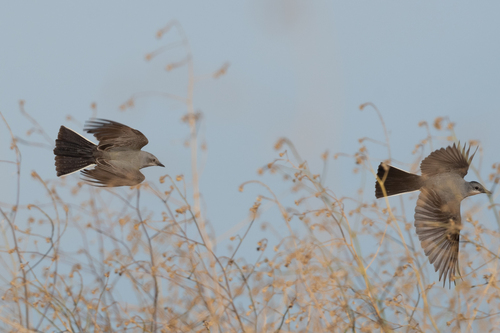
Western Kingbird (Tyrannus verticalis) Western Kingbird

Media

Loading…

In short

The most reliable field mark to separate Tropical Kingbird from Western Kingbird is the tail: Western Kingbird has a black, squared-off tail with distinct white outer edges, while Tropical Kingbird shows a brown, more deeply forked tail lacking white edges. Both species are large, yellow-bellied flycatchers with gray heads and olive backs, but subtle differences in tail shape and edge color, as well as the head pattern, are key. Juvenile plumages are not described in detail for Western Kingbird, but young Tropical Kingbirds show pale buff edges to the wing coverts. Both species are similar in size and often perch conspicuously, but careful attention to tail and head details is essential for confident identification.

Identification tips

  1. Tail shape and color: Western Kingbird has a black, squared-off tail with prominent white outer edges; Tropical Kingbird's tail is brown, more deeply forked, and lacks white edges. This is the most reliable field mark for adults and older immatures.
  2. Head pattern: Tropical Kingbird shows a pale gray head with a darker eye mask and sometimes an orange crown stripe (often hard to see); Western Kingbird's head is plain gray without a strong mask or crown stripe.
  3. Back color: Tropical Kingbird has a grayish-green back, while Western Kingbird is more uniformly gray above.
  4. Throat and breast: Tropical Kingbird's throat is pale gray, blending to olive on the breast, with bright yellow belly; Western Kingbird's underparts are also yellow but lack the distinct pale gray throat and olive breast blending.
  5. Juvenile wing coverts: Young Tropical Kingbirds have pale buff edges to the wing coverts, which may be visible at close range; this feature is not described for Western Kingbird.
  6. Tail in flight: Watch for the tail shape and white edges when the bird fans its tail in flight or when perched; Western Kingbird's white tail edges are often visible even at a distance.
  7. Bill: Both species have heavy gray bills, not a reliable separator.
  8. Hidden crown color: Western Kingbird can show crimson crown feathers when displaying or agitated, but these are usually concealed; Tropical Kingbird may show an orange crown stripe, but it is rarely visible.
  9. Perching behavior: Both species perch openly and sally for insects, so behavior is not a reliable separator.
  10. Habitat context: In the southern U.S. and northern Mexico, Western Kingbird is more likely in open, dry country; Tropical Kingbird prefers semi-open areas with more trees and shrubs, often in more humid or subtropical settings.
  11. Vocalizations: Tropical Kingbird's high-pitched twittering trill may help if heard well; Western Kingbird's calls are not described here.
  12. Season and range: In North America, Western Kingbird is a summer breeder in the west; Tropical Kingbird is more likely in the southernmost U.S. or further south, especially outside the breeding season.
  13. Sexes: Both species are sexually monomorphic; plumage differences do not help with sexing or separating the species.
  14. Nest placement: Western Kingbird may nest on man-made structures; Tropical Kingbird usually nests high in trees, but this is not a field mark for individuals.
  15. Pitfalls: Both species are large, yellow-bellied kingbirds and can be easily confused, especially in poor light or at a distance. Always prioritize tail shape and edge color when possible.

Size

Both Tropical and Western Kingbirds are nearly identical in size, with an average body mass of 37 g [wikidata]. Length and wingspan are also very similar, so size alone is not a reliable separator in the field.

Plumage

For adults, the most diagnostic difference is the tail: Western Kingbird's tail is black, squared at the tip, and has prominent white outer edges, while Tropical Kingbird's tail is brown, more deeply forked, and lacks white edging. Both species have gray heads and yellow underparts, but Tropical Kingbird has a pale gray head with a dark eye mask and sometimes an orange crown stripe, whereas Western Kingbird's head is plainer gray. Tropical Kingbird's back is grayish-green, and its throat is pale gray blending to olive on the breast, with the rest of the underparts yellow. Western Kingbird shows a similar gray and yellow pattern but can reveal hidden crimson crown feathers in display (not usually visible). Juvenile Tropical Kingbirds have pale buff edges on the wing coverts, a feature not described for Western Kingbird. Both species' sexes look alike.

Behaviour

Both species are highly territorial and aggressive toward intruders, often attacking much larger birds. They perch openly and sally out to catch insects in flight, sometimes hovering to glean from vegetation. Both eat a mix of insects and fruit. Western Kingbird may nest on man-made structures more often, while Tropical Kingbird typically nests high in trees. Their foraging and territorial behaviors are very similar and not reliably diagnostic.

Habitat

Tropical Kingbird is found from southern Arizona and Texas south through Central and South America, preferring semi-open areas with trees and shrubs, including gardens and roadsides. Western Kingbird occupies western North America as far south as Mexico, favoring open country with scattered trees, often near human habitation. In areas of overlap (southern U.S., northern Mexico), both may be present, but Western Kingbird is more likely in drier, open habitats, while Tropical Kingbird can be found in more humid or subtropical settings.

Voice

Tropical Kingbird gives a high-pitched, twittering trill (tree-e-e-e-e-e), with a more complex dawn song. Western Kingbird's vocalizations are not described in detail here, but both species are vocal and may be heard before seen. Voice can be helpful if familiar, but is not detailed enough in these notes for reliable separation.

Submit a better description

Use the same sections as the comparison. Your text is published immediately.

The most reliable field mark to separate Tropical Kingbird from Western Kingbird is the tail: Western Kingbird has a black, squared-off tail with distinct white outer edges, while Tropical Kingbird shows a brown, more deeply forked tail lacking white edges. Both species are large, yellow-bellied flycatchers with gray heads and olive backs, but subtle differences in tail shape and edge color, as well as the head pattern, are key. Juvenile plumages are not described in detail for Western Kingbird, but young Tropical Kingbirds show pale buff edges to the wing coverts. Both species are similar in size and often perch conspicuously, but careful attention to tail and head details is essential for confident identification.

  1. Tail shape and color: Western Kingbird has a black, squared-off tail with prominent white outer edges; Tropical Kingbird's tail is brown, more deeply forked, and lacks white edges. This is the most reliable field mark for adults and older immatures.
  2. Head pattern: Tropical Kingbird shows a pale gray head with a darker eye mask and sometimes an orange crown stripe (often hard to see); Western Kingbird's head is plain gray without a strong mask or crown stripe.
  3. Back color: Tropical Kingbird has a grayish-green back, while Western Kingbird is more uniformly gray above.
  4. Throat and breast: Tropical Kingbird's throat is pale gray, blending to olive on the breast, with bright yellow belly; Western Kingbird's underparts are also yellow but lack the distinct pale gray throat and olive breast blending.
  5. Juvenile wing coverts: Young Tropical Kingbirds have pale buff edges to the wing coverts, which may be visible at close range; this feature is not described for Western Kingbird.
  6. Tail in flight: Watch for the tail shape and white edges when the bird fans its tail in flight or when perched; Western Kingbird's white tail edges are often visible even at a distance.
  7. Bill: Both species have heavy gray bills, not a reliable separator.
  8. Hidden crown color: Western Kingbird can show crimson crown feathers when displaying or agitated, but these are usually concealed; Tropical Kingbird may show an orange crown stripe, but it is rarely visible.
  9. Perching behavior: Both species perch openly and sally for insects, so behavior is not a reliable separator.
  10. Habitat context: In the southern U.S. and northern Mexico, Western Kingbird is more likely in open, dry country; Tropical Kingbird prefers semi-open areas with more trees and shrubs, often in more humid or subtropical settings.
  11. Vocalizations: Tropical Kingbird's high-pitched twittering trill may help if heard well; Western Kingbird's calls are not described here.
  12. Season and range: In North America, Western Kingbird is a summer breeder in the west; Tropical Kingbird is more likely in the southernmost U.S. or further south, especially outside the breeding season.
  13. Sexes: Both species are sexually monomorphic; plumage differences do not help with sexing or separating the species.
  14. Nest placement: Western Kingbird may nest on man-made structures; Tropical Kingbird usually nests high in trees, but this is not a field mark for individuals.
  15. Pitfalls: Both species are large, yellow-bellied kingbirds and can be easily confused, especially in poor light or at a distance. Always prioritize tail shape and edge color when possible.

Both Tropical and Western Kingbirds are nearly identical in size, with an average body mass of 37 g [wikidata]. Length and wingspan are also very similar, so size alone is not a reliable separator in the field.

For adults, the most diagnostic difference is the tail: Western Kingbird's tail is black, squared at the tip, and has prominent white outer edges, while Tropical Kingbird's tail is brown, more deeply forked, and lacks white edging. Both species have gray heads and yellow underparts, but Tropical Kingbird has a pale gray head with a dark eye mask and sometimes an orange crown stripe, whereas Western Kingbird's head is plainer gray. Tropical Kingbird's back is grayish-green, and its throat is pale gray blending to olive on the breast, with the rest of the underparts yellow. Western Kingbird shows a similar gray and yellow pattern but can reveal hidden crimson crown feathers in display (not usually visible). Juvenile Tropical Kingbirds have pale buff edges on the wing coverts, a feature not described for Western Kingbird. Both species' sexes look alike.

Both species are highly territorial and aggressive toward intruders, often attacking much larger birds. They perch openly and sally out to catch insects in flight, sometimes hovering to glean from vegetation. Both eat a mix of insects and fruit. Western Kingbird may nest on man-made structures more often, while Tropical Kingbird typically nests high in trees. Their foraging and territorial behaviors are very similar and not reliably diagnostic.

Tropical Kingbird is found from southern Arizona and Texas south through Central and South America, preferring semi-open areas with trees and shrubs, including gardens and roadsides. Western Kingbird occupies western North America as far south as Mexico, favoring open country with scattered trees, often near human habitation. In areas of overlap (southern U.S., northern Mexico), both may be present, but Western Kingbird is more likely in drier, open habitats, while Tropical Kingbird can be found in more humid or subtropical settings.

Tropical Kingbird gives a high-pitched, twittering trill (tree-e-e-e-e-e), with a more complex dawn song. Western Kingbird's vocalizations are not described in detail here, but both species are vocal and may be heard before seen. Voice can be helpful if familiar, but is not detailed enough in these notes for reliable separation.

Discard your changes?

You have unsaved edits. If you leave now, those changes will be lost.

Tropical Kingbird · Western Kingbird · My Tricky Birds