

Verreaux's Eagle Owl vs African Wood-Owl
Ketupa lactea versus Strix woodfordii
Play a quiz with Verreaux's Eagle Owl and African Wood-Owl
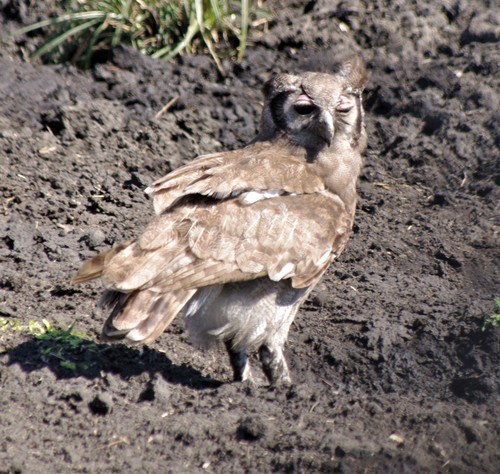 Verreaux's Eagle Owl
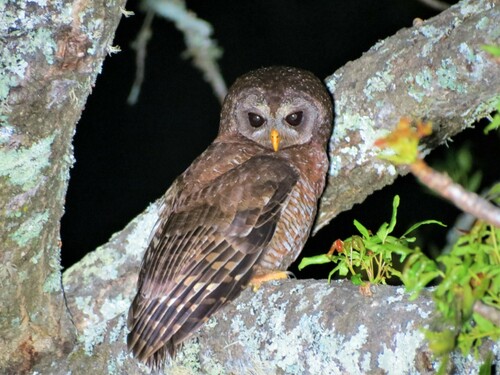 African Wood-Owl
In short
The most reliable way to separate Verreaux's Eagle Owl from African Wood-Owl is by size and overall structure: Verreaux's Eagle Owl is a true giant, nearly twice the length and several times the mass of African Wood-Owl. In the field, the eagle-owl's pale, imposing appearance and massive build are unmistakable compared to the much smaller, round-headed, and richly brown African Wood-Owl. Juvenile plumages are not described in detail for Verreaux's Eagle Owl, but African Wood-Owl juveniles are paler rufous. Both species can be found in wooded habitats, but Verreaux's Eagle Owl prefers dry savanna, while African Wood-Owl is a forest specialist. Their calls are also very different, with the wood-owl giving a distinctive series of hoots in duets, unlike the eagle-owl.
Identification tips
- Size is the most immediate clue: Verreaux's Eagle Owl is enormous, nearly double the length and several times the mass of African Wood-Owl. If the owl looks huge, it's the eagle-owl.
- Head shape and facial features: African Wood-Owl has a rounded head, large dark eyes with white eyebrows, and a compact facial disk. Verreaux's Eagle Owl has a much larger, more massive head and bill, lacking the neat white eyebrows and compact disk.
- Plumage tone: Verreaux's Eagle Owl is much paler overall ('milky'), while African Wood-Owl is rich brown above with paler, barred underparts. Juvenile wood-owls are paler rufous but still much smaller and rounder-headed.
- Bill color: African Wood-Owl has a prominent yellow beak, which stands out against its dark face. Bill color is less distinctive in Verreaux's Eagle Owl, but the bill is much larger and heavier.
- Eye color: African Wood-Owl has large, dark eyes; the eagle-owl's eye color is not specified, but its facial features are generally less contrasting.
- Flight style: Verreaux's Eagle Owl flies with slow, heavy wingbeats and appears massive and powerful. African Wood-Owl's flight is more buoyant and typical of medium-sized owls.
- Roosting behavior: African Wood-Owl roosts in dense cover, often high in trees, and is rarely seen in the open during the day. Verreaux's Eagle Owl may perch more openly and is more likely to be seen exposed.
- Habitat: In dense, closed-canopy forest, expect African Wood-Owl. In more open, dry savanna with scattered large trees, Verreaux's Eagle Owl is likely.
- Vocalizations: If you hear a duet of patterned hoots (male rapid, female higher and slower), it's African Wood-Owl. The eagle-owl does not give this type of call.
- Juvenile confusion: Juvenile African Wood-Owls are paler rufous but still small and round-headed; no distinctive juvenile marks are described for Verreaux's Eagle Owl, but its size is always diagnostic.
- Contextual clues: If you observe predation on large mammals or primates, this is unique to Verreaux's Eagle Owl.
- Perched silhouette: The eagle-owl will appear much bulkier, with a larger head and bill, and a more imposing posture than the compact, rounded wood-owl.
- Underparts: African Wood-Owl shows a white belly with brown barring, while the eagle-owl is generally paler but not described in detail here.
- Community context: African Wood-Owl is the most common forest owl in Africa, so in forested areas, it is the default species.
- When in doubt, use multiple marks: If size is hard to judge, combine habitat, head shape, plumage tone, and especially the presence of a duet call to clinch the identification.
Size
Verreaux's Eagle Owl is the largest owl in Africa, reaching up to 66 cm (26 in) in length and weighing several times more than African Wood-Owl. African Wood-Owl is a medium-sized owl, measuring 30.5–35 cm (12–13.8 in) in length and weighing 240–350 g ([wikidata]), with an average adult mass of 299 g. The eagle-owl's sheer bulk and length are diagnostic even at a distance. If you see a truly massive owl, it is almost certainly Verreaux's Eagle Owl; African Wood-Owl will always appear much smaller and more compact.
Plumage
Juvenile African Wood-Owls are paler and more rufous than adults, but still much smaller and rounder-headed than Verreaux's Eagle Owl at any age. Adult African Wood-Owls have a rounded head, large dark eyes with white eyebrows, a prominent yellow beak, and rich brown upperparts with paler, barred underparts. Verreaux's Eagle Owl, in contrast, has a much paler, 'milky' overall appearance (hence its alternate name), with a massive head and bill, and lacks the neat white eyebrows and compact facial disk of the wood-owl. The eagle-owl's plumage is not described in detail here, but its pale coloration and size are key. No distinctive age-specific upperwing patterns are noted for either species in these sources.
Behaviour
Verreaux's Eagle Owl is a powerful predator, often hunting large mammals and even primates, and is likely to be seen perched high and exposed or flying with slow, heavy wingbeats. African Wood-Owl is more secretive, roosting singly or in pairs in dense cover during the day and foraging at night. Its flight is likely to be more buoyant and less ponderous than the eagle-owl's. The eagle-owl's behavior is generally more eagle-like, while the wood-owl is more typical of medium-sized Strix owls.
Habitat
Verreaux's Eagle Owl is found primarily in dry, wooded savanna across sub-Saharan Africa, often in more open or edge habitats. African Wood-Owl is a forest specialist, arguably the most common forest owl in Africa, and prefers denser, more closed-canopy woodland. If you are in deep forest, African Wood-Owl is far more likely; in open savanna or woodland, especially with large trees, Verreaux's Eagle Owl is possible.
Voice
African Wood-Owl gives a distinctive duet: the male produces rapid, clear hoots, and the female responds with higher-pitched, slower hoots. Each series has a characteristic rhythm (WHU-hu, WHU-hu-hu, hu-hu), and the call carries over 500 meters. Verreaux's Eagle Owl's vocalizations are not described here, but they do not resemble the wood-owl's patterned duet. If you hear a classic Strix-style hooting duet, it is African Wood-Owl.