

White-backed Woodpecker vs Great Spotted Woodpecker
Dendrocopos leucotos versus Dendrocopos major
Play a quiz with White-backed Woodpecker and Great Spotted Woodpecker
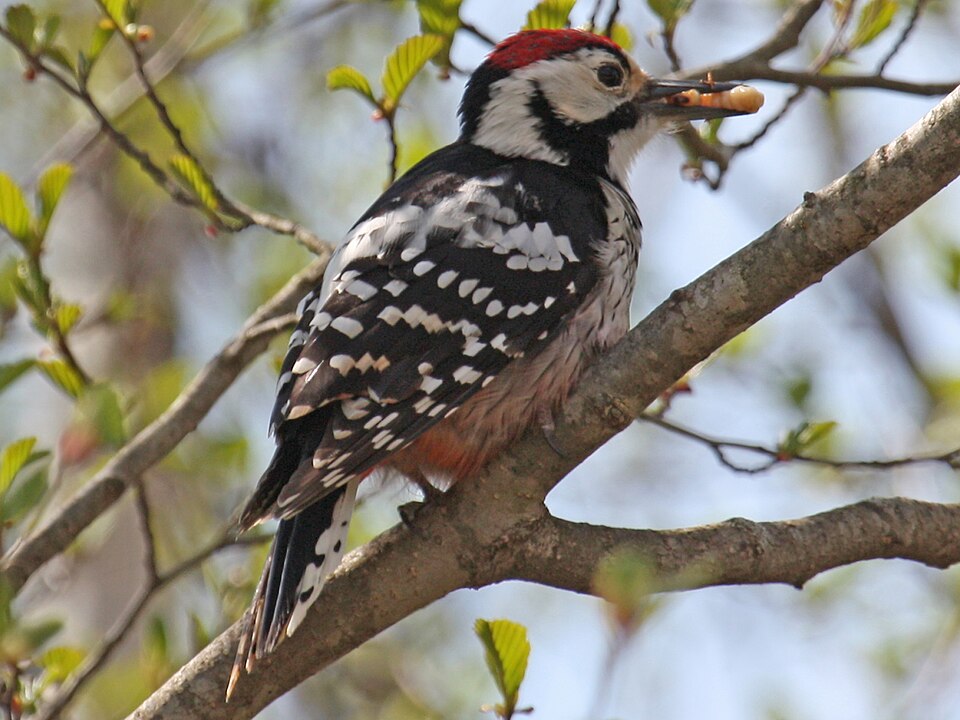 White-backed Woodpecker
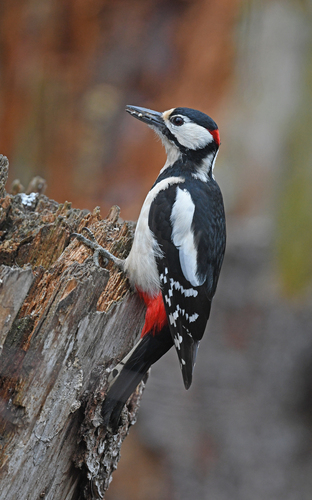 Great Spotted Woodpecker
In short
The most reliable field mark between White-backed and Great Spotted Woodpecker is the upperwing pattern: White-backed shows bold white bars across the wings (not spots), and a strikingly white lower back, while Great Spotted has white wing spots and a large white shoulder patch, but never a white lower back. In adults, White-backed males have a red crown (females black), while Great Spotted males have a red nape and both sexes show a red vent. Juvenile Great Spotted can be confusing, but their red crown is less extensive and their wing pattern still differs. Size, structure, and voice offer supporting clues, but focus on the wing and back pattern for a confident separation.
Identification tips
- Upperwing pattern (all ages): White-backed shows white bars across the wings, while Great Spotted has white spots and a large white shoulder patch. This is the most consistent field mark in flight or perched.
- Lower back color (all ages): White-backed has a striking white lower back, contrasting with the black back of Great Spotted. This is especially visible when the bird is climbing or in flight.
- Crown color (adults): White-backed male has a red crown, female a black crown. Great Spotted male has a red nape (not crown); female lacks red on the head. Juvenile Great Spotted has a red crown, but the wing pattern still differs.
- Ventral coloration: Great Spotted always shows a red vent and undertail in adults; White-backed lacks this bright red vent, appearing more uniformly pale below.
- Juvenile confusion: Juvenile Great Spotted can show a red crown, but look for the spotted (not barred) wing and lack of white lower back. Juvenile White-backed already shows the adult's barred wing and white lower back.
- Size and structure: White-backed is larger and bulkier, with a longer tail and heavier jizz, but beware overlap with large Great Spotted individuals, especially in the north.
- Habitat context: White-backed is rare in fragmented or urban habitats; Great Spotted is common in gardens and parks. If in doubt in a city, it is almost always Great Spotted.
- Subspecies variation: Some Great Spotted subspecies (northern) are larger and paler, but still lack the white lower back and barred wing of White-backed.
- Drumming and calls: Both species drum, but White-backed's drumming is described as very loud. Calls are not reliably separable in the field based on the provided notes.
- Sexing adults: Only male White-backed has a red crown; female is all black-crowned. Great Spotted male has a red nape, female lacks red on the head. This helps when birds are seen well from above.
- Red on head in juveniles: Juvenile Great Spotted has a red crown, but the rest of the plumage is duller and less well-marked, and the wing pattern remains spotted, not barred.
- Back pattern in flight: In flight, White-backed shows a broad white lower back and barred wings, while Great Spotted shows a black back with a white shoulder patch and spotted wings.
- Underpart color: Great Spotted adults have a bright red vent and undertail; White-backed is paler below without this strong red.
- General impression: White-backed often appears longer and heavier, with a more elongated profile, especially when climbing trunks.
- Pitfalls: Beware juvenile Great Spotted with red crowns and dull plumage; always check the wing and back pattern for confirmation.
Size
White-backed Woodpecker is distinctly larger, measuring 24–26 cm in length with a 38–40 cm wingspan, making it the largest spotted woodpecker in the western Palearctic [wikipedia]. Great Spotted Woodpecker is medium-sized at 20–24 cm length and a 34–39 cm wingspan [wikipedia], with an average adult mass of 89 g [wikidata]. In the field, White-backed often appears bulkier and longer-tailed, but beware overlap with large Great Spotted individuals, especially northern subspecies.
Plumage
-
Juvenile/immature birds: Both species' juveniles can show red on the crown, but the upperwing pattern is key. Juvenile White-backed already shows white bars across the wings (not spots), and a white lower back. Juvenile Great Spotted has a spotted wing pattern, a large white shoulder patch, and a red crown (less extensive in females), but the lower back is dark and the vent pinkish rather than red. Juvenile Great Spotted also has less defined markings and a brownish tinge to the upperparts.
-
Adults: White-backed male has a red crown, female a black crown. The back is extensively white, especially on the lower back, and the wings are barred white and black (not spotted). Great Spotted male has a black crown with a red nape patch (female lacks red on the head), and the back is black with a large white shoulder patch but not a white lower back. The wings are black with white spots, and the underparts are white with a bright red vent and undertail. Subspecies variation in Great Spotted can affect underpart color and size, but the wing and back pattern remain consistent.
Behaviour
Both species drum and forage in similar ways, scaling bark and probing dead wood. White-backed is often more secretive and prefers mature, undisturbed forests, while Great Spotted is more adaptable and frequently visits gardens, parks, and a wider range of woodland types. In flight, both show undulating woodpecker flight, but White-backed may appear heavier and longer-tailed.
Habitat
White-backed Woodpecker is a specialist of mature, often deciduous or mixed forests with abundant dead wood, and is much less likely to be found in urban or fragmented habitats. Great Spotted Woodpecker is highly adaptable, found in a wide range of wooded habitats including parks, gardens, and coniferous forests. If you see a 'spotted' woodpecker in a city park, it is almost always Great Spotted.
Voice
White-backed's drumming is very loud, and its calls include a soft 'kiuk' and a longer 'kweek.' Great Spotted also drums and calls, but the notes do not provide enough detail for reliable separation in the field based on voice alone.
White-backed Woodpecker · Great Spotted Woodpecker · My Tricky Birds