

White-rumped Sandpiper vs Semipalmated Sandpiper
Calidris fuscicollis versus Calidris pusilla
Play a quiz with White-rumped Sandpiper and Semipalmated Sandpiper
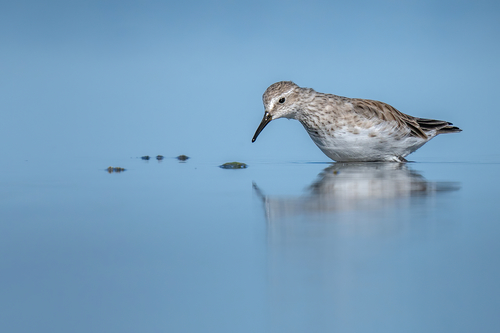 White-rumped Sandpiper
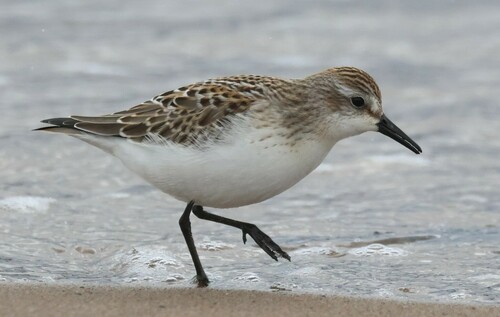 Semipalmated Sandpiper
In short
The most reliable way to separate White-rumped Sandpiper from Semipalmated Sandpiper is by spotting the White-rumped's distinctive white rump in flight—a feature never shown by Semipalmated. If the birds are not flying, look for the White-rumped's longer wings (which project well past the tail) and slightly larger, slimmer build. Both species can look very similar when perched, especially juveniles, but careful attention to wing length, bill shape, and subtle plumage differences can help. Age and season can complicate things, but the white rump in flight and long primary projection are the best clues in all plumages.
Identification tips
- White rump in flight: White-rumped Sandpiper always shows a bright white rump and uppertail coverts in flight, contrasting with the dark center of the tail. Semipalmated Sandpiper's rump is dull and matches the back. This is the single most reliable field mark, especially in mixed flocks or when birds flush.
- Primary projection: On the ground, White-rumped Sandpiper's wingtips extend well beyond the tail (long primary projection). Semipalmated's primaries barely reach or just meet the tail tip. This mark works for all ages and seasons, but is best seen on perched birds at rest.
- Bill shape and length: White-rumped Sandpiper has a longer, slightly decurved bill, while Semipalmated's bill is shorter, stubbier, and straight. This is subtle and variable, but helpful when seen well.
- Juvenile upperparts: Juvenile White-rumped Sandpipers show a white 'V' on the back and black-centered scapulars with brown and white edges. Juvenile Semipalmateds are plainer above, lacking the white 'V' and strong contrast.
- Breast streaking: Adult White-rumped Sandpipers (especially in breeding plumage) have fine streaking on the breast and flanks; Semipalmateds are usually cleaner white below with little or no streaking.
- Supercilium: White-rumped Sandpiper shows a pale or white supercilium (eyebrow) in all plumages, often more prominent than on Semipalmated, which has a less distinct pale eyebrow.
- Leg color: Both species have dark legs; this is not a useful separator.
- Overall shape: White-rumped Sandpiper is slightly larger, longer-winged, and more attenuated, with a slimmer look. Semipalmated is more compact and short-winged.
- Plumage tone: In winter, White-rumped is darker above with black feather centers, while Semipalmated is more uniformly grey-brown. This is subtle and not always reliable.
- Flock size/context: Semipalmated Sandpipers are often in huge flocks during migration, while White-rumped is usually in small numbers. However, both can occur together.
- Feeding behavior: Both species forage similarly, but White-rumped may probe slightly deeper and move more quickly. Not a strong separator.
- Habitat: Both use similar habitats; context is not diagnostic.
- Voice: Not described in the notes; do not rely on calls for separation based on this information.
- Sex/season: Males and females are similar in both species; seasonal changes mostly affect overall brightness and contrast, not key field marks.
- Pitfalls: Beware of dull juvenile White-rumped Sandpipers, which can look very similar to Semipalmated, especially when not in flight. Always try to see the rump and wing projection for confirmation.
Size
White-rumped Sandpiper is slightly heavier on average (body mass ~42.75g [wikidata]) than Semipalmated Sandpiper (not directly measured here, but typically lighter in field guides). Both are similar in length (15–18 cm), but White-rumped is a bit longer-winged, giving it a more attenuated, slender look, especially when compared side-by-side. In flocks, White-rumped often appears a touch larger and longer than Semipalmated, but this is subtle and not always reliable without direct comparison.
Plumage
Juvenile and non-breeding plumages are the trickiest. For juveniles, White-rumped Sandpiper shows a white 'V' on the back and more contrasty black-based feathers with brown and white edges on the scapulars and wing coverts, while Semipalmated juveniles are plainer above with less contrast and lack the white 'V'. In all ages, White-rumped has a white rump visible in flight, while Semipalmated's rump is dull and matches the back. Adult White-rumped in breeding plumage has a streaked breast and flanks, a pale supercilium, and a longer, slightly decurved bill; Semipalmated is plainer, with a shorter, straight bill and less streaking. In winter, both species become duller, but White-rumped retains darker upperparts with black feather centers and a white supercilium, while Semipalmated is more uniformly grey-brown above and white below.
Behaviour
Both species forage actively on mudflats and shorelines, often in mixed flocks, and their feeding behavior is very similar. White-rumped Sandpiper may appear a bit more restless, often moving quickly and sometimes probing deeper with its slightly longer bill. In migration, Semipalmated Sandpipers often gather in massive flocks, while White-rumped is usually found in smaller numbers. Flight style is similar, but White-rumped's longer wings can give it a more graceful, buoyant look.
Habitat
Both species breed in the tundra of northern Canada and Alaska and migrate through similar coastal and inland stopover sites. During migration, Semipalmated Sandpipers are far more numerous and can form huge flocks at key stopovers, while White-rumped Sandpipers are usually seen in smaller groups or singly. Both winter in South America, but White-rumped is more likely to be found further south. Habitat overlap is extensive, so context is rarely diagnostic.
White-rumped Sandpiper · Semipalmated Sandpiper · My Tricky Birds