

White-rumped Spinetail vs Silver-backed Needletail
Zoonavena sylvatica versus Hirundapus cochinchinensis
Play a quiz with White-rumped Spinetail and Silver-backed Needletail
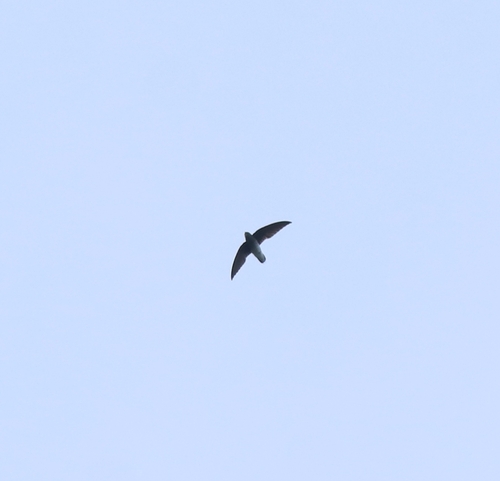 White-rumped Spinetail
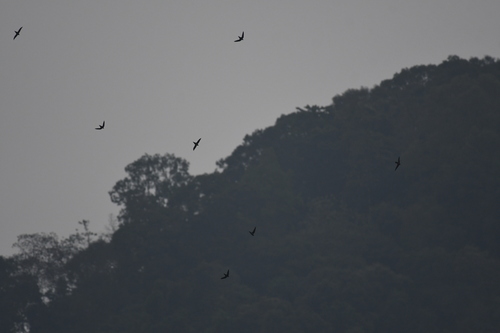 Silver-backed Needletail
In short
The most reliable field mark to separate White-rumped Spinetail from Silver-backed Needletail is the presence of a distinct white vent or rump patch on the spinetail, which is lacking in the needletail. Both species are swifts with similar overall structure, but the spinetail is much smaller and is usually seen over forest waterbodies, while the needletail is a large, powerful swift of Southeast Asian forests. If you see a swift with a prominent white vent in the Western Ghats or nearby forests, it's almost certainly a White-rumped Spinetail. In contrast, a much larger swift lacking a white vent and found further east is likely a Silver-backed Needletail.
Identification tips
- White vent/rump patch: Look for a distinct white patch at the vent or rump; this is present in all ages of White-rumped Spinetail and absent in Silver-backed Needletail. This is the single most reliable field mark.
- Overall size: If you have a sense of scale, the Silver-backed Needletail is much larger and heavier (80g) than the petite spinetail. In mixed swift flocks, the needletail will stand out for its bulk.
- Flight style: The needletail is a powerful, fast-flying swift, often appearing more forceful and direct. The spinetail, being smaller, may appear lighter and more agile, especially when foraging low over forest waterbodies.
- Geographic range: White-rumped Spinetail is only found in the Western Ghats, Bangladesh, and Nepal, while Silver-backed Needletail is found in Southeast Asia, Sumatra, Java, and Taiwan. If you are in India or Nepal, the spinetail is likely; further east, suspect needletail.
- Habitat preference: Spinetails are closely tied to forest waterbodies, while needletails are more generalist within Southeast Asian forests.
- Plumage uniformity: Apart from the white vent, the spinetail is otherwise dark above and below, similar to the needletail. Do not rely on subtle back coloration, as the needletail's 'silver' back is not a sharply defined patch and can be hard to see in the field.
- No white vent on needletail: If you see a swift with no trace of white on the vent or rump, especially in Southeast Asia, you are likely looking at Silver-backed Needletail.
- No age-specific upperwing marks: Neither species is reported to show distinctive juvenile or immature upperwing patterns that would help in separation.
- Perched views are rare: Both species are almost always seen in flight, so focus on flight marks and silhouette.
- Potential confusion with House Swift: The spinetail can resemble a House Swift, but the white vent is diagnostic for spinetail.
- No vocal clues provided: Vocalizations are not described in the sources, so do not rely on calls for separation.
- Sexes similar: No sexual dimorphism is noted for either species, so all field marks apply to both sexes.
- Beware of lighting: In poor light, the white vent of the spinetail may be less obvious, but it should still be visible in most conditions.
- Contextual clues: If you see a small swift over a forest pond in the Western Ghats with a white vent, it's almost certainly a spinetail. A much larger, uniform swift in Southeast Asia is the needletail.
- Avoid confusion with other needletails: Only Silver-backed Needletail is in the comparison; other needletails may have different field marks.
Size
Silver-backed Needletail is dramatically larger and heavier than White-rumped Spinetail, with an adult mass of about 80 grams [wikidata], compared to the much smaller spinetail (no precise mass available, but all sources agree it is a small swift). This size difference is striking in direct comparison: the needletail is a robust, powerful swift, while the spinetail is noticeably petite and lighter in flight.
Plumage
The key plumage difference is the white vent or rump patch of the White-rumped Spinetail, visible from below and behind in flight in all plumages. The Silver-backed Needletail lacks this white vent and instead has a more uniform dark underbody and back, sometimes with a silvery or pale sheen on the back but not a sharply defined white patch. No age-specific upperwing patterns are described for either species in the available notes, so this white vent is the most consistent mark across all ages and seasons. Both species otherwise show the typical swift silhouette and dark plumage, but the spinetail's white vent is unique and diagnostic.
Behaviour
White-rumped Spinetail is often seen flying low over waterbodies within forests, typically in the Western Ghats, Bangladesh, and Nepal. It tends to stay close to forested areas and water. Silver-backed Needletail is a strong, fast-flying swift of Southeast Asian forests, sometimes appearing as a vagrant on islands. Both species are aerial insectivores, but the needletail's larger size and more powerful flight may make it appear bulkier and more forceful in the air.
Habitat
White-rumped Spinetail is restricted to forests of the Western Ghats, Bangladesh, and Nepal, and is frequently seen over waterbodies within these forests. Silver-backed Needletail inhabits forests across Southeast Asia, Sumatra, Java, and Taiwan, and is a rare vagrant elsewhere. Their ranges do not typically overlap, so geographic context is a strong clue: spinetail in the Indian subcontinent, needletail further east.
White-rumped Spinetail · Silver-backed Needletail · My Tricky Birds