

Wood Sandpiper vs Spotted Redshank
Tringa glareola versus Tringa erythropus
Play a quiz with Wood Sandpiper and Spotted Redshank
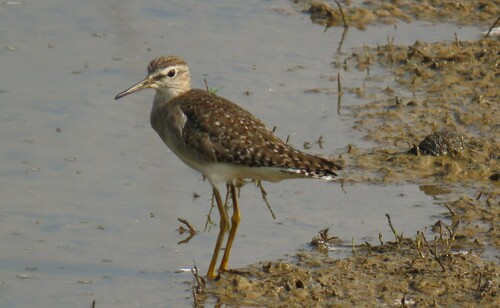 Wood Sandpiper
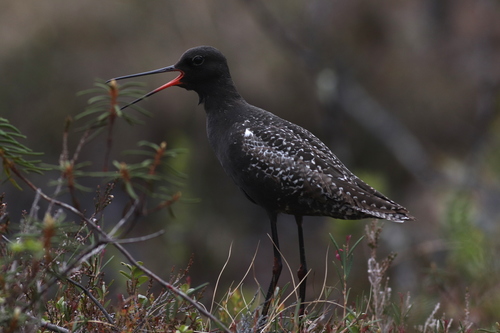 Spotted Redshank
In short
The most reliable way to separate Wood Sandpiper from Spotted Redshank is by size and structure: Spotted Redshank is much larger and heavier, with a long, straight bill and strikingly long red legs, while Wood Sandpiper is daintier, with a finer, shorter bill and yellowish legs. In flight, Spotted Redshank shows a bold white oval on the back, while Wood Sandpiper has a much less contrasting white rump. Juvenile and nonbreeding plumages can cause confusion, but Spotted Redshank juveniles are larger, with fine white speckling above and pale, barred underparts, compared to the Wood Sandpiper's more subdued, mottled brown appearance. Habitat can help: Wood Sandpiper prefers freshwater and wetland edges, while Spotted Redshank is more often found in larger, open wetlands and occasionally coastal sites.
Identification tips
- Size is the first check: Spotted Redshank is much larger and heavier than Wood Sandpiper; use this especially when birds are together, but even singly, look for the long-legged, long-billed, stately impression.
- Leg color and length: Spotted Redshank has long, bright red legs (darkening in breeding plumage), while Wood Sandpiper's legs are distinctly yellowish and proportionally shorter.
- Bill shape and color: Spotted Redshank's bill is long, straight, and red-based, often appearing heavier than Wood Sandpiper's shorter, finer, all-dark bill.
- Flight pattern – white on back: In flight, Spotted Redshank shows a bold white oval on the back, visible at a distance. Wood Sandpiper's white rump is smaller and less striking.
- Juvenile/immature plumage: Spotted Redshank juveniles are grey-brown with fine white speckling above and pale, finely barred underparts. Wood Sandpiper juveniles are brown above with diffuse, smaller spots and lack the crisp barring below.
- Breeding plumage: Spotted Redshank adults become black or dark grey with white spots and dark legs in breeding season—unique among shanks. Wood Sandpiper remains light brown and mottled, with yellowish legs.
- Nonbreeding plumage: Spotted Redshank is very pale in winter but still larger and longer-legged than Wood Sandpiper, which remains brownish and mottled.
- Habitat preference: Wood Sandpiper is almost always in freshwater habitats, while Spotted Redshank can be found in larger, open wetlands and sometimes coastal areas, especially on passage.
- Feeding style: Spotted Redshank often wades deeper and feeds with a sweeping motion; Wood Sandpiper feeds at the edge, probing lightly and moving with agility.
- Voice: Spotted Redshank's creaking whistle and sharp alarm are distinctive if heard; Wood Sandpiper's calls are softer and less striking.
- Jizz: Wood Sandpiper appears dainty and buoyant, while Spotted Redshank is tall, upright, and elegant.
- Pitfalls with distant birds: At long range, a pale Spotted Redshank can look similar to a Wood Sandpiper, but size, leg length, and flight pattern should resolve the ID.
- When marks fail: In poor light or at great distance, focus on relative size, leg color, and flight pattern for the most reliable separation.
- No overlap in breeding plumage: A black-bodied, white-spotted wader in spring is always Spotted Redshank; Wood Sandpiper never shows this plumage.
- No strong sexual dimorphism: Both species show similar plumage in both sexes, so sex is not a useful field mark.
Size
Spotted Redshank is more than twice as heavy as Wood Sandpiper (151.5g vs 67.5g) and visibly larger in the field. It is a large, long-legged wader, while Wood Sandpiper is the smallest of the shanks, appearing much more delicate and compact. The difference is especially obvious when both species are seen together, but even singly, Spotted Redshank's long legs and bill are distinctive. Wood Sandpiper is noticeably smaller, with a lighter, more agile build.
Plumage
- Juvenile/immature birds: Spotted Redshank juveniles are grey-brown above with fine white speckling and pale, finely barred underparts. In contrast, Wood Sandpiper juveniles and immatures are brown above with diffuse, smaller spots and mottling, and lack the crisp barring below. In flight, Spotted Redshank shows a prominent white oval on the back, while Wood Sandpiper's rump patch is smaller and less contrasting.
- Adult breeding: Spotted Redshank adults are strikingly black or dark grey with white spots in breeding plumage, and their legs turn dark grey. Wood Sandpiper adults in breeding plumage are light brown above with darker mottling and yellowish legs, never showing the all-dark look of Spotted Redshank.
- Adult nonbreeding: Spotted Redshank becomes very pale in winter, but remains larger with red legs and bill. Wood Sandpiper remains brownish and mottled, with yellowish legs. The white oval on the back of Spotted Redshank in flight remains a key mark in all plumages.
- Moult: Both species have complex moult strategies, but this is not easily seen in the field except for the clear difference in juvenile and adult plumages.
Behaviour
Wood Sandpiper is more likely to be seen actively feeding at the edge of shallow freshwater, probing with its shorter bill and moving with a light, agile gait. Spotted Redshank often wades deeper, using its longer bill to probe and sweep, and may appear more stately or deliberate in movement. Both species can be wary, but Spotted Redshank's larger size and longer legs make its feeding style more distinctive when observed side by side.
Habitat
Wood Sandpiper is strongly associated with freshwater habitats: marshes, wet meadows, lake edges, and riverbanks. It avoids coastal and saline environments. Spotted Redshank, while also using freshwater wetlands, is more versatile and can be found in larger, open wetlands and sometimes at coastal sites, especially on migration. If you find a small, delicate wader at a muddy freshwater pool, Wood Sandpiper is more likely; a large, long-legged wader in a wide, open wetland or coastal lagoon may be Spotted Redshank.
Voice
Spotted Redshank gives a distinctive creaking whistle 'teu-it' and an alarm 'kyip-kyip-kyip,' which are quite different from the Wood Sandpiper's softer, more typical sandpiper calls. However, vocalizations are not always heard and may be less reliable unless the bird is calling frequently.