

Yellow-bellied Flycatcher vs Acadian Flycatcher
Empidonax flaviventris versus Empidonax virescens
Play a quiz with Yellow-bellied Flycatcher and Acadian Flycatcher
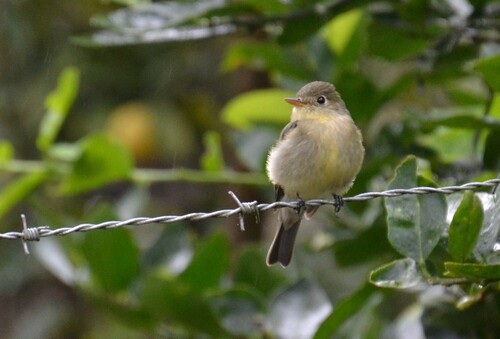 Yellow-bellied Flycatcher
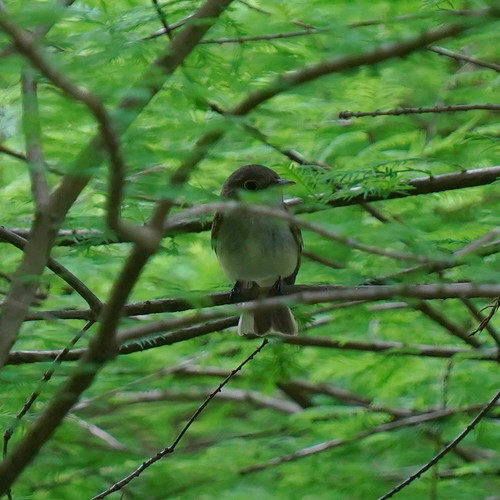 Acadian Flycatcher
In short
The most reliable field mark to separate Yellow-bellied Flycatcher from Acadian Flycatcher is the underpart color: Yellow-bellied shows distinctly yellowish underparts (especially the throat), while Acadian is much whiter below with only a faint olive wash on the breast. Both have olive-green upperparts and white eye rings, but Yellow-bellied's wing bars and eye ring often appear more yellowish, and its overall impression is greener and brighter. Structurally, Yellow-bellied is slightly smaller, with a shorter tail and a broader, flatter bill with a more orange-pink lower mandible, compared to Acadian's longer wingspan and yellower lower mandible. Vocalizations are quite different, and are often the best field clue when plumage is ambiguous.
Identification tips
- Underpart color: Yellow-bellied Flycatcher shows distinctly yellowish underparts, especially the throat and belly, while Acadian Flycatcher is white below with only a faint olive wash on the breast. This is the most consistent field mark for all ages and seasons.
- Upperparts: Yellow-bellied is greener above, while Acadian is more olive, but this can be subtle and affected by light.
- Eye ring: Both species have a prominent eye ring, but Yellow-bellied's is often yellowish or buffy, while Acadian's is crisp white. The difference is most obvious in good light.
- Wing bars: Yellow-bellied's wing bars are white to yellowish and contrast strongly with blackish wings; Acadian's are white and less contrasting against the darker wings.
- Bill color: Both have a dark upper mandible, but Yellow-bellied's lower mandible is orange-pink, while Acadian's is yellowish. This is subtle and best seen at close range.
- Tail and structure: Yellow-bellied has a relatively short tail and a broad, flat bill; Acadian appears longer-winged and slightly larger overall, but this is not always obvious in the field.
- Vocalizations: Learn the songs: "tse-berk" (Yellow-bellied) vs. "peet-sa" or "ka-zeep" (Acadian). Calls are often the best clue when plumage is ambiguous.
- Wing pattern in flight: No unique juvenile or immature upperwing marks are described for either species that would help in flight; focus on underpart color and structure.
- Perched posture: Both perch upright, but Yellow-bellied may look more compact due to its shorter tail.
- Season and location: Both can occur in similar habitats, so do not rely on context alone for separation.
- Sex differences: No sexual dimorphism is described in the sources; all field marks apply to both sexes.
- Lighting pitfalls: In poor light, Acadian's olive wash can look yellower, and Yellow-bellied's yellow can be muted; always try for multiple views.
- Wing bar color: If the wing bars look distinctly yellowish, favor Yellow-bellied; if crisp white, favor Acadian.
- Bill base color: If you get a clear look at the bill, an orange-pink lower mandible points to Yellow-bellied, yellowish to Acadian.
- Voice trumps plumage: If you hear a clear song, use that for ID, as plumage overlap and lighting can cause confusion.
Size
Yellow-bellied Flycatcher is slightly smaller and lighter, with a body mass around 11.3 g [wikidata], length 13–15 cm, and wingspan 18–20 cm. Acadian Flycatcher is marginally larger: length 14–15 cm and wingspan 22–23 cm [wikipedia]. In the field, Acadian may look longer-winged and more attenuated, but the difference is subtle and not always reliable for a single perched bird.
Plumage
- Adults: Yellow-bellied Flycatcher has greenish upperparts and distinctly yellowish underparts, especially on the throat and belly, with a dusky chest wash. Its eye ring and wing bars are often yellowish or buffy, standing out against blackish wings. Acadian Flycatcher is olive above, with darker wings and tail, and whitish underparts; the breast is only faintly washed with olive. Its eye ring and wing bars are white, not yellowish.
- Bill: Both have a dark upper mandible, but Yellow-bellied's lower mandible is orange-pink, while Acadian's is yellowish.
- Juvenile/immature wing pattern: No specific age-related upperwing pattern differences are described in the sources for these two species, so focus on adult plumage and underpart color for all ages.
Behaviour
Both species are typical Empidonax flycatchers, sallying from perches to catch insects. Yellow-bellied often perches low or mid-level in trees and sometimes hovers over foliage. No unique behavioral differences are noted in the sources, so behavior alone is not a reliable separator.
Habitat
No direct habitat distinctions are provided in the notes. Both species are woodland flycatchers, and overlap in some forested habitats. Use plumage and voice for separation rather than habitat.
Voice
Vocalizations are highly diagnostic. Yellow-bellied Flycatcher gives a rough, descending "tse-berk"; Acadian Flycatcher's song is an explosive "peet-sa" or a unique two-note "ka-zeep." Acadian also gives a soft "peet" call and sometimes a call reminiscent of a Northern Flicker. If you hear the song well, identification is straightforward.
Yellow-bellied Flycatcher · Acadian Flycatcher · My Tricky Birds