
Motmot

African Rail vs Broad-billed Roller

Rallus caerulescens versus Eurystomus glaucurus

Play a quiz with African Rail and Broad-billed Roller
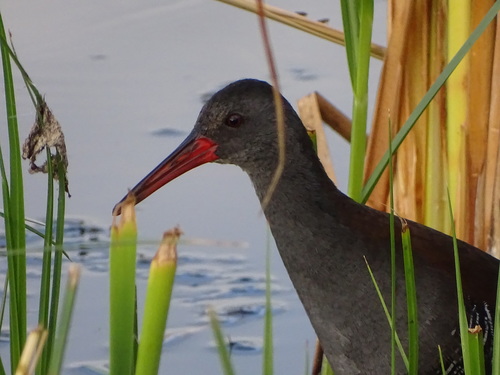
African Rail (Rallus caerulescens) African Rail
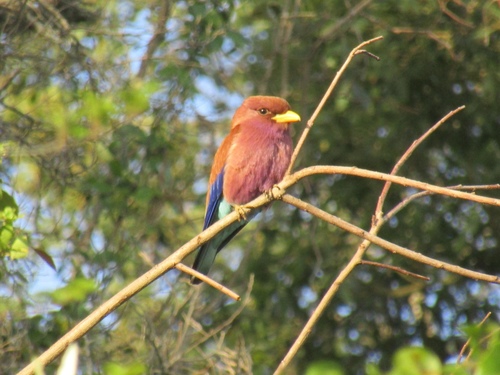
Broad-billed Roller (Eurystomus glaucurus) Broad-billed Roller

Media

Loading…

In short

The most reliable way to separate African Rail from Broad-billed Roller is by overall structure and bill color: African Rail is a slender, laterally compressed wetland bird with a long, slim, dull red bill, while Broad-billed Roller is a robust, upright percher with a thick, bright yellow bill. In flight, the roller flashes brilliant blue in the wings and tail, never shown by the rail. Plumage differences are also strong: African Rail has blue-grey underparts and brown upperparts with black-and-white flanks, while the roller has a lilac breast, brown back, and no barring. Habitat is a strong clue: rails are secretive marsh birds, rollers are conspicuous in open woodland or perched high. Juvenile rollers are duller but still structurally distinct from rails.

Identification tips

  1. Bill shape and color: African Rail has a long, slim, dull red bill; Broad-billed Roller has a thick, broad, bright yellow bill. This is visible even at a distance and is diagnostic at all ages.
  2. Body shape: Rails are laterally compressed, with a narrow, elongated body adapted for slipping through reeds. Rollers are robust, upright, and broad-headed, with a much chunkier silhouette.
  3. Leg color: African Rail has red legs, matching its bill; Broad-billed Roller’s legs are less conspicuous but do not match the bill’s brightness.
  4. Upperparts: African Rail is plain brown above (no streaking or pattern), while the roller is warm brown but with a lilac foreneck and breast.
  5. Underparts: Rails show blue-grey underparts (adults) or buff (immatures), with bold black-and-white barring on the flanks and undertail. Rollers have a lilac or pale breast (juveniles), never barred or blue-grey.
  6. Flight appearance: Broad-billed Roller in flight shows brilliant blue in the wings and tail, a feature never present in African Rail. Rails fly low and weakly, rarely exposing much color.
  7. Tail: Rail’s tail is short and often held cocked; roller’s tail is longer and squared off, often fanned in flight.
  8. Juvenile confusion: Juvenile African Rail is buff below, but still has flank barring and a slim red bill. Juvenile roller is duller and paler than adult but structurally identical to adult roller, with a broad yellow bill and no barring.
  9. Habitat: Rails are always in or near dense marsh vegetation; rollers are in open woodland, forest edge, or perched on exposed branches, rarely near dense reeds.
  10. Behavior: Rails are secretive, running or slipping between reeds, rarely perching in the open. Rollers are conspicuous, often sallying from perches or flying high above the canopy.
  11. Vocalizations: Rail’s call is a whistled trill; roller’s is a harsh, snarling rattle. Calls are distinctive and habitat-appropriate.
  12. Feeding: Rails probe mud or shallow water for invertebrates; rollers hunt flying insects, often in groups, and may drink on the wing.
  13. Sexes: Both species have similar plumage in both sexes, so sex is not a useful field mark.
  14. Size impression: Despite similar lengths, rails appear much slimmer and lighter in build; rollers are bulkier and more robust.
  15. Common pitfalls: Distant or brief views may confuse a perched roller for a rail due to size, but bill shape, posture, and habitat should quickly clarify the ID.

Size

African Rail is slightly heavier (average 160 g vs 104 g for Broad-billed Roller) but appears much slimmer and more elongated, with a body length of 27–28 cm. Broad-billed Roller is a bit longer (29–30 cm) but is chunkier, with a broad head and bill. The rail's body is laterally flattened for moving through reeds, while the roller is stocky and upright.

Plumage

No age-specific upperwing flight marks are described for either species, but overall plumage is distinctive at all ages. Adult African Rail is brown above, blue-grey below, with bold black-and-white barring on the flanks and undertail. Its back is plain (unique among Rallus rails). Immature rails replace the blue-grey with buff, but retain the overall pattern. Broad-billed Roller is warm brown above, with a lilac foreneck and breast, and the rest mainly brown; in flight, the wings and tail show brilliant blue. Juvenile rollers are duller, with a pale breast, but still lack the rail's barring and blue-grey tones. The roller's bill is always bright yellow and broad, contrasting with the rail's long, slim, dull red bill. The roller never shows flank barring.

Behaviour

African Rail is secretive, moving stealthily through dense marsh vegetation, often only glimpsed as it slips between reeds. It forages by probing mud or shallow water. Broad-billed Roller is much more conspicuous, often seen perched in the open or making strong, direct flights with rapid wingbeats. Rollers are inactive for much of the day but become active in late afternoon, sometimes gathering in groups to feed on swarming insects. They may drink on the wing, dipping their bill into water.

Habitat

African Rail is strictly a wetland species, found in dense reedbeds and marshes in eastern and southern Africa. It is rarely seen away from water or thick emergent vegetation. Broad-billed Roller occupies open woodland, savanna, and forest edge across tropical Africa and Madagascar, avoiding only the driest regions. It is rarely, if ever, found in dense marshes or reedbeds.

Voice

African Rail gives a trilled, whistled 'treee-tee-tee-tee-tee' call, often heard from cover in wetlands. Broad-billed Roller has a harsh, snarling 'k-k-k-k-k-r-r-r-r-r' call, typically delivered from a perch or in flight. The two calls are quite different and reflect their contrasting habitats.

Submit a better description

Use the same sections as the comparison. Your text is published immediately.

The most reliable way to separate African Rail from Broad-billed Roller is by overall structure and bill color: African Rail is a slender, laterally compressed wetland bird with a long, slim, dull red bill, while Broad-billed Roller is a robust, upright percher with a thick, bright yellow bill. In flight, the roller flashes brilliant blue in the wings and tail, never shown by the rail. Plumage differences are also strong: African Rail has blue-grey underparts and brown upperparts with black-and-white flanks, while the roller has a lilac breast, brown back, and no barring. Habitat is a strong clue: rails are secretive marsh birds, rollers are conspicuous in open woodland or perched high. Juvenile rollers are duller but still structurally distinct from rails.

  1. Bill shape and color: African Rail has a long, slim, dull red bill; Broad-billed Roller has a thick, broad, bright yellow bill. This is visible even at a distance and is diagnostic at all ages.
  2. Body shape: Rails are laterally compressed, with a narrow, elongated body adapted for slipping through reeds. Rollers are robust, upright, and broad-headed, with a much chunkier silhouette.
  3. Leg color: African Rail has red legs, matching its bill; Broad-billed Roller’s legs are less conspicuous but do not match the bill’s brightness.
  4. Upperparts: African Rail is plain brown above (no streaking or pattern), while the roller is warm brown but with a lilac foreneck and breast.
  5. Underparts: Rails show blue-grey underparts (adults) or buff (immatures), with bold black-and-white barring on the flanks and undertail. Rollers have a lilac or pale breast (juveniles), never barred or blue-grey.
  6. Flight appearance: Broad-billed Roller in flight shows brilliant blue in the wings and tail, a feature never present in African Rail. Rails fly low and weakly, rarely exposing much color.
  7. Tail: Rail’s tail is short and often held cocked; roller’s tail is longer and squared off, often fanned in flight.
  8. Juvenile confusion: Juvenile African Rail is buff below, but still has flank barring and a slim red bill. Juvenile roller is duller and paler than adult but structurally identical to adult roller, with a broad yellow bill and no barring.
  9. Habitat: Rails are always in or near dense marsh vegetation; rollers are in open woodland, forest edge, or perched on exposed branches, rarely near dense reeds.
  10. Behavior: Rails are secretive, running or slipping between reeds, rarely perching in the open. Rollers are conspicuous, often sallying from perches or flying high above the canopy.
  11. Vocalizations: Rail’s call is a whistled trill; roller’s is a harsh, snarling rattle. Calls are distinctive and habitat-appropriate.
  12. Feeding: Rails probe mud or shallow water for invertebrates; rollers hunt flying insects, often in groups, and may drink on the wing.
  13. Sexes: Both species have similar plumage in both sexes, so sex is not a useful field mark.
  14. Size impression: Despite similar lengths, rails appear much slimmer and lighter in build; rollers are bulkier and more robust.
  15. Common pitfalls: Distant or brief views may confuse a perched roller for a rail due to size, but bill shape, posture, and habitat should quickly clarify the ID.

African Rail is slightly heavier (average 160 g vs 104 g for Broad-billed Roller) but appears much slimmer and more elongated, with a body length of 27–28 cm. Broad-billed Roller is a bit longer (29–30 cm) but is chunkier, with a broad head and bill. The rail's body is laterally flattened for moving through reeds, while the roller is stocky and upright.

No age-specific upperwing flight marks are described for either species, but overall plumage is distinctive at all ages. Adult African Rail is brown above, blue-grey below, with bold black-and-white barring on the flanks and undertail. Its back is plain (unique among Rallus rails). Immature rails replace the blue-grey with buff, but retain the overall pattern. Broad-billed Roller is warm brown above, with a lilac foreneck and breast, and the rest mainly brown; in flight, the wings and tail show brilliant blue. Juvenile rollers are duller, with a pale breast, but still lack the rail's barring and blue-grey tones. The roller's bill is always bright yellow and broad, contrasting with the rail's long, slim, dull red bill. The roller never shows flank barring.

African Rail is secretive, moving stealthily through dense marsh vegetation, often only glimpsed as it slips between reeds. It forages by probing mud or shallow water. Broad-billed Roller is much more conspicuous, often seen perched in the open or making strong, direct flights with rapid wingbeats. Rollers are inactive for much of the day but become active in late afternoon, sometimes gathering in groups to feed on swarming insects. They may drink on the wing, dipping their bill into water.

African Rail is strictly a wetland species, found in dense reedbeds and marshes in eastern and southern Africa. It is rarely seen away from water or thick emergent vegetation. Broad-billed Roller occupies open woodland, savanna, and forest edge across tropical Africa and Madagascar, avoiding only the driest regions. It is rarely, if ever, found in dense marshes or reedbeds.

African Rail gives a trilled, whistled 'treee-tee-tee-tee-tee' call, often heard from cover in wetlands. Broad-billed Roller has a harsh, snarling 'k-k-k-k-k-r-r-r-r-r' call, typically delivered from a perch or in flight. The two calls are quite different and reflect their contrasting habitats.

Discard your changes?

You have unsaved edits. If you leave now, those changes will be lost.

African Rail · Broad-billed Roller · My Tricky Birds