
Arnot's Chat vs Capped Wheatear
Myrmecocichla arnotti versus Oenanthe pileata
Play a quiz with Arnot's Chat and Capped Wheatear
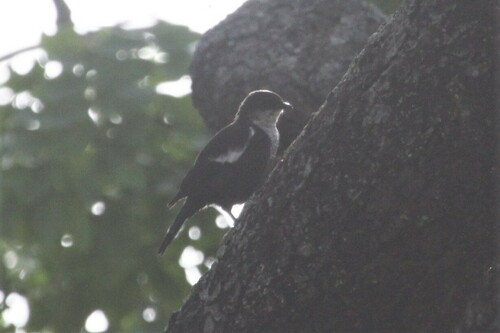 Arnot's Chat
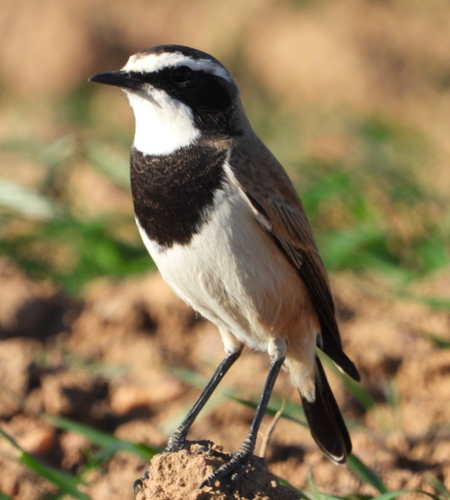 Capped Wheatear
In short
The most reliable field mark to separate Arnot's Chat from Capped Wheatear is the presence of a white crown in adult male Arnot's Chat, versus the black cap and bold black breast band of Capped Wheatear. Juveniles of both species can be confusing, but Capped Wheatear juveniles show a brown cap and diffuse breast band, while young Arnot's Chat have white-tipped feathers on the crown or throat. In flight, Capped Wheatear shows a distinctive black T-pattern on the white rump and tail, which Arnot's Chat lacks. Both are similar in size and share black legs and bill, but their head and wing patterns are the most practical field clues.
Identification tips
- White crown (adult male Arnot's Chat): Look for a pure white crown contrasting with a black body—unique to male Arnot's Chat among these two. Capped Wheatear always has a black cap, not white, in all plumages.
- Black cap and breast band (Capped Wheatear): Adult Capped Wheatear shows a black cap, cheeks, and a bold black breast band, with a white throat and underparts. Arnot's Chat never has a black breast band or white eye stripe.
- Tail pattern in flight (all ages): Capped Wheatear has a distinctive black T on a white rump and tail, visible when the bird fans its tail or flies. Arnot's Chat lacks this, having a more uniformly dark tail and rump.
- Juvenile head pattern: Juvenile Capped Wheatear has a brown (not black or white) cap and cheeks, and a weak, diffuse breast band. Juvenile Arnot's Chat shows white-tipped feathers on the crown or throat, which can look patchy but never forms a full white crown.
- White throat (female Arnot's Chat): Female Arnot's Chat has a white throat and neck, sharply set off from a black crown and body. In Capped Wheatear, the white throat blends into the white underparts and is not as sharply defined.
- White patch on wing coverts (male Arnot's Chat): Male Arnot's Chat shows a white patch on the wing coverts, which is absent in Capped Wheatear.
- Buff flanks (Capped Wheatear): Capped Wheatear adults have buff coloring on the flanks and lower belly, whereas Arnot's Chat is more uniformly dark below (except for the white throat in females).
- Bill and legs: Both species have black bills and legs; this is not a useful separator.
- Perched posture: Both species perch upright, but Capped Wheatear often flicks its tail, drawing attention to the white rump and tail pattern.
- Subspecies confusion: Some Arnot's Chat subspecies (e.g., harterti) have less white on the head and wings, making them appear even darker and easier to confuse with Capped Wheatear. In these cases, rely on tail pattern and breast band.
- Habitat overlap: While habitat can give a clue (Capped Wheatear in open grassland, Arnot's Chat in woodland/savanna), do not rely solely on this where both occur.
- Sexual dimorphism: Only Arnot's Chat is strongly sexually dimorphic in head pattern (white crown in males, black in females); Capped Wheatear sexes are similar.
- White eye stripe (Capped Wheatear): The white supercilium (eye stripe) is prominent in Capped Wheatear, absent in Arnot's Chat.
- Overall impression: If the bird appears mostly black with a white crown or throat, think Arnot's Chat. If it shows a black cap, white underparts, and a black breast band, think Capped Wheatear.
- When in doubt: Watch for the tail pattern in flight—Capped Wheatear's black T on white is the single most reliable field mark in all ages and sexes.
Size
Both species are very close in size: Arnot's Chat measures 16–18 cm and around 35 g, while Capped Wheatear is 17–18 cm and about 32 g [wikipedia]. In the field, size alone is not a useful separator. Both have black legs and a pointed black bill, so structural differences are subtle or absent.
Plumage
-
Juveniles: Juvenile Capped Wheatear has a brown cap and cheeks, with a weak, diffuse breast band. Juvenile Arnot's Chat resembles adults but with white feather tips on the crown or throat (not a full white crown or throat). The juvenile Capped Wheatear's tail pattern is already developing the black T on the white rump, which is absent in Arnot's Chat of any age.
-
Adult males: Arnot's Chat (nominate) is black with a striking white crown and a white patch on the wing coverts. Capped Wheatear adult has a black cap, cheeks, and breast band, with a white eye stripe and throat, and a white belly with buff flanks. The Capped Wheatear's tail pattern is diagnostic: a black T on a white rump and tail, unlike the more uniformly dark tail of Arnot's Chat.
-
Adult females: Female Arnot's Chat has a black crown and a white throat and neck (tipped with black), while female Capped Wheatear is similar to the male but may be slightly duller. The white throat of female Arnot's Chat is more isolated and sharply defined compared to the continuous white underparts of Capped Wheatear.
-
Subspecies: Some Arnot's Chat races (e.g., harterti) have less white on the wings and a mostly black head, which can reduce contrast with Capped Wheatear, but the tail pattern remains a reliable separator.
Behaviour
Both species are ground-dwelling insectivores and may be seen perched upright on low bushes or rocks. Capped Wheatear often flicks its tail and shows its white rump in flight, a behavior that draws attention to its tail pattern. Arnot's Chat is less likely to flash a white rump and may appear more uniformly dark when perched or in flight.
Habitat
Both are found in southern Africa and can overlap in range. Arnot's Chat is generally associated with open woodland and savanna, while Capped Wheatear favors open grassland, short scrub, and bare ground. However, habitat alone is not diagnostic where ranges overlap.