
Barn Swallow vs Red-rumped Swallow
Hirundo rustica versus Cecropis daurica
Play a quiz with Barn Swallow and Red-rumped Swallow
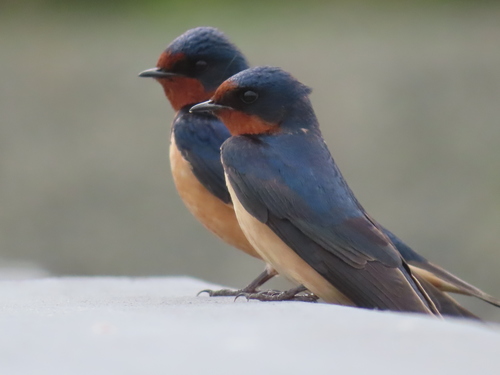 Barn Swallow
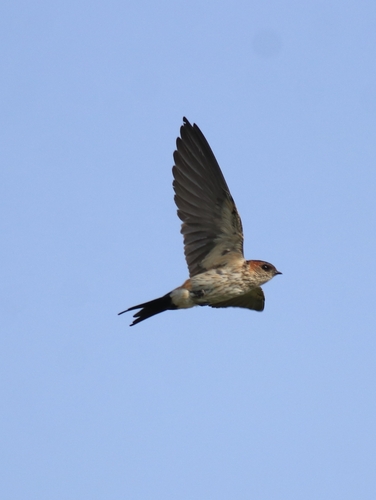 Red-rumped Swallow
In short
The most reliable field mark to separate Barn Swallow from Red-rumped Swallow is the combination of underpart and rump pattern: Barn Swallow adults show a clean rufous throat and forehead, a blue-black breast band, and white (not streaked) underparts, while Red-rumped Swallow has white underparts heavily streaked with dark lines and a distinct chestnut rump patch. In flight, Barn Swallow's tail is deeply forked with long streamers (especially in adults), while Red-rumped's tail is less deeply forked and the rump is more conspicuous. Juvenile Barn Swallows can be confused with Red-rumped due to shorter tails, but still lack the heavy underpart streaking and have a less distinct rump patch. Pay special attention to the rump and underpart streaking when viewing birds in flight or perched.
Identification tips
- Underpart streaking: Red-rumped Swallow always shows heavy dark streaking on otherwise white underparts (all ages), while Barn Swallow's underparts are clean and off-white (adults) or only faintly marked (juveniles).
- Rump color: Red-rumped Swallow has a chestnut or rufous rump patch, sometimes streaked or paler in juveniles/subspecies, always contrasting with the blue back. Barn Swallow's rump is blue, matching the upperparts.
- Throat and forehead: Barn Swallow has a rich rufous forehead, chin, and throat, separated from the underparts by a dark blue breast band. Red-rumped Swallow's face is white or pale with a faint or absent reddish collar, and no strong breast band.
- Tail shape and length: Barn Swallow adult has very long, deeply forked tail streamers (especially males), with a line of white spots across the outer tail. Red-rumped Swallow's tail is less deeply forked, with shorter streamers and less distinct white spots.
- Juvenile confusion: Juvenile Barn Swallow lacks long tail streamers and is browner above, but still lacks heavy underpart streaking and has a blue (not rufous) rump. Juvenile Red-rumped Swallow is duller overall but always shows some chestnut rump and underpart streaking.
- Breast band: Barn Swallow has a broad, dark blue breast band separating the rufous throat from the white belly. Red-rumped Swallow lacks a breast band; the throat merges into the streaked underparts.
- Face pattern: Barn Swallow's rufous face is distinctive. Red-rumped Swallow has a pale or white face with a possible faint reddish collar.
- Perched posture: Barn Swallow often appears more elongated and slender due to its long tail streamers, especially when perched. Red-rumped Swallow looks more compact with a shorter tail.
- Flight jizz: Barn Swallow's flight is more acrobatic and graceful, with long tail streamers trailing behind. Red-rumped Swallow's flight is slightly more direct and less 'swallow-like' due to the shorter tail.
- Habitat context: In built-up or farm areas, Barn Swallow is much more likely. In hilly, rural, or lightly wooded country, especially away from buildings, check for Red-rumped Swallow.
- Nesting sites: Barn Swallow nests on buildings, under eaves, or even under osprey nests. Red-rumped Swallow prefers cliffs, bridges, or rural structures.
- Vocalization: Barn Swallow is more vocal, especially near nests. Red-rumped Swallow is quieter and less likely to call conspicuously.
- Sex differences: Female Barn Swallow has shorter tail streamers and paler underparts than male, but still shows the same basic pattern. Red-rumped Swallow sexes are alike.
- Subspecies variation: Some Red-rumped Swallow subspecies (e.g., C. d. erythropygia) have a uniform chestnut rump without streaks and a shallow tail fork; others have a paler, streaked rump. Always check for underpart streaking and rump color.
- Pitfalls: In poor light or at distance, juvenile Barn Swallow may appear similar to Red-rumped Swallow due to short tail and duller plumage, but lack of underpart streaking and a blue rump are key. Always try to see the rump and belly clearly.
Size
Both species are similar in overall length (Barn Swallow 17–19 cm including tail streamers, Red-rumped Swallow about 19 cm), but Barn Swallow's tail streamers can make it appear longer and more slender, especially in adult males. Wingspans are also similar (Barn Swallow 32–34.5 cm). Weight is not reliably separable in the field. Size alone is not a strong separator, but Barn Swallow often looks slimmer and more elongated due to its tail.
Plumage
- Juvenile/immature birds: Juvenile Barn Swallow is browner above, with a paler rufous face, whiter underparts, and lacks long tail streamers. Juvenile Red-rumped Swallow is duller and browner, with a paler rump and shorter outer tail feathers, but always shows heavy dark streaking on the underparts and some form of chestnut rump patch (sometimes streaked or paler depending on subspecies).
- Adults: Barn Swallow adult has steel blue upperparts, a rufous forehead, chin and throat, a broad blue-black breast band, and clean off-white underparts. The tail is deeply forked with long outer tail streamers and a line of white spots across the outer tail. Red-rumped Swallow adult has blue upperparts, a rufous or chestnut rump (sometimes streaked), white underparts with heavy dark streaking, and a less deeply forked tail. The face is white and the reddish collar may be faint or absent. Tail white spots are less distinct than in Barn Swallow.
- Key contrast: Underpart streaking and rump color are the most consistent field marks across all ages.
Behaviour
Both species are aerial insectivores and often forage in open areas. Barn Swallow is more likely to be seen in close association with human settlements, often nesting on buildings or under eaves, and frequently perches on wires in groups. Red-rumped Swallow prefers open, hilly, or lightly wooded country, often away from dense human habitation, and may nest on cliffs or under bridges. Both species can be seen flying low over fields or water, but Barn Swallow tends to be more confiding and visible in built-up areas.
Habitat
Barn Swallow is extremely widespread and adaptable, commonly found in open country, farmland, and near human settlements across much of the world. Red-rumped Swallow favors open, often hilly or lightly wooded areas, sometimes with cultivation, and is less tied to buildings or close human proximity. In Asia, Red-rumped Swallow is more likely in hilly or rural landscapes, while Barn Swallow is ubiquitous in villages, towns, and farms.
Voice
Barn Swallow has a variety of calls, including a soft 'witt' or 'witt-witt', a loud 'splee-plink' when excited, and sharp alarm calls. Red-rumped Swallow's voice is not described in detail in the notes, but it is generally quieter and less vocal than Barn Swallow. Vocalizations are not the most reliable field mark for separation, but Barn Swallow is more likely to be heard calling, especially near nests.