

Black Baza vs Ayres's Hawk-Eagle
Aviceda leuphotes versus Hieraaetus ayresii
Play a quiz with Black Baza and Ayres's Hawk-Eagle
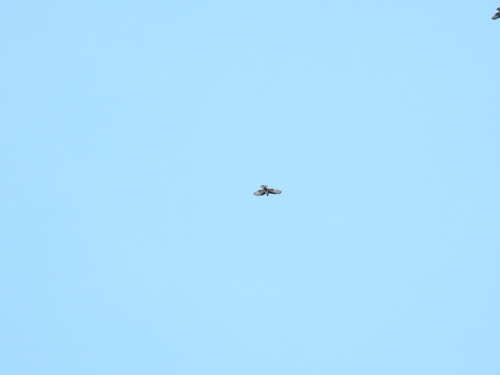 Black Baza
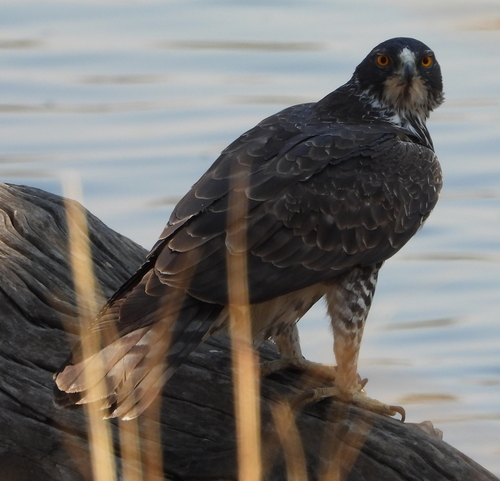 Ayres's Hawk-Eagle
In short
The most reliable field mark to separate Black Baza from Ayres's Hawk-Eagle is overall size and structure: Black Baza is a much smaller, compact raptor with a prominent upright crest, while Ayres's Hawk-Eagle is a medium-sized eagle with a longer tail, longer wings, and a more powerful, upright stance. In flight, Black Baza appears crow-like and often travels in small flocks, while Ayres's Hawk-Eagle soars singly or in pairs with a classic eagle silhouette. Juvenile Ayres's Hawk-Eagle is brown above and white below with sparse markings, lacking the striking black-and-white contrast of adult Black Baza. Perched, the Black Baza's bold white scapulars and chestnut barring (especially on females) are unique, while Ayres's Hawk-Eagle shows a more mottled, streaked appearance. Habitat also differs: Black Baza is an Asian forest raptor often seen in mixed flocks, while Ayres's Hawk-Eagle is an African woodland species.
Identification tips
- Size is the most immediate clue: Ayres's Hawk-Eagle is much larger and bulkier than Black Baza. If you see a raptor the size of a small eagle, it's not a Black Baza.
- Crest shape and posture: Black Baza has a prominent, upright crest that is always obvious when perched. Ayres's Hawk-Eagle has a small, sometimes pronounced crest, but it is never as upright or bushy as the Baza's.
- Wing and tail proportions: Black Baza has short, broad wings and a short tail, giving a compact, crow-like silhouette in flight. Ayres's Hawk-Eagle has longer wings and a longer, more squared tail, typical of eagles.
- Flight style: Black Baza often flies in small flocks, with agile, crow-like flight. Ayres's Hawk-Eagle soars singly or in pairs, with slow, powerful wingbeats and long glides.
- Upperwing pattern (all ages): Black Baza shows bold white patches on the scapulars and secondaries (especially males), creating a high-contrast black-and-white wing. Ayres's Hawk-Eagle (including juveniles) lacks any such white panels, showing instead a more uniform dark upperwing with some mottling in adults.
- Underparts: Black Baza males are mostly black with some white and chestnut; females have more chestnut barring below. Ayres's Hawk-Eagle adults are white below with heavy dark brown spots and blotches, never showing the clean, bold chestnut bands of female Baza.
- Juvenile confusion: Juvenile Ayres's Hawk-Eagle is brown above, white below with sparse brown markings; it lacks any bold white scapulars or contrasting wing panels. Juvenile Black Baza is not described here, but all ages are more strikingly patterned than Ayres's Hawk-Eagle juveniles.
- Tail pattern: Ayres's Hawk-Eagle has an ashy grey tail with a broad black tip and 3–4 narrower dark bars. Black Baza's tail pattern is not described in detail, but is not as prominently barred.
- Bill and feet: Black Baza has short, stout legs and feet with strong talons, and a bill with two tooth-like indentations (not visible at distance). Ayres's Hawk-Eagle has a more powerful eagle bill and well-feathered legs.
- Perched jizz: Black Baza perches upright, often with crest raised and white scapulars obvious. Ayres's Hawk-Eagle perches more horizontally, with a longer tail and less obvious crest.
- Group size: Flocking behavior is a strong clue: Black Baza is often in groups, especially on migration. Ayres's Hawk-Eagle is solitary or in pairs.
- Habitat and range: Black Baza is only found in Asia, in forested or wooded areas, sometimes in urban parks during migration. Ayres's Hawk-Eagle is only found in Africa, in woodland and forest edge.
- Voice: If you hear a 'chu-weep' or gull-like mewing, suspect Black Baza. Ayres's Hawk-Eagle is not known for similar calls.
- Sex differences: Female Black Baza has more chestnut barring below and less white in the wing than the male; Ayres's Hawk-Eagle females are larger, darker, and more densely spotted than males, but both sexes are much larger than any Baza.
- Melanistic confusion: Melanistic Ayres's Hawk-Eagle is mostly black with white markings, but is still much larger and structurally different from Black Baza, and lacks the bold white scapulars and crest.
Size
Ayres's Hawk-Eagle is dramatically larger than Black Baza. Adult Ayres's Hawk-Eagle averages about 839.5 g [wikidata], with a length of 44–57 cm and a wingspan of 106–137 cm [wikipedia]. In contrast, Black Baza is much smaller, at 30–35 cm long, 66–80 cm wingspan, and 168–224 g [wikipedia]. Even the smallest Ayres's Hawk-Eagle is several times heavier and longer than the largest Black Baza. In the field, this size gap is unmistakable if seen side by side or with familiar raptors for scale.
Plumage
Juvenile and immature birds are often confused, so focus on these ages first:
- Juvenile Ayres's Hawk-Eagle is dark brown above, with a white underside sparsely marked with brown. The upperwing is uniformly dark, lacking bold white patches or contrasting panels. As it matures, underparts become duskier and browner before adult plumage appears.
- Black Baza (all ages) is much more boldly patterned: adults (especially males) show striking white scapulars, secondary coverts, and secondaries, with a prominent upright crest. Females have more chestnut barring below and less white in the wing. In flight, Black Baza shows a crow-like, compact wing shape with strong black-and-white contrast, especially on the upperwing. Juvenile Black Baza is not described in detail here, but the species is always more contrasting and patterned than any Ayres's Hawk-Eagle age.
Adults:
- Black Baza males: bold white scapulars and secondaries, black body, upright crest.
- Black Baza females: similar but with more chestnut barring below, less white in the wing.
- Ayres's Hawk-Eagle: blackish upperparts with white mottling, ashy grey tail with black bars, white underparts heavily spotted with dark brown, brown underwing coverts with white, and a small (sometimes pronounced) crest. Melanistic phase is mostly black with white markings, but still much larger and differently shaped than Black Baza.
Behaviour
Black Baza is often seen in small groups or flocks, especially during migration, and is gregarious at roosts. It is somewhat crepuscular, more active at dusk or in overcast weather, and frequently joins mixed-species foraging flocks. Its feeding is agile and acrobatic, catching insects in aerial sallies or picking them from foliage with its feet.
Ayres's Hawk-Eagle, in contrast, is a solitary or paired hunter, soaring or perching high to scan for prey. It is not gregarious and does not join mixed flocks. Its hunting style is more typical of eagles: scanning from a perch or soaring, then stooping on birds or small mammals.
Habitat
Black Baza is an Asian forest raptor, found in forests of Northeast India, the eastern Himalayas, China, and Southeast Asia. It is migratory in parts of its range, wintering in peninsular India and Sri Lanka, and is often seen in wooded habitats, sometimes near metropolitan parks during migration or winter.
Ayres's Hawk-Eagle is native to African woodlands and is never found in Asia. It prefers open woodlands and forest edges, rarely venturing into dense forest or urban parks. Thus, range and habitat are strong clues: Black Baza in Asia, Ayres's Hawk-Eagle in Africa.
Voice
Black Baza gives a 'chu-weep' call, somewhat like a large cuckoo-shrike, as well as soft squeals, whistles, and a shrill, gull-like mewing. Ayres's Hawk-Eagle's vocalizations are not described in detail here, but are not known to be similar to Black Baza's calls.