

Black-naped Tern vs Tahiti Petrel
Sterna sumatrana versus Pseudobulweria rostrata
Play a quiz with Black-naped Tern and Tahiti Petrel
 Black-naped Tern
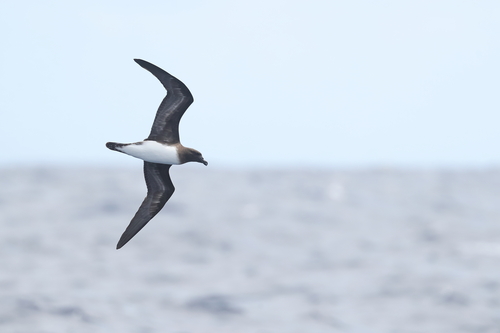 Tahiti Petrel
In short
The most reliable way to separate Black-naped Tern from Tahiti Petrel is by overall color and structure: Black-naped Tern is a slender, mostly white bird with a distinctive black nape band and deeply forked tail, while Tahiti Petrel is a much larger, heavy-bodied seabird with dark brown upperparts, a white belly, and a wedge-shaped tail. In flight, the tern shows silvery-grey wings and long, streaming tail feathers, whereas the petrel appears dark above with long, straight wings and a white underbody. Even at a distance, the tern’s white plumage and elegant build contrast sharply with the petrel’s bulkier, darker appearance. Both species may be seen over tropical Pacific waters, but their size, shape, and coloration are unmistakably different.
Identification tips
- Overall color: Black-naped Tern is almost entirely white with pale grey wings, while Tahiti Petrel is dark brown above with a white belly. This is the single most obvious difference at any distance.
- Nape mark: Look for the thin black line running from the eye around the nape on the tern; Tahiti Petrel lacks any such facial or nape markings.
- Tail shape: Black-naped Tern has a deeply forked, pure white tail that extends well past the wingtips when perched. Tahiti Petrel’s tail is wedge-shaped and does not project beyond the wings.
- Wing shape and flight: The tern’s wings are long, slender, and pointed, giving a buoyant, fluttery flight. The petrel’s wings are long and narrow but held straight out, with a heavier, more gliding flight reminiscent of an albatross.
- Bill shape: Black-naped Tern has a slender, straight black bill; Tahiti Petrel’s bill is thick, black, and bulbous at the base.
- Leg color: Both have black legs, but the tern’s are more visible when perched; petrels are rarely seen perched in the open.
- Underwing pattern: Tahiti Petrel has a faint white line along the underwing, but this is subtle and not always visible; Black-naped Tern’s underwings are mostly white with pale grey, lacking any dark or bold lines.
- Perched posture: If seen perched, the tern’s tail will stream well past the wings, and the bird will appear slim and upright. Petrels are rarely seen perched except at breeding sites.
- Size: The petrel is much larger and bulkier; if seen together, the difference is striking.
- Habitat context: Terns are usually seen near islands, reefs, or coastal waters; petrels are more likely to be seen far offshore.
- Head and neck: Tahiti Petrel has a small head and long neck relative to its body, with a dark hooded appearance; the tern has a proportionally smaller, sleeker head with a clean white face.
- Jizz: Tern is agile, buoyant, and often hovers; petrel is steady, gliding, and rarely hovers.
- Plumage pitfalls: At great distance, a tern in shadow may look darker, but the structure and tail shape will still separate them. Conversely, a petrel in strong light may show a paler belly, but the dark upperparts and wedge tail are distinctive.
- Juvenile confusion: Juvenile Tahiti Petrel is similar to adult and does not show the white nape or tail of the tern; juvenile Black-naped Tern is not likely to be confused due to its paler, mottled appearance at hatching, and quickly acquires adult-like plumage.
- Bill size at range: Even at a distance, the petrel’s bill appears thick and heavy, while the tern’s is needle-like.
Size
Black-naped Tern is much smaller and lighter (body mass ~106 g, length 30–35 cm, wingspan 66 cm) compared to Tahiti Petrel (body mass 315–506 g, length 38–42 cm, wingspan ~104.5 cm). The petrel is nearly three to five times heavier, with a much broader wingspan and a bulkier, more robust body. The tern is slim, delicate, and long-tailed, while the petrel is solidly built with a proportionally larger head and body.
Plumage
- Juvenile/immature birds: No distinctive upperwing pattern is described for either species' juveniles that would aid in separation; both are similar to adults in overall pattern, though Black-naped Tern hatchlings are mottled brown and not likely to be confused in the field.
- Adults: Black-naped Tern is almost entirely white, with pale silvery-grey wings and a narrow black line starting at the eye and running around the nape. The only dark on the wings is a narrow black edge on the outermost primary. The tail is pure white and deeply forked, extending well past the wingtips when perched. Tahiti Petrel adults are mostly dark brown above with a darker hood, paler rump, and white abdomen. The underwings are dark with a faint white line along the middle and slightly paler flight feathers. The tail is wedge-shaped and not as deeply forked as the tern’s. The bill of the petrel is black, stout, and bulbous, unlike the slender black bill of the tern.
Behaviour
Black-naped Tern is agile and buoyant in flight, often seen hovering or dipping close to the water, with long, slender wings and a deeply forked tail giving it a graceful, tern-like jizz. It often perches on rocks or buoys, with its tail streaming well past the wingtips. Tahiti Petrel, in contrast, has a heavier, more purposeful flight, with long, narrow wings held straight out from the body (almost albatross-like) and a wedge-shaped tail. The petrel rarely perches in view at sea and is more likely to be seen gliding or shearing low over the water.
Habitat
Both species are oceanic and found over tropical Pacific waters, but Black-naped Tern is strictly coastal, rarely seen far from islands or reefs, and almost never inland. It breeds and roosts on small rocky islets. Tahiti Petrel is a true pelagic species, often seen far from land, and breeds in remote mountainous islands. If a bird is seen close to shore, especially perched, it is more likely to be a tern; petrels are almost never seen resting on rocks or beaches.