

Blue-and-white Flycatcher vs Zappey's Flycatcher
Cyanoptila cyanomelana versus Cyanoptila cumatilis
Play a quiz with Blue-and-white Flycatcher and Zappey's Flycatcher
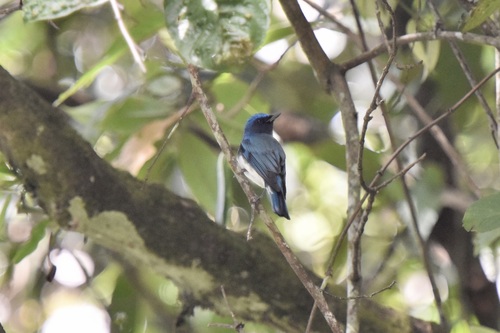 Blue-and-white Flycatcher
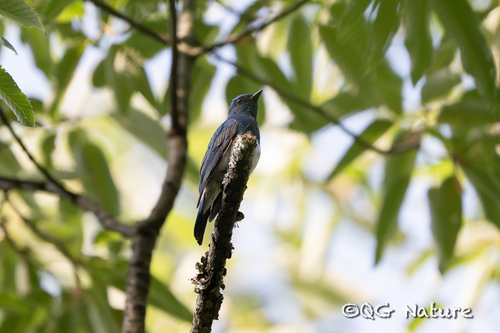 Zappey's Flycatcher
In short
The most reliable field mark between Blue-and-white Flycatcher and Zappey's Flycatcher is the shade and tone of blue on adult males: Blue-and-white shows a deep, intense cobalt blue, while Zappey's is a greener, turquoise-blue. Both species are very similar in size and structure, and females and immatures are particularly challenging, but Zappey's males have a greener cast to the blue and a slightly different face and breast pattern. Immature males of both species show blue wings but otherwise brownish plumage, making separation difficult at this age. Careful attention to the precise hue of blue and the extent of black or greenish-black on the face and upper breast is key for adult males; for females and immatures, reliable separation in the field is extremely difficult and often not possible without direct comparison or range context.
Identification tips
- Adult male blue tone: Blue-and-white Flycatcher males are deep, intense cobalt blue, while Zappey's males are greener, with a turquoise-blue cast. This is the single most reliable field mark for adult males in good light.
- Face and breast color (adult males): Blue-and-white shows black on the face and upper breast, while Zappey's has greenish-black in these areas. The difference is subtle but can be seen in direct comparison.
- Tail base patches: Both species have white at the base of the outer tail feathers, but Zappey's has two small white patches on the sides, while Blue-and-white's is a more prominent single patch. This is a minor mark and not always visible.
- Flank color (adult males): Zappey's males may show faintly greyish flanks, while Blue-and-white's are blackish on the flanks. This is subtle and often hard to judge.
- Female and immature confusion: Females and immature males of both species are very similar—grey-brown above, pale below, with a white or pale throat. Blue-and-white females may appear slightly smaller-headed, but this is not a strong field mark.
- Immature male pattern: Both species' immature males have blue wings, rump, and tail but a brownish or grey-brown head and mantle, and a white throat. There are no described differences in upperwing or flight pattern for these ages, so separation is not reliable in the field.
- Structure and size: Both species are large, robust flycatchers with similar proportions and structure. Do not rely on size or shape for separation.
- Bill and legs: Both have dark grey to black bills and legs; these features do not separate the species.
- Song and calls: Only Blue-and-white's song is described (melancholic whistles); Zappey's is not detailed, so do not use voice for separation unless local knowledge provides more information.
- Range context: If you are in Japan, Korea, or the Russian Far East during breeding season, Blue-and-white is expected; in central China, Zappey's is more likely. During migration, both may occur together, and range is not a reliable separator.
- Seasonal context: Both species are migratory and may overlap on passage, so do not rely on season alone.
- Sexing pitfalls: Young males can look like females, and both can be confused with each other. Only adult males in fresh plumage are reliably separated by color tone.
- Lighting conditions: The difference in blue tone is best seen in good light; in shade or poor light, the distinction may be lost.
- Direct comparison: If you see both species together, the greener cast of Zappey's and the deeper blue of Blue-and-white are easier to appreciate. Otherwise, caution is needed.
- Photographic review: If possible, review photos for subtle color differences, as field views may not be sufficient for a confident identification.
Size
Both species are large flycatchers, with Blue-and-white Flycatcher averaging 16–17 cm in length and about 23 g in mass [wikidata], and Zappey's Flycatcher listed as 17 cm long [wikipedia]. There is no meaningful size difference in the field; both appear robust for a flycatcher, and structure is not a useful separator.
Plumage
For adult males in breeding plumage, Blue-and-white Flycatcher is deep cobalt blue above with black on the face, upper breast, and flanks, and a striking white underside. Zappey's Flycatcher adult males are greener, with turquoise-blue upperparts, greenish-black face and upper breast, and pure white underparts (flanks faintly greyish). Both have white patches at the base of the outer tail feathers, but Zappey's has two small white patches on the sides of the tail base, while Blue-and-white's patch is more prominent but not described as split. Females of both species are grey-brown above and pale below, with Blue-and-white females showing a smaller-headed profile and pale beige-white on the lower throat, while Zappey's females have a white throat. Immature males of both species are intermediate: blue wings, rump, and tail like adult males, but brownish or grey-brown head and mantle and white throat like females, making them very difficult to separate in the field. There are no distinctive juvenile or first-winter upperwing patterns described for either species.
Behaviour
Both species behave as typical flycatchers, perching upright and sallying out to catch insects. There are no described behavioral differences that aid separation in the field.
Habitat
Habitat is not a reliable separator where ranges overlap, as both species use similar wooded habitats during migration and breeding. However, Blue-and-white Flycatcher breeds further northeast (Japan, Korea, NE China, Russian Far East), while Zappey's breeds in central China and winters further south (Malay Peninsula, Sumatra, Java). Outside overlap zones, range may help, but not within shared migration corridors.
Voice
Blue-and-white Flycatcher has a short, melancholic series of whistles. No distinctive vocal differences are described for Zappey's Flycatcher in the available notes, so song is not a reliable separator in the field.
Blue-and-white Flycatcher · Zappey's Flycatcher · My Tricky Birds