

Common Redpoll vs Arctic Redpoll
Acanthis flammea versus Acanthis hornemanni
Play a quiz with Common Redpoll and Arctic Redpoll
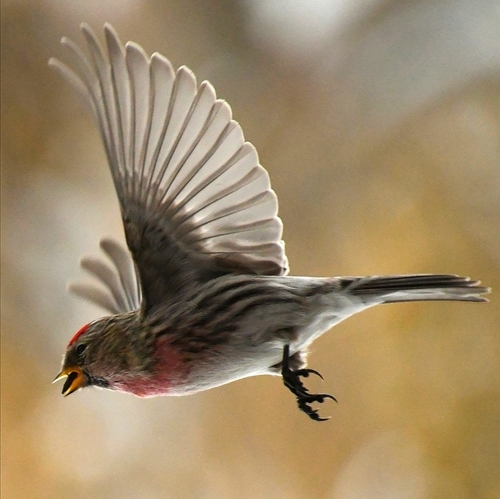 Common Redpoll
 Arctic Redpoll
In short
Separating Common Redpoll from Arctic Redpoll is notoriously challenging, especially in the field, as both are small, streaky finches with red foreheads and black bibs. The most reliable field mark—when visible—is the Arctic Redpoll's much paler, almost white overall appearance and especially its unstreaked or faintly streaked white rump, compared to the Common Redpoll's heavily streaked rump. Juvenile and first-winter birds are especially tricky, but Arctic Redpolls generally appear frostier and less marked, while Common Redpolls show more brownish tones and heavier streaking throughout. Structural differences are subtle, and both species overlap in size, but careful attention to rump pattern and overall paleness, especially in flocks, offers the best chance for separation.
Identification tips
- Rump pattern (all ages): Arctic Redpolls have a white or nearly unstreaked rump, best seen in flight or when the bird is preening; Common Redpolls have a heavily streaked rump. This is the single most reliable field mark.
- Overall paleness (all ages): Arctic Redpolls appear much paler and frostier, with a white or silvery look, especially on the face, underparts, and upperparts. Common Redpolls are browner and dingier overall, with more extensive streaking.
- Flank streaking: Arctic Redpolls have faint or absent streaking on the flanks, while Common Redpolls show bold, dark streaks along the flanks. This is especially useful on perched birds.
- Face and throat: Arctic Redpolls have a clean, white face and throat with a small, neat black bib; Common Redpolls often show a duskier face and more diffuse bib.
- Wing bars: Both species have two pale wing bars, but these may appear brighter and more contrasting on Arctic Redpoll due to the paler background.
- Bill structure: Arctic Redpolls sometimes show a slightly shorter, stubbier bill, but this is subtle and unreliable in the field.
- Breast color (males): Both can have pinkish or red suffusion on the breast, but Common Redpoll males often show a deeper, more extensive red wash. This is variable and not diagnostic on its own.
- Vent and undertail coverts: Arctic Redpolls have white undertail coverts with little or no streaking; Common Redpolls have dark streaks here. This is a supporting mark when visible.
- Juvenile/first-winter birds: Young Arctic Redpolls are especially pale and frosty, with very little streaking, while young Common Redpolls are browner and more heavily streaked.
- Flock composition: In mixed flocks, look for the palest, whitest individuals as potential Arctic Redpolls, but always check rump and flank pattern to confirm.
- Habitat context: If seen in the far north or in true Arctic tundra, Arctic Redpoll is more likely, but both species can occur together in winter.
- Behavior: Not useful for separation; both species behave similarly.
- Size: Not a reliable separator; both are equally small.
- Voice: No diagnostic differences noted in the provided sources; do not use voice for separation.
- Pitfalls: Beware of pale Common Redpolls and darker Arctic Redpolls—always check multiple field marks, especially rump and flank streaking, before making an identification.
Size
Both species are very similar in size, with adults measuring 11.5–14 cm in length and weighing 12–16 grams, and wingspans of 19–22 cm. There is no consistent size difference in the field; both appear as small, active finches. Do not rely on size for separation.
Plumage
For all ages, the key difference is the rump and overall coloration: Arctic Redpolls (including juveniles and immatures) have a white or nearly unstreaked rump and a much paler, frosty look overall, while Common Redpolls show a heavily streaked rump and more brownish, dingy tones on the upperparts and flanks. Both have a red forehead and black bib, but Arctic Redpolls usually have less streaking on the flanks and a cleaner white underbody. Males of both species can show pinkish suffusion on the breast, but this is often more extensive and brighter in Common Redpolls. Wing bars are present and similar in both, but may appear crisper on Arctic due to the paler background. Juvenile and first-winter birds of Arctic Redpoll are especially pale and can look almost white in the right light, while Common Redpolls remain more streaked and brownish.
Behaviour
Both species are highly active, often feeding acrobatically in flocks on birch and alder catkins. Their movements and feeding behaviors are nearly indistinguishable in the field. Both may forage in trees or occasionally on the ground. Behavior is not a reliable separator.
Habitat
Habitat overlap is extensive, especially in winter, but Arctic Redpolls breed farther north in true Arctic tundra, while Common Redpolls occupy both Arctic and boreal forest zones. In the non-breeding season, both can occur together in the same flocks in suitable habitat (birch, alder, willow thickets). Habitat is not a reliable field mark except at the extremes of breeding range.