
Dusky Warbler vs Common Chiffchaff
Phylloscopus fuscatus versus Phylloscopus collybita
Play a quiz with Dusky Warbler and Common Chiffchaff
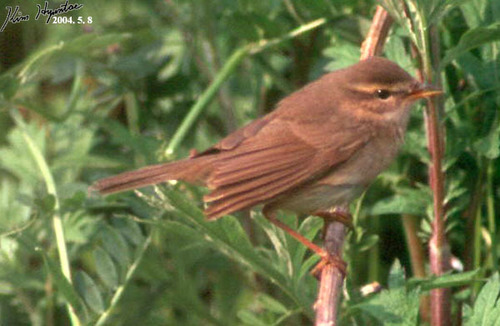 Dusky Warbler
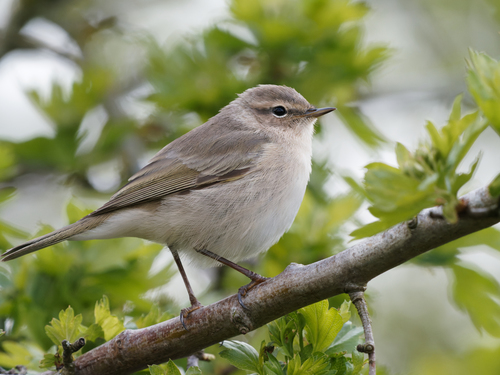 Common Chiffchaff
In short
The most reliable field mark between Dusky Warbler and Common Chiffchaff is overall tone: Dusky Warbler is plainer and colder brown above, with a more prominent, longer whitish supercilium, while Chiffchaff is greenish-brown above with a shorter, less distinct supercilium. Juvenile and fresh-plumaged birds can be especially confusing, but Dusky Warbler always lacks the greenish or yellowish hues of Chiffchaff. Both are small, dumpy Phylloscopus warblers with fine bills, but Dusky Warbler is slightly darker and more uniform, especially on the upperparts. When in doubt, focus on the face pattern and overall color, as vocalizations and subtle jizz differences can help but are less reliable at a distance or with silent birds.
Identification tips
- Supercilium length and contrast: Dusky Warbler shows a longer, more prominent whitish supercilium that extends well behind the eye; Chiffchaff's is shorter and less distinct. This is often the best single mark, especially on perched birds.
- Upperpart color: Dusky Warbler is plain, unstreaked brown above (cold-toned, sometimes slightly olive in juveniles), while Chiffchaff is greenish-brown above, especially after moult. Look for any green or yellow tones—these point to Chiffchaff.
- Underpart color: Dusky Warbler has buff underparts, lacking any yellow wash. Chiffchaff can show off-white underparts with yellowish flanks (especially in fresh plumage or juveniles). If you see yellow, it's Chiffchaff.
- Face pattern: Dusky Warbler's face is plainer and more contrasting due to the strong supercilium; Chiffchaff's face is less marked, with a weaker supercilium and less contrast overall.
- Tail movement: Chiffchaff often dips and wags its tail side-to-side; Dusky Warbler rarely does this. Watch for this behavior when birds are foraging.
- Primary projection: Both have short primary projection, so this is not a strong separator between these two, though Chiffchaff is sometimes noted for it.
- Leg color: Both species have dark legs, so this is not useful for separation.
- Bill shape: Both have fine, pointed bills typical of Phylloscopus warblers; bill structure is not a separator.
- Juvenile confusion: Young Dusky Warblers are more olive above than adults, but never as greenish or yellow as Chiffchaff. Juvenile Chiffchaffs are browner above than adults, but after moult become greener and paler.
- Song: If you hear a repetitive 'chiff-chaff' song, it's Chiffchaff. Dusky Warbler does not sing this way.
- Habitat and context: In western Europe, Chiffchaff is common and expected; Dusky Warbler is a rare vagrant, usually in dense, low vegetation. If you find a Phylloscopus warbler in a typical woodland or park, it's almost certainly Chiffchaff.
- Season: Chiffchaff is present in Europe from early spring through autumn, with some overwintering. Dusky Warbler is only likely in autumn as a vagrant.
- Flight jizz: Chiffchaff has rounded wings in flight, but this is subtle and not a strong field mark between these two.
- Sex differences: Both species are sexually monomorphic; sex cannot be determined by plumage or size in the field.
- Pitfalls: Beware of worn or wet birds, which can appear duller and browner than usual. Always check for green or yellow tones and supercilium length before making an identification.
Size
Both species are very similar in size and shape, being small, compact leaf warblers with fine, pointed bills. Chiffchaff is typically 10–12 cm long and weighs 6–8 grams [wikipedia], and Dusky Warbler is described as similar in size and shape to Chiffchaff [wikipedia]. In the field, size is not a reliable separator between these two.
Plumage
- Juveniles and fresh post-juvenile birds: Dusky Warbler juveniles are more olive-tinged above than adults, but still lack the greenish or yellowish tones of Chiffchaff. Chiffchaff juveniles are browner above than adults, with yellow-white underparts, but after their first moult (about 10 weeks post-fledging) they become brighter and greener above with a paler supercilium.
- Adults: Dusky Warbler is unstreaked, plain brown above and buff below, with a prominent long whitish supercilium. Chiffchaff adults are greenish-brown above, off-white below (sometimes yellowish on the flanks in fresh plumage), and have a short, less distinct supercilium. Both have fine, dark bills and dark legs, but Chiffchaff can show more yellow tones in fresh plumage, especially on the flanks.
- Wing pattern: No strong age-specific upperwing marks or panels are noted for either species; both have rather plain wings. Chiffchaff has short primary projection, but this is subtle and not a strong field mark between these two.
Behaviour
Chiffchaff is well known for its distinctive tail movement: a dip followed by a sideways wag, which is rarely shown by Dusky Warbler. Both species are active, insectivorous foliage-gleaners, but Chiffchaff's tail-wagging is a useful behavioral clue. In flight, Chiffchaff shows rounded wings, but this is subtle and not always diagnostic. Both species are often seen flitting through low vegetation or shrubs.
Habitat
Dusky Warbler breeds in the east Palearctic, favoring dense, shrubby habitats, especially near water. It is a rare vagrant in Europe, usually found in low, tangled vegetation. Chiffchaff is a common breeder in open woodlands, parks, and gardens across Europe and the Palearctic, and winters in southern Europe, Asia, and North Africa. In western Europe, Chiffchaff is much more likely except during peak vagrancy periods for Dusky Warbler.
Voice
Chiffchaff is named for its simple, repetitive 'chiff-chaff' song, which is a key identification feature in spring and early summer. Its call is a soft 'hweet.' Dusky Warbler's vocalizations are not described in detail here, but are not as distinctive as Chiffchaff's song. Silent birds can be very difficult, so rely on plumage and structure when no song is heard.