

Large-tailed Nightjar vs Savanna Nightjar
Caprimulgus macrurus versus Caprimulgus affinis
Play a quiz with Large-tailed Nightjar and Savanna Nightjar
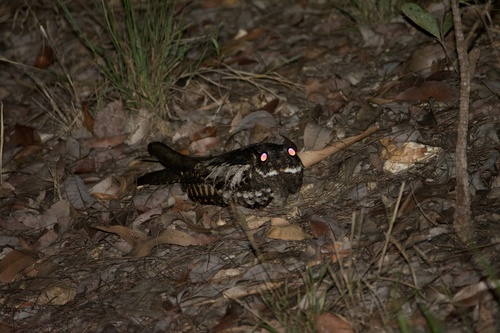 Large-tailed Nightjar
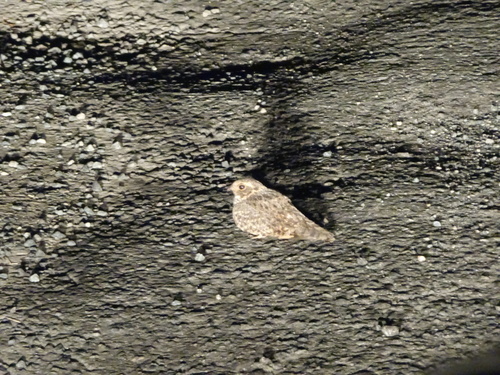 Savanna Nightjar
In short
The most reliable field mark to separate Large-tailed Nightjar from Savanna Nightjar is the tail: Large-tailed Nightjar has a distinctly longer, broader tail, especially obvious in flight or when perched. Adult males of both species show white throat patches, but only Large-tailed Nightjar males have large white patches on the primaries and outer tail feathers, while Savanna Nightjar males have smaller white wing and tail patches. Females and immatures of both species are drabber, but Savanna Nightjar females and juveniles lack white tail patches entirely. Structure and size are also key: Large-tailed Nightjar is notably larger and bulkier, with a length up to 33 cm versus a maximum of 26 cm for Savanna Nightjar. Both species are cryptically plumaged and can be difficult to distinguish at rest, but careful attention to tail length, wing patches in flight, and overall size will usually resolve confusion.
Identification tips
- Tail length and shape: Large-tailed Nightjar has a much longer and broader tail than Savanna Nightjar, obvious in both flight and when perched. If the tail looks short or only slightly projects beyond the wing-tips, suspect Savanna Nightjar.
- White patches in flight (adult males): Large-tailed Nightjar males show large, bold white patches on the primaries and outer tail feathers, especially striking in flight. Savanna Nightjar males have smaller white patches on the wings and tail; females and immatures of both species lack these or show only faint markings.
- Crown and scapular pattern: Large-tailed Nightjar males have a pale crown with a dark median stripe and a row of black scapulars with broad buff or whitish fringes. This combination is lacking in Savanna Nightjar.
- Throat patch: Both species' males have white throat patches, but in Savanna Nightjar females and immatures, the throat patch is subtle or absent, and the plumage is redder. Large-tailed Nightjar females have a smaller, less vibrant throat patch but are generally greyer.
- Overall size: Large-tailed Nightjar is significantly larger and bulkier than Savanna Nightjar. If you see a nightjar that looks notably big or elongated, especially with a long tail, Large-tailed is more likely.
- Plumage tone: Savanna Nightjar females and immatures have a reddish tinge to their plumage and lack white tail patches. Large-tailed Nightjar females are paler and greyer, with some buff on the wings but less red overall.
- Juvenile/immature confusion: Both species' juveniles are mottled and cryptic, but size and tail length can still help. If the bird is small and compact with no white in the tail, Savanna Nightjar is more likely; if larger and greyer, consider Large-tailed Nightjar.
- Habitat context: In dense or moist forest, especially near the Himalayas or in Southeast Asian montane forest, Large-tailed Nightjar is more likely. In open country, rocky areas, or urban settings (especially rooftops), Savanna Nightjar is favored.
- Behavior at rest: Both species are well camouflaged, but Large-tailed Nightjar tends to roost in denser cover, while Savanna Nightjar may be found in more open or exposed locations.
- Vocalizations: If you hear a loud, booming nightjar call in an urban area, it's likely Savanna Nightjar. Large-tailed Nightjar's song is more monotonous and less likely to be described as disruptive.
- Wing structure: Both have long, pointed wings, but Large-tailed Nightjar's wings appear broader and more powerful, matching its larger size.
- Sexual dimorphism: Only males of either species show white in the tail; females and immatures lack this, so do not rely on tail patches alone unless you can age/sex the bird.
- Urban adaptation: Savanna Nightjar is much more likely to be found in cities or on buildings; Large-tailed Nightjar is rarely urban.
- Feeding behavior: Both sally for insects at dusk and night, but this is not diagnostic between the two.
- Pitfall: Both species are extremely well camouflaged and can look very similar when roosting. Use a combination of tail length, size, and wing/tail patches (when visible) for the most reliable ID.
Size
Large-tailed Nightjar is substantially larger, measuring 31.5–33 cm in length, while Savanna Nightjar is 20–26 cm long. The Savanna Nightjar's body mass (82.5 g) is within the range for nightjars of its size, but the Large-tailed Nightjar is consistently bulkier and longer-tailed. In the field, Large-tailed Nightjar appears more robust and elongated, especially when perched, with a proportionally longer tail and broader wings. Savanna Nightjar is smaller, more compact, and has a shorter tail relative to its body. These size differences are usually obvious if the birds are seen side-by-side or with a good sense of scale.
Plumage
-
Juvenile/Immature birds: Both species' juveniles resemble adult females, lacking white tail patches and showing mottled, cryptic coloration. However, Savanna Nightjar immatures are generally smaller and have a redder tinge to their plumage, while Large-tailed Nightjar immatures are larger and greyer overall.
-
Adult males: Large-tailed Nightjar males have a pale crown with a dark median stripe, a row of black scapulars with broad buff or whitish fringes, a white throat patch, and most distinctively, large white patches on the primaries and outer tail feathers (especially visible in flight). The tail is broad and long with uneven dark bars. Savanna Nightjar males have a white throat patch and white patches on the tail and wings, but these are smaller and less bold than in Large-tailed Nightjar; the tail is shorter and less broad.
-
Adult females: Both are drabber than males. Large-tailed Nightjar females are paler and greyer, with smaller buff wing patches and less vibrant tail patches. Savanna Nightjar females have a subtle throat patch, a reddish tint, and lack white tail patches entirely. Both sexes of Savanna Nightjar have vermiculated grey-brown plumage, but only Large-tailed Nightjar shows the combination of pale crown and strong scapular pattern.
-
In flight: Large-tailed Nightjar's large white primary and tail patches are diagnostic for adult males; Savanna Nightjar's wing and tail patches are smaller and less conspicuous, and absent in females and immatures.
Behaviour
Both species are nocturnal, cryptic, and rely on camouflage during the day. Large-tailed Nightjar is noted for its remarkable camouflage and tends to roost on the ground or low branches in dense or semi-open forest, blending into leaf litter or bark. Savanna Nightjar is also highly camouflaged but is more likely to be found in open or rocky areas, and in some regions, has adapted to urban environments, even nesting on flat roofs. Both hunt insects by sallying from perches at dusk and night. Savanna Nightjar is especially noted for its bold urban behavior in some areas, while Large-tailed Nightjar is more strictly associated with natural or semi-natural habitats.
Habitat
Large-tailed Nightjar prefers subtropical or tropical moist lowland forest, mangrove forest, and montane forest, often near forest edges, plantations, or wooded parks, and sometimes in agricultural areas. Its range extends from the southern Himalayan foothills through Southeast Asia to northern Australia. Savanna Nightjar, while also found in South and Southeast Asia, favors more open habitats such as savanna, rocky soils, and even urban areas (notably in Taiwan). It is less tied to dense forest and more likely to be encountered in open country or on man-made structures. Overlap is possible in edge habitats, but context can help: a nightjar in dense forest is more likely Large-tailed; in open or urban settings, Savanna Nightjar is more probable.
Voice
Large-tailed Nightjar has a distinctive, monotonous territorial song, described as a series of deep, low-pitched "wroww" or fast-repeated "wrrrog/grrrog" notes, most often heard at night during courtship or territory defense. Savanna Nightjar is famous for its loud, booming call (up to 90 decibels in urban areas), which can be a nuisance in cities. While both species are vocal at night, the Savanna Nightjar's call is more likely to be described as booming or disruptive, while Large-tailed Nightjar's song is more monotonous and less likely to be mistaken for a loud urban noise.