

Long-tailed Skua vs Arctic Skua
Stercorarius longicaudus versus Stercorarius parasiticus
Play a quiz with Long-tailed Skua and Arctic Skua
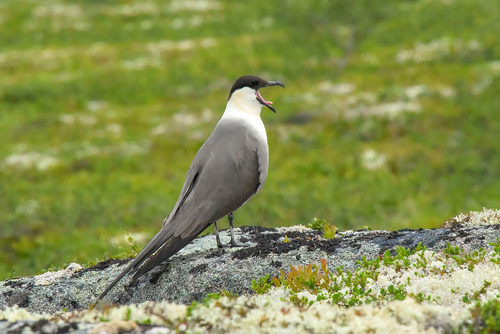 Long-tailed Skua
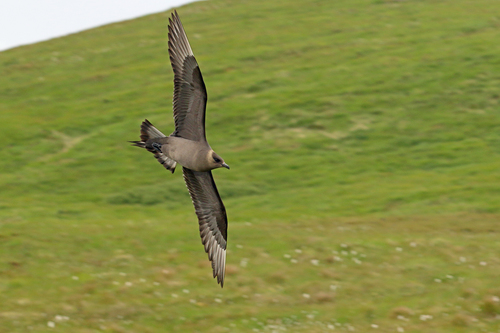 Arctic Skua
In short
Separating Long-tailed Skua (Stercorarius longicaudus) from Arctic Skua (Stercorarius parasiticus) is most reliable in adults during the breeding season, when the Long-tailed shows extremely long, slender tail streamers and lacks the white wing flash seen in Arctic. Immature and juvenile birds are much trickier: focus on structure and overall tone—Long-tailed is slimmer, longer-winged, and colder grey, while Arctic is bulkier, shorter-winged, and browner. In flight, check for the white wing flash (present in Arctic, absent in Long-tailed) and tail projection (much longer in adult Long-tailed). Both species show confusing variation in juvenile plumage, so structural and flight jizz are often more helpful than color. Expect overlap and uncertainty with young birds, especially at sea.
Identification tips
- White wing flash: Arctic Skua of all ages and morphs shows a bold white flash at the base of the primaries in flight; Long-tailed Skua lacks this mark entirely. This is the most reliable single field mark, especially for immatures.
- Tail streamers (adults in breeding plumage): Long-tailed Skua has extremely long, thin tail streamers (up to 15 cm), far exceeding the short, pointed tail of Arctic Skua (about 7 cm). Outside the breeding season, both lose streamers, so this is only useful in summer adults.
- Structure and jizz: Long-tailed is slimmer, longer-winged, and more tern-like in flight, with a lighter, more buoyant style. Arctic is bulkier, shorter-winged, and more falcon-like, with deeper wingbeats. This is especially helpful with juveniles and non-breeding birds.
- Overall color tone (juveniles/immatures): Long-tailed is usually colder grey and more uniform, while Arctic is warmer brown. However, both are variable and this mark is not foolproof.
- Back color (adults): Adult Long-tailed has a grey back; adult light-morph Arctic has a brown back. Dark and intermediate morph Arctic adults are overall brown to dark brown.
- Head pattern (adults): Both have a black cap, but adult Arctic (light morph) shows a yellowish-white head and neck, while Long-tailed is more uniformly capped and lacks the yellowish wash.
- Underparts (adults): Adult Arctic (light morph) has mainly white underparts; Long-tailed is less contrasting.
- Bill and legs: Not reliably separable in the field based on available notes.
- Flight behavior: Long-tailed often hovers and appears more tern-like; Arctic is more direct and falcon-like.
- Habitat context: Long-tailed is more likely inland on passage; Arctic is more common from shore.
- Aggression: Both can be aggressive near nests, but this is not a reliable field mark.
- Voice: Long-tailed gives yelping/rattling calls; Arctic gives nasal mewing notes. Not usually diagnostic except on breeding grounds.
- Size: Long-tailed is slightly smaller and lighter, but overlap is extensive and not reliable in the field.
- Season: Tail streamer length only helps in breeding adults (summer); in winter or with immatures, rely on wing flash and structure.
- Plumage variation: Both species show wide variation in juvenile plumage; always use multiple marks and expect some birds to be unidentifiable without close, prolonged views.
Size
Long-tailed Skua is the smallest skua, with a body mass around 289 g and a length of 38–58 cm, but up to half of this length can be the tail streamers in adults. Arctic Skua is slightly larger and heavier (41–48 cm length, 300–650 g), with a shorter tail streamer (about 7 cm in adults). In the field, Long-tailed appears more slender and tern-like, while Arctic is bulkier and more robust, but size alone is unreliable due to overlap and the effect of tail streamers.
Plumage
-
Juveniles/immatures: Both species are highly variable and can be very similar, but Long-tailed is usually colder grey and more uniform, while Arctic is warmer brown. Juvenile Long-tailed is slimmer, longer-winged, and more tern-like, with a greyer cast. Juvenile Arctic is bulkier, shorter-winged, and browner overall. Both lack the adult tail streamers. The most reliable mark is the white wing flash: present in all morphs of Arctic (including juveniles), absent in Long-tailed.
-
Adults (breeding): Long-tailed is unmistakable with very long, thin tail streamers (up to 15 cm), a grey back, black cap, and dark primaries with no white wing flash. Arctic adult (light morph) has a brown back, white underparts, yellowish-white head and neck with a black cap, and a white wing flash on dark primaries; tail streamer is shorter and less pointed. Dark and intermediate morph Arctic adults are overall brown to dark brown but still show the white wing flash.
-
Adults (non-breeding): Both species lose tail streamers and become less distinctive, but structural differences and wing flash remain helpful.
Behaviour
Long-tailed Skua often hovers over breeding territories and appears more tern-like in flight, with a lighter, more buoyant flight style. Arctic Skua is more falcon-like and direct, with stronger, more powerful wingbeats. Both species engage in kleptoparasitism (chasing other birds for food), but Arctic Skua is more commonly seen from shore and is generally bolder. On the breeding grounds, both can be aggressive toward intruders.
Habitat
Both species breed on dry tundra or upland fells in the Arctic, but Long-tailed Skua prefers higher, drier ground and is more likely to be found inland on passage (sometimes even in fields or golf courses). Arctic Skua is more often seen from shore and is the most common jaeger in coastal migration. Both winter at sea in the southern hemisphere, but Arctic Skua is more likely to be seen near coasts during migration.
Voice
Long-tailed Skua gives yelping and rattling calls on the breeding grounds, and a harsh 'kreeah' cry at sea. Arctic Skua is usually silent except for a nasal mewing sound and shorter alarm notes on the breeding grounds. Voice is rarely diagnostic in the field, except possibly on territory.