
Motmot

Red-billed Dwarf Hornbill vs African Grey Hornbill

Lophoceros camurus versus Lophoceros nasutus

Play a quiz with Red-billed Dwarf Hornbill and African Grey Hornbill

Red-billed Dwarf Hornbill (Lophoceros camurus) Red-billed Dwarf Hornbill
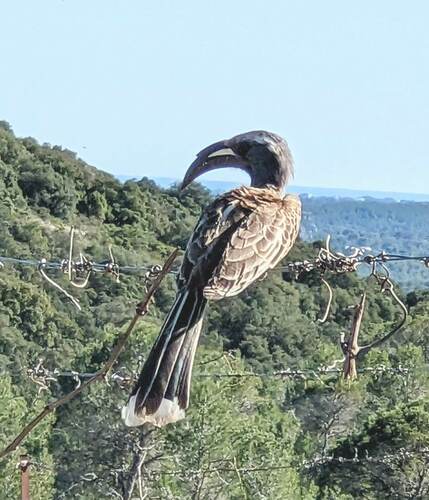
African Grey Hornbill (Lophoceros nasutus) African Grey Hornbill

Media

Loading…

In short

The most reliable field mark separating these two is bill color: Red-billed Dwarf Hornbill shows a distinctly red bill, while African Grey Hornbill has a mostly dark bill with a pale stripe or creamy mark in males, and a tricolored, red-tipped mandible in females. African Grey Hornbill is much larger, with a long tail and prominent casque, and is mostly grey-brown with white lines on the head and back (the latter visible in flight). Red-billed Dwarf Hornbill is smaller, and found in dense rainforest, whereas African Grey Hornbill prefers open woodland and savannah. Juvenile African Grey Hornbills have all-dark bills, which can cause confusion, but their larger size and grey-brown plumage remain distinctive.

Identification tips

  1. Bill color is the most reliable mark: Red-billed Dwarf Hornbill always shows a red bill, while African Grey Hornbill has a mostly dark bill with a pale stripe (male) or tricolored, red-tipped bill (female). Juvenile African Grey Hornbills have all-dark bills, which can cause confusion, so use other marks in young birds.
  2. Size and structure: African Grey Hornbill is much larger and bulkier, with a long tail and prominent casque on the bill (especially in males). Red-billed Dwarf Hornbill is smaller, more compact, and lacks a prominent casque.
  3. Plumage color: African Grey Hornbill is grey-brown overall, with a darker head, flight feathers, and tail, and has white lines along the crown and down the back (the latter visible in flight). Red-billed Dwarf Hornbill is generally darker and lacks these white lines.
  4. Tail length: African Grey Hornbill has a notably long tail, which is obvious in flight and when perched. Red-billed Dwarf Hornbill has a shorter tail.
  5. Habitat: If seen in dense, humid rainforest, Red-billed Dwarf Hornbill is expected; in open woodland or savannah, African Grey Hornbill is the default.
  6. Behavior: African Grey Hornbill is often conspicuous, perching in the open and calling loudly. Red-billed Dwarf Hornbill is more secretive and stays within dense forest cover.
  7. Flight style: African Grey Hornbill has an undulating flight, typical of hornbills, and may show the white back line in flight. No specific flight style is described for Red-billed Dwarf Hornbill, but its smaller size and compact shape should be apparent.
  8. Juvenile confusion: Juvenile African Grey Hornbills have all-dark bills, but their size, grey-brown plumage, and white head/back lines still separate them from Red-billed Dwarf Hornbill.
  9. Sex differences: In African Grey Hornbill, males have a pale stripe on the otherwise dark bill, while females have a tricolored bill with a red tip. Red-billed Dwarf Hornbill does not show such variation; the bill is always red in adults.
  10. Vocalizations: If you hear a loud, piping 'pee-o pee-o pee-o' call, it is African Grey Hornbill. Red-billed Dwarf Hornbill's voice is not described here, so silence is not diagnostic, but the call is a strong pointer to African Grey Hornbill.
  11. Range overlap: Be aware of local habitat—if you are in a region where both occur, habitat is a strong clue. In mixed habitats, use bill color and size as your primary marks.
  12. Casque presence: The casque (bony ridge on the bill) is more prominent in African Grey Hornbill, especially in males. Red-billed Dwarf Hornbill lacks a prominent casque.
  13. Perched vs. in flight: When perched, compare bill color, size, and tail length. In flight, look for the white back line in African Grey Hornbill and overall bulk.
  14. Pitfalls: Poor views or immature African Grey Hornbills can be misleading due to bill color, so always check multiple features—size, structure, and habitat are especially important.
  15. Checklist for quick separation: (a) Red bill = Red-billed Dwarf Hornbill; (b) Large, grey-brown, long tail, white lines = African Grey Hornbill; (c) Habitat: rainforest = Red-billed Dwarf Hornbill, savannah/open woodland = African Grey Hornbill.

Size

African Grey Hornbill is substantially larger, measuring 45–51 cm in length (nearly twice the body mass of Red-billed Dwarf Hornbill, which is about 104 g). Its long tail and overall bulk are obvious even at a distance. Red-billed Dwarf Hornbill is much smaller and more compact, with a proportionally shorter tail and lighter build. If seen together, the size difference is striking, but beware of lone birds or poor views where size can be hard to judge.

Plumage

No detailed age-specific wing pattern is available for either species, but overall coloration is helpful. African Grey Hornbill is grey-brown overall, with a darker head, flight feathers, and tail. It shows a white line down each side of the crown and another down the back, the latter only visible in flight. The bill is dark with a pale stripe or creamy mark in males, and tricolored with a red tip in females; juveniles have an all-dark bill. Red-billed Dwarf Hornbill, by contrast, has a distinctly red bill and is generally darker and more compact, lacking the white lines and pale bill markings of African Grey Hornbill. The plumage of Red-billed Dwarf Hornbill is less well described, but the bill color is always diagnostic in adults.

Behaviour

African Grey Hornbill often perches conspicuously in open woodland or savannah, sometimes advertising itself with loud calls. Its flight is undulating, and it frequently moves between trees. Red-billed Dwarf Hornbill is more secretive, typically staying within dense rainforest and less likely to be seen in open areas. Its behavior is more retiring, making it harder to spot except in suitable forest habitat.

Habitat

Red-billed Dwarf Hornbill is restricted to African tropical rainforest, where it keeps to dense, humid forest interiors. African Grey Hornbill, on the other hand, is widespread in sub-Saharan Africa and prefers open woodland and savannah, rarely entering dense rainforest. If you see a hornbill in open, dry country, it is almost certainly African Grey Hornbill; in dense, humid forest, Red-billed Dwarf Hornbill is more likely.

Voice

African Grey Hornbill is very vocal, giving a distinctive piping 'pee-o pee-o pee-o' call, which is often heard before the bird is seen. There is no vocal description available for Red-billed Dwarf Hornbill in these notes, so voice is only diagnostic for African Grey Hornbill.

Submit a better description

Use the same sections as the comparison. Your text is published immediately.

The most reliable field mark separating these two is bill color: Red-billed Dwarf Hornbill shows a distinctly red bill, while African Grey Hornbill has a mostly dark bill with a pale stripe or creamy mark in males, and a tricolored, red-tipped mandible in females. African Grey Hornbill is much larger, with a long tail and prominent casque, and is mostly grey-brown with white lines on the head and back (the latter visible in flight). Red-billed Dwarf Hornbill is smaller, and found in dense rainforest, whereas African Grey Hornbill prefers open woodland and savannah. Juvenile African Grey Hornbills have all-dark bills, which can cause confusion, but their larger size and grey-brown plumage remain distinctive.

  1. Bill color is the most reliable mark: Red-billed Dwarf Hornbill always shows a red bill, while African Grey Hornbill has a mostly dark bill with a pale stripe (male) or tricolored, red-tipped bill (female). Juvenile African Grey Hornbills have all-dark bills, which can cause confusion, so use other marks in young birds.
  2. Size and structure: African Grey Hornbill is much larger and bulkier, with a long tail and prominent casque on the bill (especially in males). Red-billed Dwarf Hornbill is smaller, more compact, and lacks a prominent casque.
  3. Plumage color: African Grey Hornbill is grey-brown overall, with a darker head, flight feathers, and tail, and has white lines along the crown and down the back (the latter visible in flight). Red-billed Dwarf Hornbill is generally darker and lacks these white lines.
  4. Tail length: African Grey Hornbill has a notably long tail, which is obvious in flight and when perched. Red-billed Dwarf Hornbill has a shorter tail.
  5. Habitat: If seen in dense, humid rainforest, Red-billed Dwarf Hornbill is expected; in open woodland or savannah, African Grey Hornbill is the default.
  6. Behavior: African Grey Hornbill is often conspicuous, perching in the open and calling loudly. Red-billed Dwarf Hornbill is more secretive and stays within dense forest cover.
  7. Flight style: African Grey Hornbill has an undulating flight, typical of hornbills, and may show the white back line in flight. No specific flight style is described for Red-billed Dwarf Hornbill, but its smaller size and compact shape should be apparent.
  8. Juvenile confusion: Juvenile African Grey Hornbills have all-dark bills, but their size, grey-brown plumage, and white head/back lines still separate them from Red-billed Dwarf Hornbill.
  9. Sex differences: In African Grey Hornbill, males have a pale stripe on the otherwise dark bill, while females have a tricolored bill with a red tip. Red-billed Dwarf Hornbill does not show such variation; the bill is always red in adults.
  10. Vocalizations: If you hear a loud, piping 'pee-o pee-o pee-o' call, it is African Grey Hornbill. Red-billed Dwarf Hornbill's voice is not described here, so silence is not diagnostic, but the call is a strong pointer to African Grey Hornbill.
  11. Range overlap: Be aware of local habitat—if you are in a region where both occur, habitat is a strong clue. In mixed habitats, use bill color and size as your primary marks.
  12. Casque presence: The casque (bony ridge on the bill) is more prominent in African Grey Hornbill, especially in males. Red-billed Dwarf Hornbill lacks a prominent casque.
  13. Perched vs. in flight: When perched, compare bill color, size, and tail length. In flight, look for the white back line in African Grey Hornbill and overall bulk.
  14. Pitfalls: Poor views or immature African Grey Hornbills can be misleading due to bill color, so always check multiple features—size, structure, and habitat are especially important.
  15. Checklist for quick separation: (a) Red bill = Red-billed Dwarf Hornbill; (b) Large, grey-brown, long tail, white lines = African Grey Hornbill; (c) Habitat: rainforest = Red-billed Dwarf Hornbill, savannah/open woodland = African Grey Hornbill.

African Grey Hornbill is substantially larger, measuring 45–51 cm in length (nearly twice the body mass of Red-billed Dwarf Hornbill, which is about 104 g). Its long tail and overall bulk are obvious even at a distance. Red-billed Dwarf Hornbill is much smaller and more compact, with a proportionally shorter tail and lighter build. If seen together, the size difference is striking, but beware of lone birds or poor views where size can be hard to judge.

No detailed age-specific wing pattern is available for either species, but overall coloration is helpful. African Grey Hornbill is grey-brown overall, with a darker head, flight feathers, and tail. It shows a white line down each side of the crown and another down the back, the latter only visible in flight. The bill is dark with a pale stripe or creamy mark in males, and tricolored with a red tip in females; juveniles have an all-dark bill. Red-billed Dwarf Hornbill, by contrast, has a distinctly red bill and is generally darker and more compact, lacking the white lines and pale bill markings of African Grey Hornbill. The plumage of Red-billed Dwarf Hornbill is less well described, but the bill color is always diagnostic in adults.

African Grey Hornbill often perches conspicuously in open woodland or savannah, sometimes advertising itself with loud calls. Its flight is undulating, and it frequently moves between trees. Red-billed Dwarf Hornbill is more secretive, typically staying within dense rainforest and less likely to be seen in open areas. Its behavior is more retiring, making it harder to spot except in suitable forest habitat.

Red-billed Dwarf Hornbill is restricted to African tropical rainforest, where it keeps to dense, humid forest interiors. African Grey Hornbill, on the other hand, is widespread in sub-Saharan Africa and prefers open woodland and savannah, rarely entering dense rainforest. If you see a hornbill in open, dry country, it is almost certainly African Grey Hornbill; in dense, humid forest, Red-billed Dwarf Hornbill is more likely.

African Grey Hornbill is very vocal, giving a distinctive piping 'pee-o pee-o pee-o' call, which is often heard before the bird is seen. There is no vocal description available for Red-billed Dwarf Hornbill in these notes, so voice is only diagnostic for African Grey Hornbill.

Discard your changes?

You have unsaved edits. If you leave now, those changes will be lost.

Red-billed Dwarf Hornbill · African Grey Hornbill · My Tricky Birds